Research · Education · Memory

Study The Holocaust

A platform dedicated to the study, research and preservation of the memory of the Shoah. Because remembering is an act of justice.

Educate to never repeat

Study The Holocaust was born from the conviction that Holocaust education is a vital tool for building more just societies. Through rigorous research, our podcast and educational content, we seek to bring this history closer to new generations.

6M

Jewish victims

1933–1945

Years of horror

∞

Duty of memory

Xime Basualdo

Xime Basualdo

Historian and researcher specializing in World War II and the Shoah. My work focuses on rescuing the stories of those who were silenced, documenting testimonies that time threatens to erase, and bringing this memory closer to new generations.

Creator of the podcast Memoria de Cenizas and this educational platform. I firmly believe that every recovered name, every story told, is an act of resistance against oblivion.

Content creation student with AI, Community Manager, and soon Marketing student.

Historian Researcher Podcaster Educator Community Manager

Articles & essays

Reflections, historical analysis and research on the Shoah and collective memory.

Article image

The duty to remember: why the Shoah challenges us today

In a world where hate speech resurfaces with new force, the memory of the Holocaust becomes more relevant than ever.

Read more →
Article image

Voices from the ashes: survivors in Latin America

Thousands of Holocaust survivors rebuilt their lives in Latin America. Their testimonies reveal stories of resilience and the urgency of sharing their experience.

Read more →
Article image

The extermination camps: cartography of planned horror

A journey through the Nazi machinery of destruction, from the first camps to the implementation of the "Final Solution".

Read more →

Understanding the perpetrators

Studying those who planned and executed the Holocaust is essential to understanding how a modern state can become a machinery of death.

The NSDAP — The Nazi Party

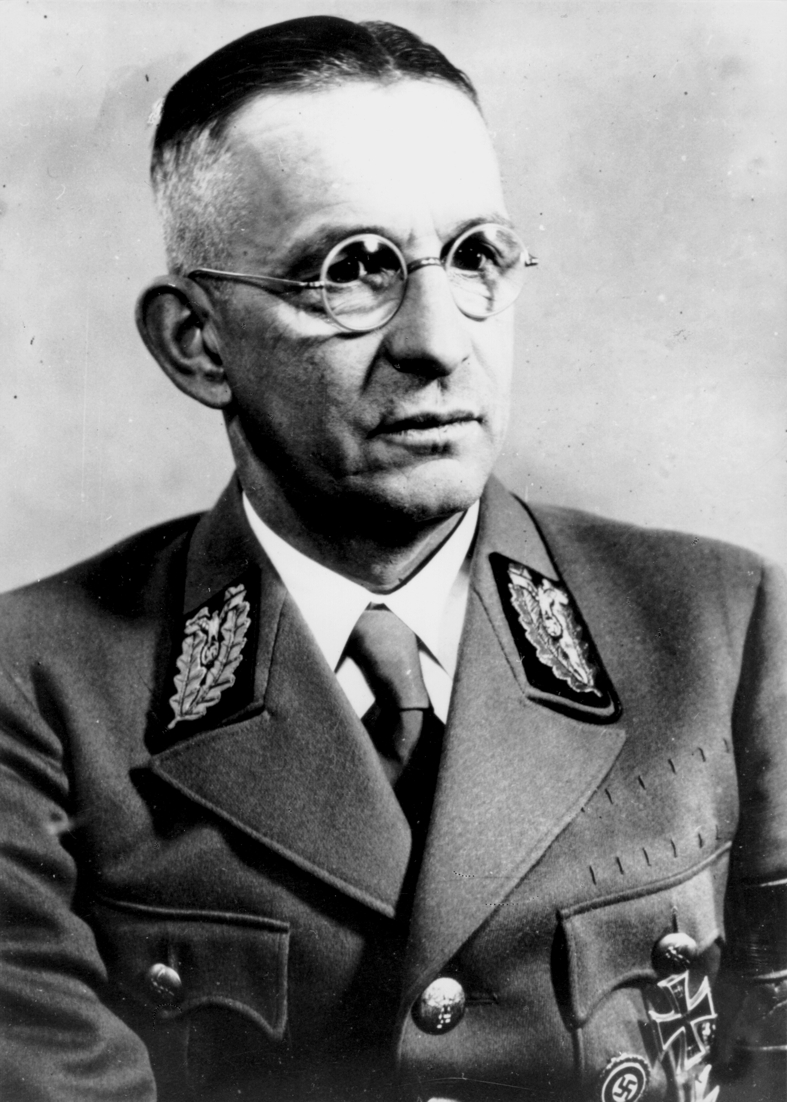
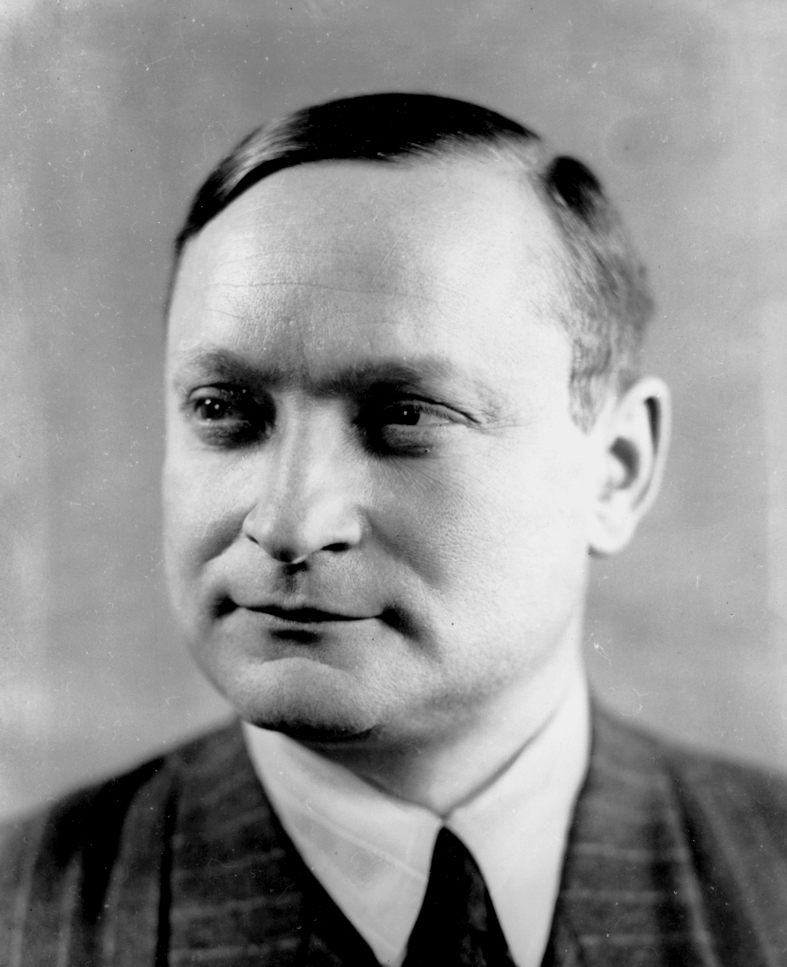
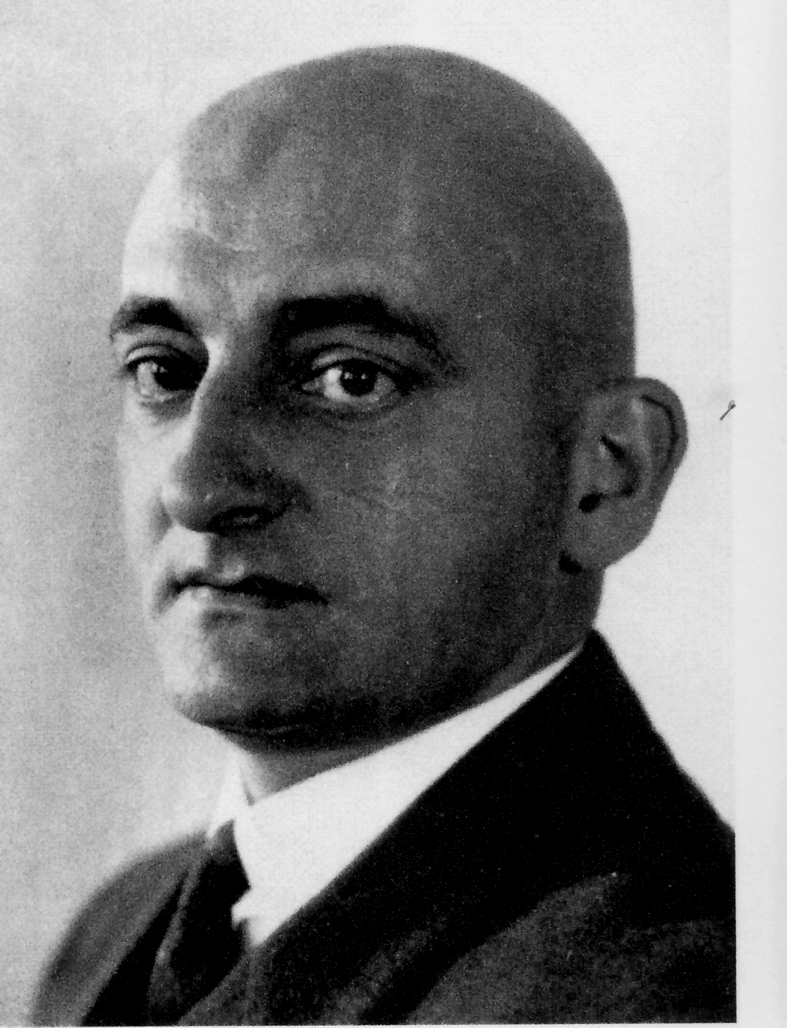
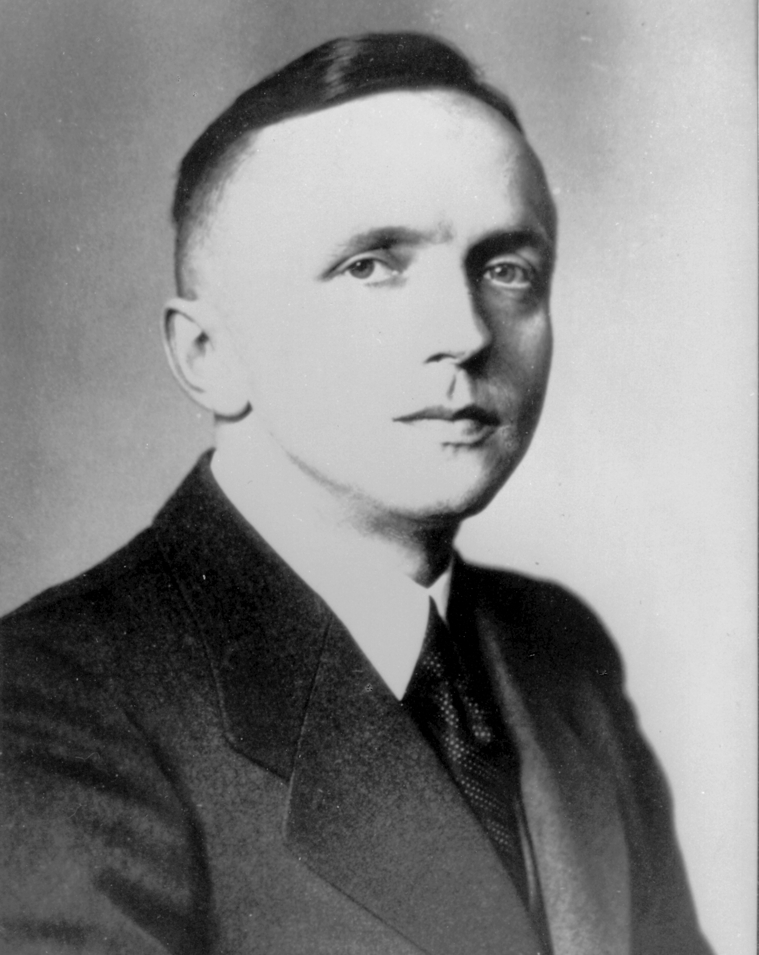
The Nationalsozialistische Deutsche Arbeiterpartei (NSDAP) seized power in January 1933 and transformed Germany into a totalitarian state. Its leaders created the ideological, legal, and administrative framework that made the Holocaust possible. These are the key figures within the party apparatus who were directly responsible for persecution, genocide, and crimes against humanity.

Adolf Hitler Führer and Reich Chancellor

Adolf Hitler

Supreme leader of the NSDAP and the Third Reich. His obsessive antisemitism, laid out in Mein Kampf (1925), became state policy. He authorized the euthanasia program (T4), approved the "Final Solution", and bore ultimate responsibility for the murder of six million Jews and millions of other victims. He committed suicide in his Berlin bunker on April 30, 1945.

Rudolf Hess Deputy Führer (1933–1941)

Rudolf Hess

Hitler's deputy and second in line in the party hierarchy. He co-signed the Nuremberg Laws of 1935, which stripped Jews of German citizenship and laid the legal foundation for persecution. He flew to Scotland in 1941 on a bizarre solo peace mission, was captured, and sentenced to life imprisonment at Nuremberg. He died in Spandau Prison in 1987.

Hermann Göring Reichsmarschall — Head of the Luftwaffe

Hermann Göring

Second most powerful man in the Third Reich. He ordered Heydrich to prepare the "Final Solution" in July 1941, signed the decree for the Aryanization of Jewish property, and created the Gestapo. He enriched himself with art looted from Jewish families across Europe. Sentenced to death at Nuremberg, he committed suicide with cyanide hours before his execution.

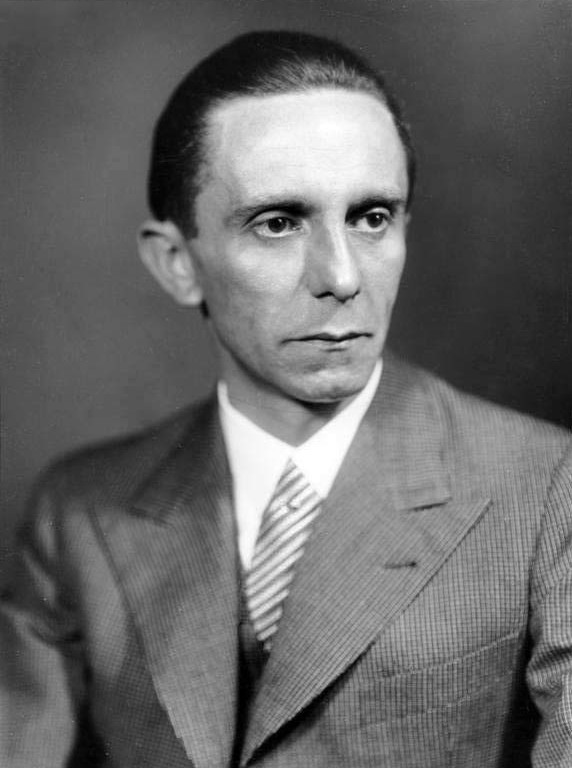
Joseph Goebbels Reich Minister of Propaganda

Joseph Goebbels

The mastermind behind Nazi propaganda. He orchestrated the Kristallnacht pogrom (November 9–10, 1938), which destroyed over 1,400 synagogues, killed at least 91 Jews, and sent 30,000 to concentration camps. His relentless antisemitic propaganda dehumanized Jews and built public support for their persecution. He produced the viciously antisemitic film "The Eternal Jew" (1940). He killed himself and his six children on May 1, 1945.

Heinrich Himmler Reichsführer-SS

Heinrich Himmler

Head of the SS and principal architect of the Holocaust. He controlled the entire concentration and extermination camp system, the Einsatzgruppen, the Gestapo, and the Waffen-SS. He personally inspected camps and mass executions. His Posen speeches (1943) openly discussed the extermination of Jews before SS officers. Captured by the Allies, he committed suicide with cyanide on May 23, 1945.

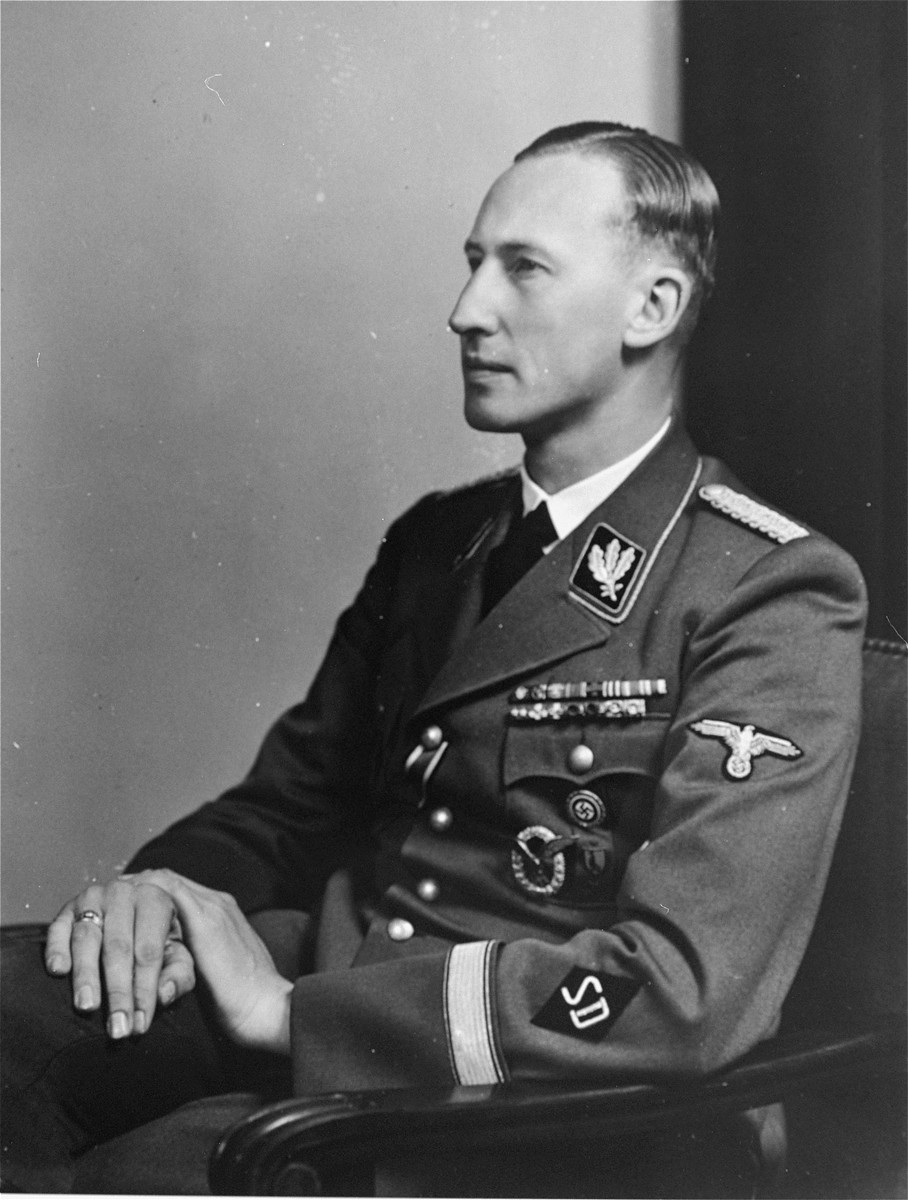
Reinhard Heydrich Head of the RSHA

Reinhard Heydrich

Known as "The Butcher of Prague" and "The Man with the Iron Heart". He chaired the Wannsee Conference (January 1942), which formalized the logistics of the "Final Solution". He founded the SD (intelligence service), organized the Einsatzgruppen, and served as Reich Protector of Bohemia and Moravia, where he unleashed a reign of terror. Assassinated by Czech and Slovak resistance fighters in Operation Anthropoid (May 1942). In retaliation, the Nazis destroyed the village of Lidice, killing all its men.

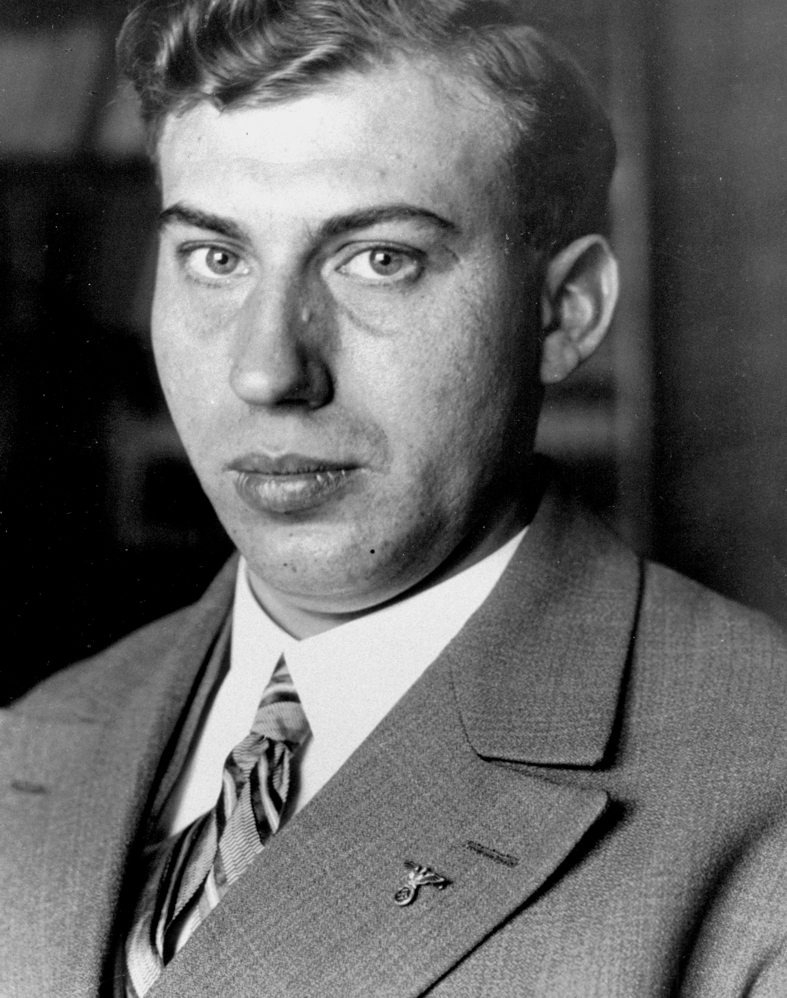
Reinhard Heydrich joven Heydrich as a young officer in the Reichsmarine, c. 1928 — before joining the SS. He was dismissed from the Navy in 1931 for "conduct unbecoming an officer" after breaking an engagement.
Roland Freisler Reich Minister of Justice

Roland Freisler

President of the Volksgerichtshof (People's Court), the Nazi regime's main instrument of judicial terror. He sentenced thousands to death, including members of the White Rose resistance and the July 20 plot conspirators. His show trials were marked by screaming tirades and total contempt for the accused. He was killed during an Allied bombing of Berlin in February 1945.

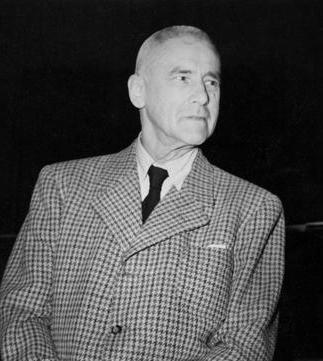
Wilhelm Frick Reich Minister of the Interior

Wilhelm Frick

The legal architect of racial persecution. He drafted and implemented the Nuremberg Laws (1935) that defined who was Jewish, stripped their citizenship, and banned marriages between Jews and non-Jews. His ministry created the bureaucratic framework for systematic exclusion, expropriation, and ultimately deportation. He was convicted and hanged at Nuremberg in 1946.

Martin Bormann Reichsleiter — Head of the Party Chancellery

Martin Bormann

Hitler's private secretary and one of the most powerful men in the Reich. He controlled access to Hitler, signed anti-Jewish decrees, and administered the party's finances, including funds stolen from victims. He radicalized anti-Jewish measures and pushed for the deportation of Jews from Germany. Sentenced to death in absentia at Nuremberg. His remains were found in Berlin in 1972, confirming he died trying to flee in May 1945.

Hans Frank Governor-General of Occupied Poland

Hans Frank

Ruled occupied Poland as a personal fief, overseeing the creation of ghettos (including Warsaw and Kraków), forced labor, mass executions, and the deportation of millions of Jews to extermination camps. His own diary, which he handed over to the Allies, served as key evidence at Nuremberg. He claimed a religious conversion before his execution and was hanged in 1946.

Alfred Rosenberg Reich Minister for the Occupied Eastern Territories

Alfred Rosenberg

The chief ideologist of the Nazi Party. His book "The Myth of the Twentieth Century" provided the pseudo-scientific racial theories that justified the Holocaust. As minister for the occupied East, he oversaw territories where millions of Jews were murdered by Einsatzgruppen and in extermination camps. He also directed the systematic looting of art and cultural treasures from Jewish collections. Convicted and hanged at Nuremberg in 1946.

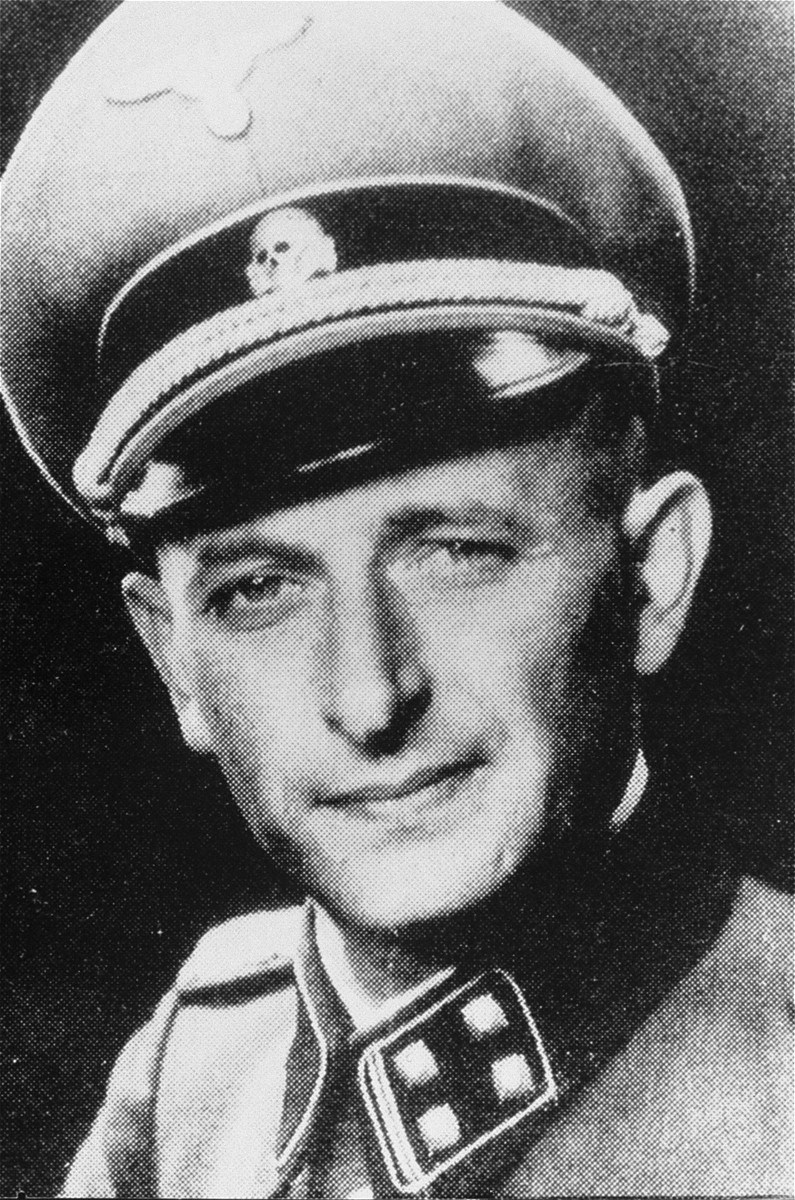
Adolf Eichmann SS-Obersturmbannführer — Head of RSHA Dept. IV B4

Adolf Eichmann

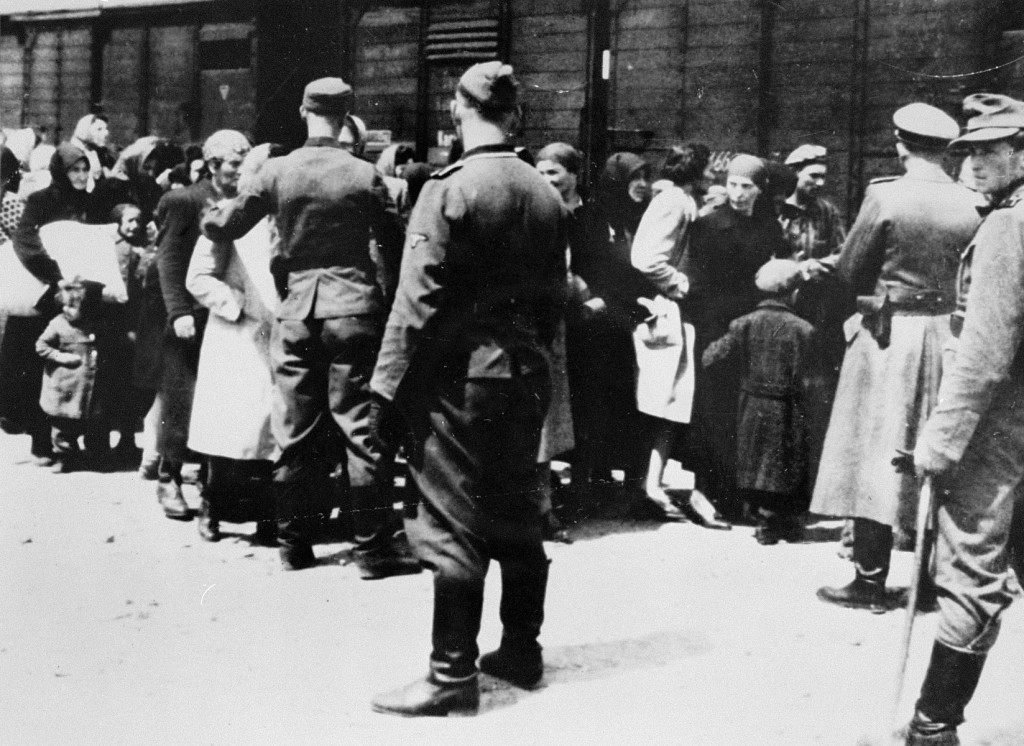
The chief logistician of the Holocaust. He organized the deportation and transport of millions of Jews to extermination camps across Europe with chilling bureaucratic efficiency. He attended the Wannsee Conference and oversaw the railway schedules that sent Jews to their deaths. He escaped to Argentina after the war and lived under the alias Ricardo Klement until captured by the Mossad in 1960. Tried in Jerusalem in a landmark trial, convicted, and executed in 1962. Hannah Arendt's coverage of his trial coined the phrase "the banality of evil".

Adolf Eichmann joven Young Eichmann in SS uniform, early 1930s — an unremarkable clerk who would become the chief logistician of genocide.
Ernst Röhm Head of the SA — Chief of Staff

Ernst Röhm

Leader of the Sturmabteilung (SA), the Nazi paramilitary brownshirts who terrorized Jews, political opponents, and anyone deemed an enemy of the party. The SA orchestrated boycotts of Jewish businesses, carried out street violence, and enforced antisemitic policies through intimidation and brutality. Röhm was murdered on Hitler's orders during the Night of the Long Knives (June 30, 1934), after which the SA was supplanted by the SS.

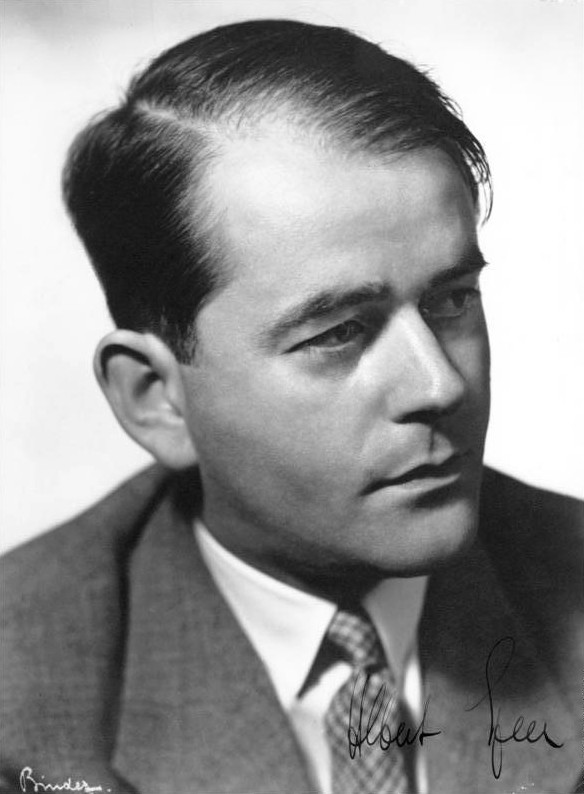
Albert Speer Reich Plenipotentiary for Total War

Albert Speer

Hitler's chief architect and later Minister of Armaments. He used millions of forced laborers, including concentration camp prisoners, to fuel the war economy. Despite his post-war claims of ignorance, evidence shows he visited camps and attended meetings where the persecution of Jews was discussed. At Nuremberg he was the only defendant to accept responsibility, and was sentenced to 20 years in Spandau Prison. He died in 1981.

Julius Streicher Anti-Jewish "newspaper" publisher

Julius Streicher

Publisher of Der Stürmer, the virulently antisemitic newspaper that ran from 1923 to 1945. Its crude cartoons and fabricated stories depicting Jews as subhuman helped normalize hatred and dehumanization across German society. Though he held no direct role in the killings, the Nuremberg Tribunal found his propaganda had directly incited mass murder. He was convicted of crimes against humanity and hanged in 1946.

The SS (Schutzstaffel)

Originally Hitler's personal bodyguard, the SS grew under Heinrich Himmler into a state within a state — a vast apparatus of terror that controlled the concentration and extermination camps, the secret police (Gestapo), the intelligence service (SD), the mobile killing units (Einsatzgruppen), and even its own military branch (Waffen-SS). The SS was the primary instrument of the Holocaust.

SS-Totenkopfverbände (Death's Head Units)

The branch of the SS responsible for guarding and administering all concentration and extermination camps. Founded by Theodor Eicke at Dachau, they were trained to view prisoners as subhuman. Their skull insignia became a symbol of terror across Europe.

The Gestapo (Geheime Staatspolizei)

The Secret State Police. Responsible for identifying, surveilling, arresting, interrogating, and deporting Jews, political opponents, resistance fighters, and anyone deemed a threat. Their vast network of informants spread terror across occupied Europe. Led by Heinrich Müller, who vanished in 1945 and was never found.

The SD (Sicherheitsdienst)

The intelligence and security service of the SS, founded by Reinhard Heydrich in 1931. It monitored internal party loyalty and external threats, and played a crucial role in planning the Holocaust. The SD and Gestapo were merged under the RSHA (Reich Main Security Office) in 1939.

The Waffen-SS

The armed military wing of the SS, with over 900,000 members at its peak. Beyond combat, Waffen-SS units committed massacres of civilians and POWs across Europe — including Oradour-sur-Glane (France), Malmedy (Belgium), and Distomo (Greece). Several Waffen-SS divisions were composed of foreign volunteers and collaborators.

The RSHA (Reich Main Security Office)

Created in 1939 by merging the Gestapo, SD, and Criminal Police under one umbrella led by Heydrich (later Ernst Kaltenbrunner). The RSHA coordinated the entire apparatus of persecution: from identifying Jews to organizing deportations to managing the extermination camps. Department IV B4, headed by Adolf Eichmann, handled the logistics of the "Final Solution".

The WVHA (SS Economic Administration)

Led by Oswald Pohl, the WVHA managed the economic exploitation of concentration camp prisoners — forced labor, confiscation of valuables (gold teeth, hair, clothing), and the administration of SS-owned enterprises. It turned human suffering into profit on an industrial scale. Pohl was convicted and hanged in 1951.

The Einsatzgruppen — Mobile killing units

Four mobile killing squads (A, B, C, D) that followed the Wehrmacht into Eastern Europe and the Soviet Union beginning in June 1941. They murdered approximately 1.5 million Jews, along with Roma, Soviet commissars, partisans, and people with disabilities — primarily through mass shootings. This was the "Holocaust by bullets", the first phase of systematic genocide before the extermination camps became operational.

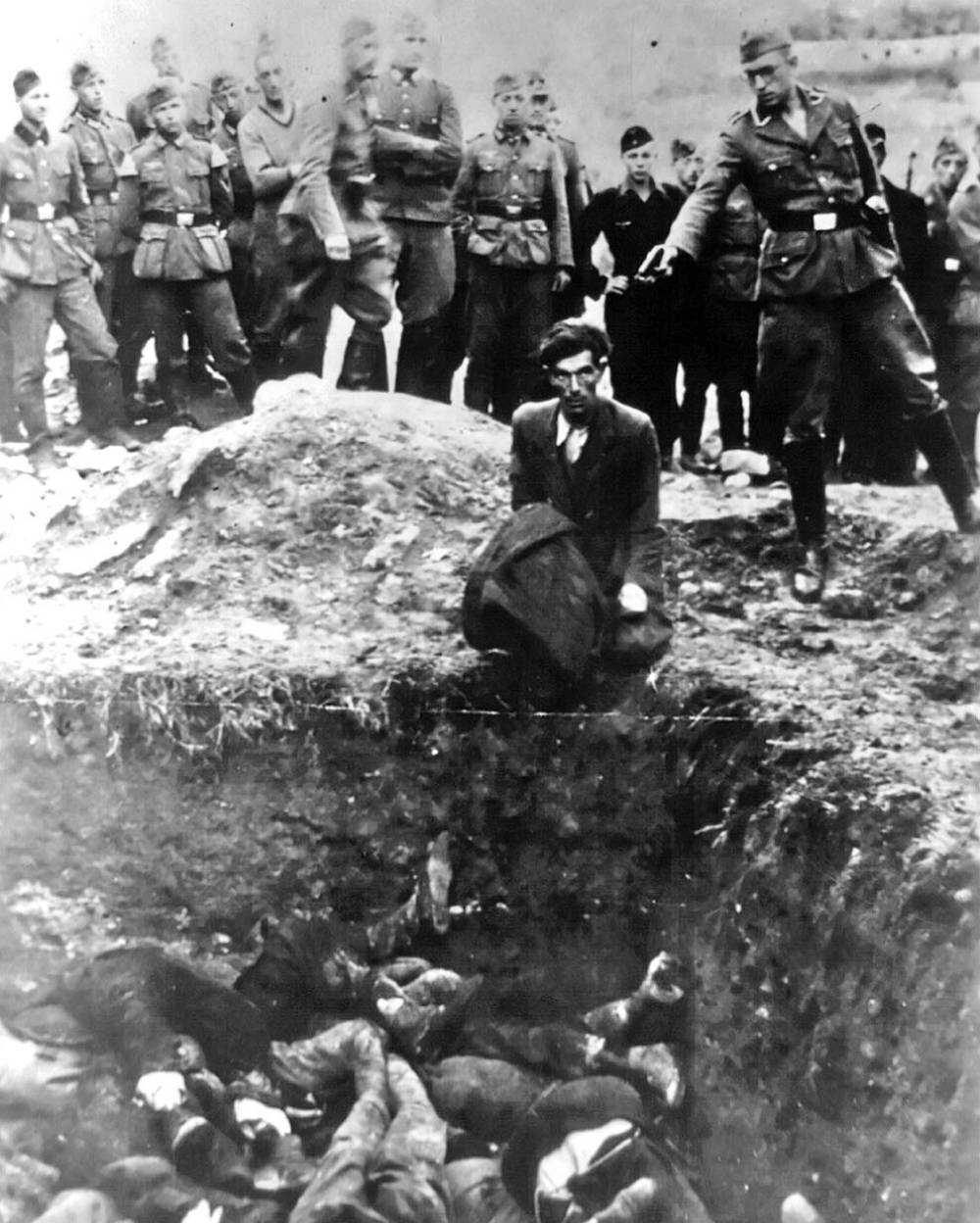
The Last Jew in Vinnitsa, 1941

"The last Jew in Vinnitsa" — A member of Einsatzgruppe D prepares to shoot a Jewish man kneeling at the edge of a mass grave, Vinnitsa, Ukraine, 1941. The executioner was identified in 2025 as Jakobus Onnen, an Einsatzkommando 6 member. This photograph, found in a German soldier's personal album labeled with these words, remains one of the most recognized images of the Holocaust.

Einsatzgruppen execution of Jews in Ivangorod, Ukraine, 1942

Einsatzgruppen execution of Jewish civilians near Ivangorod, Ukraine, 1942. Many publications crop this image to show only the soldier, the woman, and the child — but the full photograph reveals rifles held by additional soldiers at the left edge, shadows suggesting even more perpetrators present, a body at the soldier's feet, and other victims to the right. It was not an act of individual brutality — it was a mass execution.

Einsatzgruppe A

Attached to Army Group North (Heeresgruppe Nord) under Field Marshal Wilhelm Ritter von Leeb, Einsatzgruppe A advanced through the Baltic States — Lithuania, Latvia, and Estonia — beginning on June 22, 1941, the first day of Operation Barbarossa. It operated behind the 16th Army, the 18th Army, and the 4th Panzer Group, whose commander Erich Hoepner described the relationship as "very close, almost cordial." Its commander, SS-Brigadeführer Franz Walter Stahlecker, organized the unit into sub-units: Sonderkommandos 1a and 1b, and Einsatzkommandos 2 and 3. Its initial strength was approximately 990 men — the largest of the four Einsatzgruppen.

In Lithuania, the killing began within hours of the invasion. In Kaunas, between June 25 and 29, approximately 4,000 Jews were murdered in the streets and at the Lietūkis Garage in staged "spontaneous" pogroms — though Stahlecker later admitted that "secret assistance by the Germans was required" to trigger the violence. Einsatzkommando 3, under SS-Standartenführer Karl Jäger, conducted systematic massacres across Lithuanian towns. His meticulous "Jäger Report" (December 1, 1941) documented the murder of 137,346 people — listing exact dates, locations, and victim counts. Children first appeared in his tallies in mid-August 1941: 3,207 murdered in Rokiškis on August 15–16. In Ponary (Paneriai), outside Vilnius, over 70,000 Jews were shot in forest pits between July 1941 and July 1944.

In Latvia, Einsatzgruppe A worked closely with the Arajs Kommando — a unit of approximately 300 Latvian volunteers led by Viktors Arājs, many of them university students. Together they murdered 2,300 Jews in Riga on July 6–7, 1941 alone. The largest massacre came at Rumbula, outside Riga, on November 30 and December 8, 1941: approximately 25,000 Jews from the Riga Ghetto were marched to forest pits, forced to undress, and shot. This operation was commanded by SS-Obergruppenführer Friedrich Jeckeln. By October 1941, 34,000 Latvian Jews had already been killed. Within six months, Arājs and his collaborators had murdered roughly half of Latvia's entire Jewish population.

In Estonia, Sonderkommando 1a under Martin Sandberger, assisted by the Estonian Omakaitse militia, murdered all Jewish males over 16 by October 1941. By January 1942, Estonia was declared "judenfrei" — the first country to receive that designation, as announced at the Wannsee Conference. According to Einsatzgruppe A's own reports, between June 22 and November 25, 1941, the unit murdered 136,421 Jews, 1,064 communists, 653 mentally ill persons, 56 partisans, and others — a total of over 140,000 people in just five months. Stahlecker himself was killed by Soviet partisans near Krasnogvardeysk on March 23, 1942.

Einsatzgruppe B

Einsatzgruppe B was attached to Army Group Center (Heeresgruppe Mitte), commanded by Field Marshal Fedor von Bock, advancing along the main Moscow axis through Belarus and the Smolensk region. It operated behind the 4th Army, 9th Army, 2nd Panzer Group (Guderian), and 3rd Panzer Group (Hoth). Commanded initially by SS-Brigadeführer Arthur Nebe — head of the Kripo (Criminal Police) and, paradoxically, later a participant in the July 20, 1944 plot against Hitler — the unit comprised approximately 655 men organized into Sonderkommandos 7a and 7b and Einsatzkommandos 8 and 9, supplemented by Waffen-SS, Order Police battalions, and local auxiliaries.

Belarus became the epicenter of Einsatzgruppe B's operations. In Minsk, mass executions began within days of the German occupation on June 28, 1941. On November 7, 1941 — the anniversary of the Bolshevik Revolution, chosen deliberately — a massive Aktion killed 12,000 Jews from the Minsk ghetto. Einsatzkommando 8, under Dr. Otto Bradfisch, carried out systematic shootings in Mogilev, where in October 1941 Nebe personally oversaw experiments with gas vans — sealed trucks that piped engine exhaust into the cargo compartment — testing them on mental patients from the Novinki asylum before deploying them against Jews. These mobile gas chambers, developed at Nebe's request by the RSHA's technical department, became a precursor to the stationary gas chambers of the extermination camps.

Maly Trostinets, a former collective farm 12 kilometers southeast of Minsk, became the largest extermination site in the occupied Soviet Union outside of the death camps. From May 1942, Jews deported from Germany, Austria, the Czech Protectorate, and the Netherlands were transported directly there and killed upon arrival — shot in pits in the nearby Blagovshchina forest or gassed in mobile gas vans. An estimated 65,000 people were murdered at Maly Trostinets and its surrounding killing sites between 1941 and 1944. In Sonderkommando 7a's area of operations around Smolensk and Vitebsk, entire Jewish communities were annihilated. The town of Krupki saw 1,000 Jews shot on September 18, 1941; Borissov lost 7,000 Jews on October 20-21, 1941.

Nebe was replaced in November 1941 by SS-Obersturmbannführer Erich Naumann, who intensified the killings. Belarusian collaborators — including the Belarusian Auxiliary Police (Schutzmannschaft) — actively participated in roundups and executions. By late 1942, Einsatzgruppe B's operational reports (Ereignismeldungen) documented over 134,000 people killed. When combined with the operations of the Order Police battalions and Wehrmacht units in the same zone, the total death toll in Belarus reached catastrophic proportions: an estimated 800,000 Jews — nearly the entire Jewish population of Belarus — were murdered during the occupation. Nebe himself fled in 1944 and was eventually captured, tried, and executed in March 1945. Naumann was convicted at the Einsatzgruppen Trial in Nuremberg and sentenced to death, executed in 1951.

Einsatzgruppe C

Einsatzgruppe C was attached to Army Group South (Heeresgruppe Süd), commanded by Field Marshal Gerd von Rundstedt, advancing into northern and central Ukraine. It operated behind the 6th Army (Reichenau), 17th Army, and 1st Panzer Group (Kleist). Commanded by SS-Brigadeführer Dr. Otto Rasch — a lawyer with two doctoral degrees — the unit comprised approximately 700 men organized into Sonderkommandos 4a and 4b and Einsatzkommandos 5 and 6. Sonderkommando 4a, under SS-Standartenführer Paul Blobel, became the most lethal sub-unit of all the Einsatzgruppen.

The first large-scale massacre occurred at Kamianets-Podilskyi on August 27-28, 1941, where Einsatzkommando 5 together with Order Police Battalion 320 murdered 23,600 Jews — mostly Hungarian Jews who had been deported across the border. This was the first five-figure massacre of the Holocaust. Field Marshal von Reichenau, commander of the 6th Army, actively facilitated the killings, issuing his infamous 'Severity Order' (Strenge Befehl) of October 10, 1941, which stated that soldiers must show 'full understanding for the necessity of the severe but just atonement of Jewish subhumanity,' making the Wehrmacht's complicity explicit and setting the tone for the entire Eastern Front.

Babi Yar stands as the most devastating single massacre of the Holocaust by shooting. On September 29-30, 1941, Sonderkommando 4a, together with Police Battalions 45 and 303 and Ukrainian Auxiliary Police, marched 33,771 Jews of Kyiv to the ravine of Babi Yar on the city's northwestern edge. The Jews had been ordered to assemble, believing they were being resettled. Instead, they were forced to undress, hand over valuables, and walk in groups of ten to the edge of the ravine, where they were machine-gunned. The killing took 36 hours without pause. Blobel's report noted the exact figure with chilling precision. Babi Yar continued to be used as a killing site throughout the occupation: by the war's end, an estimated 100,000-150,000 people — Jews, Roma, Soviet POWs, partisans, and psychiatric patients — were murdered there.

Ukrainian collaboration was extensive in Einsatzgruppe C's zone. The Ukrainian Auxiliary Police (Ukrainische Hilfspolizei) actively participated in roundups and shootings across Volhynia, Zhytomyr, and the Kyiv region. In Dnipropetrovsk, Einsatzkommando 6 under Dr. Erhard Kroeger murdered over 10,000 Jews in late 1941. Across the Zhytomyr region, Einsatzkommando 5 annihilated dozens of Jewish communities. Rasch was replaced in late 1941 by SS-Gruppenführer Max Thomas due to health issues. In 1943, Blobel was assigned to lead Sonderaktion 1005 — the secret operation to exhume and burn bodies from mass graves across the occupied East, an attempt to destroy evidence of the massacres. Einsatzgruppe C's documented kill count exceeded 118,000, though the true total — including operations conducted jointly with local auxiliaries and police battalions — was far higher.

Einsatzgruppe D

Einsatzgruppe D was attached to the 11th Army (not a full army group, but an independent army command), commanded by General Erich von Manstein, operating in southern Ukraine, Bessarabia, Crimea, and later the Caucasus. It was the only Einsatzgruppe not assigned to an Army Group but to an individual army. Commanded by SS-Gruppenführer Otto Ohlendorf — an economist who held a doctorate in jurisprudence and served simultaneously as head of the SD-Inland (domestic intelligence) — the unit comprised approximately 600 men organized into Sonderkommandos 10a and 10b and Einsatzkommandos 11a, 11b, and 12.

Operations began in Bessarabia and southern Ukraine in July 1941, where Romanian forces under Marshal Ion Antonescu conducted parallel massacres with ferocious brutality. In Odessa, after a bomb attack on Romanian headquarters killed 67 people on October 22, 1941, Antonescu ordered savage reprisals: between October 22 and 25, Romanian and German forces murdered over 30,000 Jews — many burned alive in warehouses at Dalnik, others machine-gunned and thrown into the sea. Einsatzkommando 11b carried out shootings across the Mykolaiv and Kherson regions, while Sonderkommando 10a operated in the Rostov area. Manstein's 11th Army provided logistical support, transport, and ammunition for the killings, and Manstein later issued his own 'Severity Order' echoing Reichenau's, calling for 'hard but just punishment of Jewish subhumanity.'

The conquest of Crimea brought systematic extermination to the peninsula. Between November 1941 and July 1942, Einsatzgruppe D annihilated virtually the entire Jewish and Romani population of Crimea. In Simferopol (today Aqmescit), approximately 14,300 Jews and Romani were shot between November and December 1941. In Kerch, 7,000 Jews were murdered in the Bagerovo anti-tank ditch on November 29 - December 1, 1941. Einsatzkommando 11a systematically cleared Yevpatoria, Feodosia, and the smaller Crimean towns. The Karaites — a Jewish sect following only the Torah — were controversially spared after Nazi racial 'experts' ruled them ethnically non-Jewish, a decision that saved approximately 6,000 lives. By April 1942, Ohlendorf reported Crimea 'cleansed' of Jews.

Ohlendorf became the most articulate witness to the horror at the Einsatzgruppen Trial (Case No. 9) in Nuremberg. With clinical detachment, he described how victims were lined up at the edge of mass graves and shot, how children were killed alongside their parents, and how he had personally ensured 'humane' methods — having victims shot simultaneously rather than one by one — as if efficiency in murder constituted mercy. He admitted to the murder of approximately 90,000 people under his command, including women and children, stating he had carried out orders 'to the best of his knowledge and conscience.' Ohlendorf was sentenced to death and hanged on June 7, 1951. His successor, SS-Oberführer Walther Bierkamp, continued operations into the Caucasus in 1942, targeting Jewish communities in Krasnodar and the North Caucasus region before the German retreat after Stalingrad.

Local collaborators and auxiliaries

The Einsatzgruppen relied heavily on local police, militias, and volunteers who participated in the killings. Lithuanian, Latvian, Ukrainian, and other auxiliaries assisted in roundups, guarding, and executions. Some, like the Lithuanian Ypatingasis būrys and the Ukrainian Auxiliary Police, were directly involved in mass shootings.

Sonderaktion 1005 — Operation 1005 (1942–1944)

As the tide of war turned and the possibility of Soviet reconquest became real, the Nazi leadership faced the problem of the evidence they had left behind — hundreds of mass graves containing the bodies of over a million Jews, Roma, Soviet POWs, and others across the occupied East. In June 1942, SS-Obergruppenführer Reinhard Heydrich's successor Ernst Kaltenbrunner, on Heinrich Müller's initiative (head of the Gestapo), assigned SS-Standartenführer Paul Blobel — the same man who had commanded Sonderkommando 4a at Babi Yar — to lead Sonderaktion 1005, the top-secret operation to erase all physical traces of the mass killings.

The procedure was methodical and horrifying. Sonderkommando 1005 units — staffed primarily by Jewish prisoners selected from concentration camps and local ghettos, chained at the ankles — were forced to exhume decomposing bodies from mass graves, stack them on enormous pyres built from railroad rails, douse them with gasoline, and burn them. The ashes were then ground with bone-crushing machines, mixed with sand, and scattered. At Babi Yar alone, the operation ran from August 18 to September 19, 1943, with approximately 325 prisoners forced to unearth and burn an estimated 100,000 bodies. A team of these prisoners, knowing they would be killed when the work was done, staged a desperate escape on the night of September 29, 1943 — exactly two years after the original massacre. Of the 325 prisoners, only 15 survived the escape.

The operation expanded across the entire occupied East — from the Ponary forest outside Vilna to the Janowska camp in Lwów, from Maly Trostinets near Minsk to the extermination camps of Sobibor, Treblinka, Bełżec, and Chełmno. At the Janowska camp in Lwów, prisoners of Sonderkommando 1005 were forced to refer to the bodies as 'Figuren' (figures) — never as people. When the work was completed at a given site, the Jewish prisoners who had performed it were invariably executed to eliminate witnesses. At Ponary, another escape attempt took place on April 15, 1944, through a tunnel dug over 76 days with spoons and bare hands — of 40 prisoners, only 15 reached the forests and survived.

Despite its vast scope, Sonderaktion 1005 ultimately failed in its objective. The operation could never keep pace with the scale of the killing. Many sites were overrun by the Red Army before Blobel's units could reach them. Soviet forensic commissions — the Extraordinary State Commission — documented the mass graves they found, and survivor testimony from escaped Sonderkommando 1005 prisoners provided crucial evidence. The operation stands as one of the most chilling aspects of the Holocaust: not just the murder of over a million people, but the systematic attempt to deny that it had ever happened — a genocide followed by the attempted erasure of the genocide itself.

The Einsatzgruppen Trial (1947–1948)

Twenty-four commanders were tried at Nuremberg. Fourteen were sentenced to death (though only four were actually executed due to Cold War commutations). The trial established that "following orders" was not a valid defense for mass murder. Prosecutor Benjamin Ferencz was just 27 years old.

Franz Walter Stahlecker Commander of Einsatzgruppe A

Franz Walter Stahlecker

Led Einsatzgruppe A in the Baltic States and was responsible for the murder of over 240,000 Jews in the first months of Operation Barbarossa (1941). His detailed reports, including maps showing kill counts by region, served as key evidence of the systematic nature of the mass shootings. He was killed by Soviet partisans in 1942.

Otto Ohlendorf Commander of Einsatzgruppe D

Otto Ohlendorf

Commanded Einsatzgruppe D in southern Ukraine and Crimea, overseeing the murder of approximately 90,000 Jews, Roma, and others. At his trial, he testified with disturbing detachment about the killings, describing them as "necessary measures". He was convicted at the Einsatzgruppen Trial and hanged in 1951.

Arthur Nebe Commander of Einsatzgruppe B

Arthur Nebe

Head of the Criminal Police (Kripo) and commander of Einsatzgruppe B in Belarus and the Smolensk region. Under his command, tens of thousands of Jews were murdered. He pioneered the use of gas vans as a killing method. Despite later claiming involvement in the July 20, 1944 plot against Hitler, his role as a mass murderer is undeniable. He was arrested and executed by the Nazis in March 1945.

Otto Rasch Commander of Einsatzgruppe C

Otto Rasch

Commander of Einsatzgruppe C in Ukraine, responsible for the Babi Yar massacre in September 1941 — one of the largest single mass shootings of the Holocaust. Over 33,000 Jews from Kyiv were murdered in just two days. Also oversaw killings at Kamianets-Podilskyi. He was indicted at the Einsatzgruppen Trial but charges were dropped due to severe illness. He died in 1948.

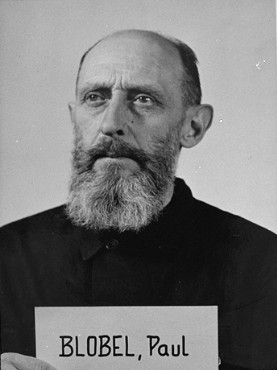
Paul Blobel Commander of Sonderkommando 4a — Einsatzgruppe C

Paul Blobel

Led Sonderkommando 4a under Einsatzgruppe C (commanded by Otto Rasch). Directly responsible for the execution of the Babi Yar massacre. Later headed "Aktion 1005", the operation to exhume and burn the bodies of mass shooting victims to destroy evidence of the crimes. Convicted at the Einsatzgruppen Trial and hanged in 1951.

Ernst Biberstein Commander of Einsatzkommando 6 — Einsatzgruppe C (under Otto Rasch)

Ernst Biberstein

A former Protestant pastor who became commander of Einsatzkommando 6, a subunit of Einsatzgruppe C operating in southern Ukraine. Under his command, thousands of Jews were murdered in mass shootings. His transformation from clergyman to mass killer exemplified how the Nazi system corrupted institutions. Sentenced to death at the Einsatzgruppen Trial, commuted to life imprisonment, released in 1958.

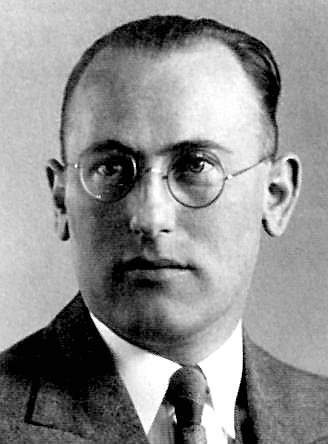
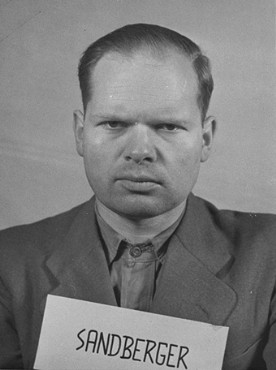
Martin Sandberger Commander of Einsatzkommando 1a — Einsatzgruppe A (under Stahlecker)

Martin Sandberger

Commanded Einsatzkommando 1a, a subunit of Einsatzgruppe A operating in Estonia under Franz Walter Stahlecker. Responsible for the murder of thousands of Jews and communists in Estonia. He declared Estonia "judenfrei" (free of Jews) — one of the first territories to receive that designation. Sentenced to death at the Einsatzgruppen Trial, commuted to life, released in 1958. He was the last surviving Einsatzgruppen Trial defendant, dying in 2010 at age 98.

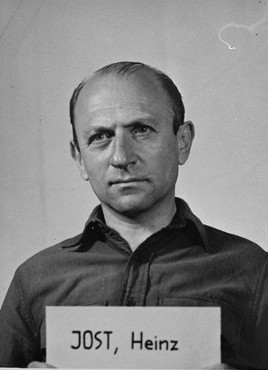
Heinz Jost Successor Commander of Einsatzgruppe A

Heinz Jost

Succeeded Stahlecker as commander of Einsatzgruppe A in the Baltic States after Stahlecker's death in 1942. Previously head of SD-Ausland (foreign intelligence). Under his command, the killing operations continued across Latvia, Lithuania, and Estonia. Sentenced to life imprisonment at the Einsatzgruppen Trial, commuted to 10 years, released in 1951.

Viktor Arajs Commander of the Arajs Kommando — Einsatzgruppe A

Viktor Arajs

Born January 13, 1910 in Baldone, Latvia. A law student and former police officer, Arajs formed a volunteer auxiliary unit under SS-Brigadeführer Walter Stahlecker (commander of Einsatzgruppe A) in July 1941, just days after the German invasion of the Soviet Union. The Arajs Kommando began with 240 Latvian volunteers and grew to approximately 1,500 men — all ethnic Latvians. On July 4, 1941, Arajs personally led the burning of the Great Choral Synagogue of Riga with several hundred Jews locked inside. The Kommando carried out the Liepāja massacres (July 24–25, 1941 — 910 Jews murdered), and played a central role in the Rumbula massacre (November 30 and December 8, 1941), where approximately 25,000 Latvian and German Jews were shot in pits outside Riga — one of the largest two-day mass shootings of the Holocaust. The unit also participated in Operation Winterzauber (1943), killing approximately 4,000 civilians in Belarus. In total, the Arajs Kommando murdered an estimated 26,000 Jews. After the war, Arajs hid in West Germany under the alias "Victor Zeibots," working at a printing company in Frankfurt for decades. He was finally arrested, tried by a Hamburg court on December 21, 1979, found guilty of the murder of 13,000 people, and sentenced to life imprisonment. He died on January 13, 1988 — his 78th birthday — in solitary confinement at Kassel prison.

Herberts Cukurs Deputy Commander of the Arajs Kommando — "The Latvian Lindbergh"

Herberts Cukurs

Born May 17, 1900 in Liepāja, Latvia. Before the war, Cukurs was a celebrated aviator — nicknamed "The Latvian Lindbergh" — famous for his daring long-distance flights from Latvia to Gambia (1933, earning the Harmon Trophy) and from Riga to Tokyo. He was a national hero. That changed in the summer of 1941. When the Germans invaded Latvia, Cukurs became deputy commander of the Arajs Kommando. Witnesses testified that he personally shot Jewish children and infants, burned Jews alive inside the Riga synagogue on July 4, 1941 — shooting anyone who tried to break the windows to escape — sexually assaulted Jewish women, and murdered over 1,200 civilians including infants. He participated in the systematic extermination of Latvia's Jewish population alongside Viktor Arajs. After the war, Cukurs obtained a visa through the Brazilian Consulate in Marseille (December 18, 1945) and settled in São Paulo, where he ran a small aviation business with Republic RC-3 Seabee amphibious aircraft. He never hid his identity. The Mossad tracked him down through agent Yaakov Meidad — the same operative who had helped capture Adolf Eichmann in Buenos Aires — who approached Cukurs using the alias "Anton Künzle," posing as an Austrian businessman. On February 23, 1965, Meidad lured Cukurs to a house in Shangrilá, a beach resort near Montevideo, Uruguay, under the pretense of a business deal. In the struggle that followed, Cukurs fought back violently — he bit one agent's finger nearly off and pleaded "Lass mich sprechen!" (Let me speak!) — before being shot twice in the head with a silenced pistol and struck with a hammer. His body was found on March 6 in a trunk, alongside documents detailing his wartime crimes and a note reading: "Those who kill with the sword will perish by the sword." He was 64 years old.

Documentaries

Essential viewing for understanding the Einsatzgruppen and the psychology of the perpetrators.

Einsatzgruppen: The Death Brigades — Part I: The Graves

The formation, deployment, and mass shootings across Eastern Europe.

Einsatzgruppen: The Death Brigades — Part II: Funeral Pyres

Sonderaktion 1005 and the attempt to erase the evidence of mass murder.

Radical Evil (2013)

What turns ordinary men into mass murderers? Based on the diaries and letters of the perpetrators themselves, this film explores the psychology behind the killings — proving they were not monsters, but human beings who made choices.

The Order Police — "Ordinary Men" and mass murder

The Ordnungspolizei (Order Police, or Orpo) were the uniformed regular police of Nazi Germany — distinct from the SS, the Gestapo, and the Einsatzgruppen. Under the command of Hauptmann der Ordnungspolizei Kurt Daluege, the Order Police numbered approximately 300,000 men by 1943. While they are often overlooked in Holocaust histories that focus on the SS and the Einsatzgruppen, the Order Police battalions were responsible for the murder of hundreds of thousands of Jews in Eastern Europe, particularly in Poland, the Soviet Union, and the occupied territories. They provided the manpower that the relatively small Einsatzgruppen lacked: while the four Einsatzgruppen totaled approximately 3,000 men, the Order Police deployed dozens of battalions numbering tens of thousands of men across the occupied East. These battalions carried out mass shootings, ghetto liquidations, deportations to extermination camps, and "Jew hunts" (Judenjagd) — the systematic combing of forests and countryside to find and kill Jews who had escaped the ghettos.

1942–1943

Reserve Police Battalion 101

Reserve Police Battalion 101, based in Hamburg, became the most thoroughly documented case study of how ordinary men became mass murderers — thanks to the groundbreaking work of historian Christopher Browning, whose 1992 book 'Ordinary Men: Reserve Police Battalion 101 and the Final Solution in Poland' reconstructed the unit's crimes from postwar trial testimonies. The battalion consisted of approximately 500 men, mostly middle-aged Hamburg reservists — dock workers, truck drivers, salesmen, construction workers — too old for the regular army. Few were committed Nazis; most had no ideological training. Yet between July 1942 and November 1943, this single battalion directly shot approximately 38,000 Jews and deported at least 45,000 more to the Treblinka extermination camp. Their first massacre took place on July 13, 1942, in the village of Józefów in the Lublin district of Poland. Major Wilhelm Trapp — a 53-year-old career policeman who wept as he gave the orders — told his men they would be shooting the village's 1,800 Jews: men, women, children, elderly. He offered any man the chance to step aside. Of the approximately 500 men, only about a dozen chose not to participate. The rest marched Jews into the forest in groups, forced them to lie face down, and shot them in the back of the neck at point-blank range, one by one, for hours. By the end of the day, their uniforms were soaked in blood and brain matter. Some vomited. Some drank heavily that night. But virtually all of them continued to participate in subsequent massacres — at Łomazy, Międzyrzec, Poniatowa, and dozens of other locations. Browning's central question — how did these ordinary, unremarkable men become willing executioners? — challenged the comforting notion that only fanatical Nazis or psychopaths could commit genocide. The answer lay in a combination of conformity, peer pressure, obedience to authority, careerism, gradual brutalization, and the dehumanization of victims. Only a tiny minority ever refused. No one who refused was punished.

Key battalions

Other Order Police battalions in the Holocaust

Battalion 101 was not unique — it was typical. Police Battalion 309 participated in the burning of the Great Synagogue of Białystok on June 27, 1941, with approximately 700 Jews locked inside. Police Battalion 322 carried out mass shootings in Belarus and Lithuania, killing thousands of Jews in 1941. Police Battalion 316 participated in mass executions in Ukraine. Police Battalion 303 was involved in the deportation of Jews from the Warsaw Ghetto to Treblinka during the Grossaktion of July–September 1942. In total, historian Edward Westermann has estimated that Order Police battalions were directly responsible for the deaths of at least several hundred thousand Jews — a figure that makes them collectively one of the most lethal instruments of the Holocaust, rivaling the Einsatzgruppen in the scale of killing. The Order Police also played a central role in the "Harvest Festival" (Erntefest) massacre of November 3–4, 1943, when approximately 42,000 Jews were shot at Majdanek, Poniatowa, and Trawniki — the single largest German shooting operation of the entire Holocaust. The critical lesson of the Order Police is that the Holocaust was not carried out only by ideological fanatics or specially selected killers. It was carried out by tens of thousands of ordinary men — fathers, husbands, neighbors — who chose to obey.

The Wannsee Conference — January 20, 1942

Conference room at the Wannsee Villa where the Final Solution was coordinated

The conference room at the Villa Marlier, Am Großen Wannsee 56–58, Berlin, where fifteen senior Nazi officials coordinated the "Final Solution" on January 20, 1942. Today the house is a memorial and museum.

In a lakeside villa in the Berlin suburb of Wannsee, fifteen senior Nazi officials met for approximately 90 minutes over cognac and lunch to coordinate the logistics of the "Final Solution to the Jewish Question". Chaired by Reinhard Heydrich and with minutes taken by Adolf Eichmann, the conference did not decide to murder the Jews — that was already underway — but formalized the bureaucratic cooperation between all branches of the German state to carry out the genocide systematically across all of occupied Europe. The only surviving copy of the minutes (the "Wannsee Protocol") was discovered in 1947.

Reinhard Heydrich Chairman — Head of the RSHA

Reinhard Heydrich

Chaired the conference and presented the plan for the deportation and murder of 11 million European Jews. The number came from a detailed country-by-country breakdown included in the protocol. Assassinated five months later in Prague.

Adolf Eichmann Secretary — RSHA Dept. IV B4

Adolf Eichmann

Took the minutes and prepared the logistics for implementation. At his 1961 trial in Jerusalem, he testified about the conference in detail, describing the relaxed atmosphere — "the gentlemen were standing together, or sitting together, and were discussing the subject quite bluntly... with no mincing of words." He noted that after the meeting, cognac was served.

Wilhelm Stuckart State Secretary — Ministry of the Interior

Wilhelm Stuckart

Co-author of the Nuremberg Laws. At Wannsee, he proposed forced sterilization as an alternative to deportation for "mixed-race" Jews (Mischlinge), arguing it would be more "administratively efficient". His suggestions revealed how the genocide was debated in coldly bureaucratic terms.

Josef Bühler State Secretary — Government General (Poland)

Josef Bühler

Hans Frank's deputy in occupied Poland. He enthusiastically requested that the "Final Solution" begin in the Government General, arguing that "the Jews should be removed from this territory as quickly as possible" because transport was not a major problem and most Jews there were already "unfit for work". He was executed in Poland in 1948.

Otto Hofmann SS-Gruppenführer — Race and Settlement Office

Otto Hofmann

Represented the SS Race and Settlement Main Office, which determined racial classifications. At Wannsee, he contributed to discussions on the definition of "Mischlinge" (people of mixed Jewish ancestry) and their fate. Sentenced to 25 years at Nuremberg, released in 1954.

Martin Luther State Secretary — Foreign Ministry

Martin Luther

Represented the Foreign Ministry. His role was to coordinate the diplomatic aspects of deporting Jews from allied and occupied countries. His office pressured satellite states (Slovakia, Romania, Hungary, etc.) to hand over their Jewish populations. It was Luther's copy of the Wannsee Protocol that survived — the only one of 30 copies not destroyed.

Heinrich Müller SS-Gruppenführer — Head of Gestapo (Amt IV)

Heinrich Müller

Head of the Gestapo and Eichmann's direct superior. He was responsible for the operational execution of arrests, deportations, and the suppression of resistance across occupied Europe. A key figure in the machinery of the Holocaust, he vanished from Hitler's bunker in May 1945 and was never found — one of the most senior Nazis to escape justice entirely. His fate remains one of the great unsolved mysteries of the postwar era.

Roland Freisler State Secretary — Reich Ministry of Justice

Roland Freisler

Represented the Ministry of Justice at Wannsee, contributing to discussions on the legal definition and treatment of "Mischlinge". He later became President of the Volksgerichtshof (People's Court), where he sentenced thousands to death in show trials — including the White Rose members and the July 20 plot conspirators. Killed during an Allied bombing raid on Berlin in February 1945.

Alfred Meyer State Secretary — Reich Ministry for the Occupied Eastern Territories

Alfred Meyer

Deputy to Alfred Rosenberg, he represented the ministry responsible for administering the vast occupied territories of the Soviet Union — where the Einsatzgruppen were carrying out mass shootings of Jews. At Wannsee, he voiced support for immediate and radical measures. He committed suicide in April 1945.

Georg Leibbrandt Reichsamtsleiter — Reich Ministry for the Occupied Eastern Territories

Georg Leibbrandt

Head of the Political Department in Rosenberg's ministry. A Baltic German who spoke Russian, he helped coordinate anti-Jewish policies in the occupied East. Despite his direct involvement, he was never convicted — charges were dropped in 1950 and he lived freely in West Germany until his death in 1982.

Friedrich Wilhelm Kritzinger State Secretary — Reich Chancellery

Friedrich Wilhelm Kritzinger

Represented the Reich Chancellery, the administrative heart of the German government. His presence ensured that the highest levels of the state apparatus were informed and complicit. He was one of the few Wannsee attendees to later express remorse, telling interrogators he was "ashamed" of what had happened. He died in 1947 before trial.

Erich Neumann State Secretary — Office of the Four-Year Plan

Erich Neumann

Represented Hermann Göring's economic planning office. His role at Wannsee was to address the economic implications of deporting Jewish workers from essential war industries — a concern that temporarily delayed deportations from some areas. He was briefly interned after the war but never tried, and died in 1948.

Gerhard Klopfer State Secretary — Party Chancellery

Gerhard Klopfer

Represented Martin Bormann's Party Chancellery, the administrative center of the NSDAP. He supported radical measures against "Mischlinge" at the conference. He was the last surviving participant of the Wannsee Conference, dying in 1987 — he was never convicted of any crime and lived as a lawyer in postwar West Germany.

Karl Eberhard Schöngarth SS-Oberführer — Commander of Sipo/SD in the Government General

Karl Eberhard Schöngarth

Commander of the Security Police and SD in occupied Poland. He oversaw the machinery of persecution in the Government General, including roundups and deportations of Jews to extermination camps. After the war he was convicted by a British military court for the murder of a downed Allied airman and executed in 1946.

Rudolf Lange SS-Sturmbannführer — Commander of Sipo/SD in Latvia

Rudolf Lange

The youngest participant at Wannsee. As commander of the Security Police in Latvia, he had already personally organized the murder of the Riga Ghetto Jews at Rumbula (November–December 1941) — over 25,000 people shot in two days. He attended Wannsee as an experienced practitioner of mass murder. He was killed in combat in February 1945.

Camp commandants and executors

Rudolf Höss Commandant of Auschwitz

Rudolf Höss

Commanded Auschwitz from 1940 to 1943, overseeing the murder of over one million people. He implemented the use of Zyklon B gas and expanded the camp into the largest killing center in history. He wrote his memoirs in prison, providing chilling insight into the mind of a mass murderer. He was hanged at Auschwitz in 1947, next to the crematorium he had built.

Rudolf Höss joven Höss as a young man — he volunteered for World War I at age 15, becoming one of the youngest NCOs in the German Army. He later joined the Freikorps and the Nazi Party in 1922.
Franz Stangl Commandant of Treblinka

Franz Stangl

Commanded Sobibór and then Treblinka, where approximately 900,000 people were murdered. A former T4 euthanasia program participant, he ran the camp with cold efficiency. He escaped to Brazil after the war via the Vatican Ratlines. Extradited to West Germany in 1967, he was sentenced to life imprisonment and died in prison in 1971.

Gustav Wagner Deputy Commandant of Sobibór — 'The Beast'

Gustav Wagner

Born July 18, 1911 in Vienna. Wagner joined the Nazi Party in 1931 and participated in the T4 euthanasia program at Hartheim castle from May 1940. In March 1942 he was assigned to help establish the Sobibór extermination camp, where he served as deputy commandant under Franz Stangl with the official title of quartermaster-sergeant. Known as 'The Beast' and 'The Wolf,' Wagner was notorious for extreme sadism: he beat inmates to death, tore babies apart, and desecrated Yom Kippur observances. He personally selected prisoners for the gas chambers or slave labor. Heinrich Himmler called him 'one of the most deserving men of Operation Reinhard.' More than 200,000 Jews were gassed at Sobibór. Wagner was absent during the prisoner uprising of October 14, 1943. After the war, he escaped via Rome — aided by clergy at the Collegio Teutonico — and reached Brazil, where he was admitted as a permanent resident on April 12, 1950 under the alias 'Günther Mendel.' He was discovered after Simon Wiesenthal traced his location through Franz Stangl's testimony, and survivor Stanisław Szmajzner identified him at a Brazilian police station in 1978. Israel, Poland, Austria, and West Germany all requested his extradition, but the Brazilian Supreme Court rejected every request on June 22, 1979. In a 1979 BBC interview, Wagner stated: 'I had no feelings… It just became another job.' He was found dead with a knife in his chest on his farm in Atibaia, São Paulo, on October 3, 1980. The official ruling was suicide — but the circumstances remain widely disputed.

Amon Göth Commandant of Płaszów

Amon Göth

Known for his extreme sadism, he personally shot prisoners from the balcony of his villa overlooking the camp. He liquidated the Kraków Ghetto in March 1943 and ran Płaszów as a reign of terror. His cruelty was depicted in the film Schindler's List. He was tried by a Polish court and hanged near the former Płaszów camp in 1946.

Theodor Eicke Inspector of Concentration Camps

Theodor Eicke

Commandant of Dachau and later Inspector of all concentration camps. He created the brutal camp system that became the model for all others — the rules, the punishments, the guard training, the dehumanization. He established the SS-Totenkopfverbände (Death's Head Units) that guarded all camps. Killed on the Eastern Front in 1943.

Richard Baer Last Commandant of Auschwitz I

Richard Baer

The last commandant of Auschwitz I (May 1944 – January 1945), overseeing the camp during the Hungarian Jewish deportations — the most intensive killing period when over 430,000 Hungarian Jews arrived. After the war he lived under a false identity as a forestry worker until arrested in 1960. He died in custody in Frankfurt in 1963 before his trial could begin.

Odilo Globocnik Head of Operation Reinhard

Odilo Globocnik

SS-Gruppenführer and the chief organizer of Operation Reinhard — the systematic murder of nearly two million Jews in the extermination camps of Bełżec, Sobibór, and Treblinka. He oversaw the construction and operation of these three death camps, the forced labor camps in the Lublin district, and the seizure of victims' property. He committed suicide by cyanide capsule upon capture by British forces in May 1945.

Christian Wirth Inspector of Operation Reinhard camps — 1st Commandant of Bełżec

Christian Wirth

Known as "Christian the Terrible", he was the first commandant of Bełżec and later inspector of all three Operation Reinhard death camps. A veteran of the T4 euthanasia program, he developed the fixed gas chambers using engine exhaust at Bełżec that became the model for Sobibór and Treblinka. His extreme brutality terrified even fellow SS officers. He was killed by Yugoslav partisans in 1944.

Gottlieb Hering 2nd Commandant of Bełżec

Gottlieb Hering

Succeeded Christian Wirth as commandant of Bełżec, where approximately 500,000 Jews were murdered between March 1942 and December 1942. Another T4 veteran, he oversaw the final phase of killings and the subsequent dismantling and concealment of the camp. He died in 1945, reportedly by suicide.

Franz Reichleitner Commandant of Sobibór

Franz Reichleitner

Commanded Sobibór extermination camp from September 1942, where approximately 170,000 Jews were murdered in gas chambers. A T4 euthanasia veteran, he continued the killing operations until the Sobibór prisoner uprising in October 1943, after which the camp was dismantled. He was killed by Italian partisans in January 1944.

Kurt Franz Last Commandant of Treblinka

Kurt Franz

Deputy and then last commandant of Treblinka, where approximately 900,000 Jews were murdered. Known for extreme cruelty and his dog "Barry", trained to attack prisoners. He kept a photo album titled "Schöne Zeiten" ("Beautiful Times") documenting camp life. After the war he lived freely until arrested in 1959. Sentenced to life imprisonment in 1965, he was released in 1993 for health reasons and died in 1998.

Karl Frenzel Head of Camp III — Sobibór

Karl Frenzel

Head of Camp III (the extermination area) at Sobibór, directly supervising the gas chambers and the murder process. Known for personally selecting victims and for acts of individual sadism. Survived the Sobibór uprising and lived freely in West Germany until 1962. Sentenced to life imprisonment in 1985 in the Sobibór trial, released in 1992 on appeal.

Johann Niemann Deputy Commandant of Sobibór

Johann Niemann

Born August 4, 1913. Niemann joined the Nazi Party in 1931 at age 18 and the SS in 1934. He served as a corpse cremator at multiple Aktion T4 euthanasia centers — Grafeneck, Brandenburg, and Bernburg — where he helped murder thousands of disabled Germans. He was then assigned to the Bełżec extermination camp, where he commanded Camp II (the killing area). In early 1943 he transferred to Sobibór as deputy commandant under Karl Frenzel. After Heinrich Himmler personally visited Sobibór in February 1943, Niemann was promoted to SS-Untersturmführer. He oversaw prisoner discipline and security with systematic brutality — when Frenzel reported that some Dutch Jews were organizing an escape, Niemann ordered the seventy-two Jews to be executed immediately. On October 14, 1943, during the Sobibór prisoner uprising, Niemann was the highest-ranking SS officer in camp. He was lured to the tailor's barracks under the pretense of being fitted for a leather jacket. There, Alexander Shubayev — a Jewish Red Army soldier imprisoned at Sobibór — killed him with an axe. His death was the opening blow of the revolt that led to the escape of approximately 300 prisoners, the largest and most successful uprising at any Nazi extermination camp. He was 30 years old. In 2020, his wartime photo album — containing approximately 80 images documenting his career from the T4 program through Sobibór — was donated to the United States Holocaust Memorial Museum by his grandson.

Karl Otto Koch Commandant of Buchenwald / Majdanek

Karl Otto Koch

Commandant of Buchenwald (1937–1941) and then Majdanek (1941–1942). His regime of terror included mass executions, sadistic torture, and massive corruption. His wife Ilse Koch became infamous as the "Witch of Buchenwald" for her cruelty toward prisoners. Ultimately arrested by the SS itself for corruption and embezzlement, he was tried by an SS court and executed by the SS in April 1945.

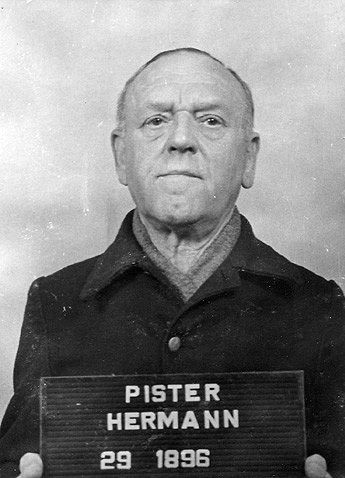
Hermann Pister Last Commandant of Buchenwald

Hermann Pister

Last commandant of Buchenwald (1942–1945), overseeing the camp during its most deadly period including death marches. Under his command, over 10,000 prisoners died of starvation, disease, and executions. He was convicted by a U.S. military tribunal and sentenced to death, but died of a heart attack in 1948 before the sentence could be carried out.

Josef Kramer Commandant of Bergen-Belsen

Josef Kramer

Known as the "Beast of Belsen", he commanded Bergen-Belsen and previously served at Auschwitz-Birkenau where he personally operated the gas chambers. At Bergen-Belsen, he presided over catastrophic conditions — tens of thousands died of typhus, starvation, and overcrowding in the final months of the war. The horrific scenes found by British liberators in April 1945 shocked the world. He was convicted and hanged in December 1945.

Fritz Suhren Commandant of Ravensbrück

Fritz Suhren

Commandant of Ravensbrück, the main concentration camp for women, from 1942 to 1945. Under his command, prisoners were subjected to medical experiments, forced labor, and mass executions. A gas chamber was installed in late 1944. He oversaw the death marches at war's end. Captured by the French, he was convicted and executed in 1950.

Anton Kaindl Last Commandant of Sachsenhausen

Anton Kaindl

Last commandant of Sachsenhausen concentration camp (1942–1945), located near Berlin. Under his command, thousands of prisoners were murdered through shooting, gassing, and lethal injection. He oversaw "Station Z", the camp's execution facility with its own gas chamber. Captured by the Soviets, he was sentenced to life imprisonment and died in a Soviet prison in 1948.

Franz Ziereis Commandant of Mauthausen

Franz Ziereis

Commandant of Mauthausen concentration camp (1939–1945), one of the most brutal camps in the system. Under his command, prisoners were worked to death in the notorious quarry, murdered by being thrown from the "Stairs of Death", and killed in the camp's gas chamber. Over 90,000 prisoners died at Mauthausen. He was shot while fleeing American forces and died during interrogation in May 1945, making a deathbed confession of the camp's atrocities.

Hans Bothmann Commandant of Chełmno (Kulmhof)

Hans Bothmann

Commanded the Chełmno extermination camp, the first Nazi camp where gas was used for mass murder. Victims were killed in specially modified gas vans using engine exhaust. At least 152,000 people, mostly Jews from the Łódź Ghetto, were murdered there. He oversaw the reopening of the camp in 1944 for the liquidation of the Łódź Ghetto. He hanged himself in British custody in 1946.

Max Koegel Commandant of Flossenbürg / Majdanek

Max Koegel

Commandant of Ravensbrück (1940–1942), then Majdanek (briefly), and finally Flossenbürg (1943–1945). At Flossenbürg, prisoners were worked to death in granite quarries and subjected to mass executions. He oversaw the execution of Admiral Canaris and Dietrich Bonhoeffer at Flossenbürg in April 1945. He committed suicide in U.S. custody in June 1946.

Fritz Hartjenstein Commandant of Natzweiler-Struthof

Fritz Hartjenstein

Commandant of Natzweiler-Struthof in Alsace (1942–1944), the only concentration camp on French soil, and later Auschwitz II-Birkenau (May–November 1944). Natzweiler had a gas chamber used for experiments by the Ahnenerbe and for the murder of Jews whose skeletons were intended for a collection at the Reich University of Strasbourg. Sentenced to death by a French military tribunal, the sentence was commuted but he died in prison in 1954.

Max Pauly Commandant of Neuengamme

Max Pauly

Commandant of Neuengamme concentration camp near Hamburg (1942–1945), one of the largest camps in northern Germany with over 80 subcamps. Over 42,000 prisoners died under his command from forced labor, starvation, disease, and executions. He was responsible for the murder of 20 Jewish children who had been subjected to tuberculosis experiments. Convicted by a British military tribunal and hanged in October 1946.

Otto Förschner Commandant of Dora-Mittelbau

Otto Förschner

Commandant of Dora-Mittelbau (1943–1945), the underground camp where prisoners were forced to build V-2 rockets in the Mittelwerk tunnels under inhuman conditions. Thousands died from exhaustion, starvation, and cave-ins in the poorly ventilated tunnels. More people died building the V-2 than were killed by the weapon itself. He was convicted by a U.S. military tribunal at the Dachau trials and hanged in 1946.

Paul-Werner Hoppe Commandant of Stutthof

Paul-Werner Hoppe

Commandant of Stutthof concentration camp near Danzig (1942–1945), the first Nazi camp established outside German borders. Under his command, the camp expanded massively and a gas chamber was installed in 1944. Over 65,000 prisoners died there from forced labor, starvation, typhus epidemics, and gassing. He organized death marches in January 1945. After the war he lived under a false name until arrested in 1953. Sentenced to only 9 years by a West German court in 1957.

Last Commandant of Gross-Rosen

Johannes Hassebroek

Last commandant of Gross-Rosen concentration camp in Lower Silesia (1943–1945), which had over 100 subcamps across the region. Under his command, prisoners were worked to death in stone quarries and armaments factories. He ordered the death marches in early 1945 as the Soviet army approached, during which thousands perished. Over 40,000 prisoners died at Gross-Rosen. Tried by a British military tribunal, he was sentenced to life imprisonment but released in 1954.

Herbert Kappler SS Commander in Rome

Herbert Kappler

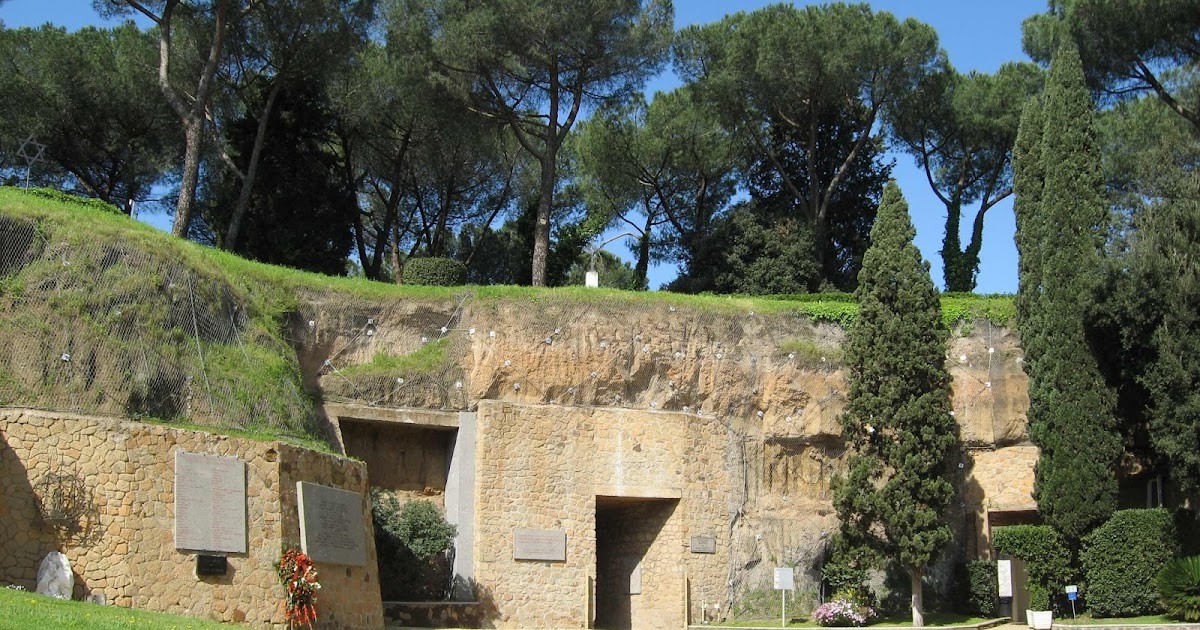
SS-Obersturmbannführer and head of the German Security Police (Sipo-SD) in Rome. Kappler orchestrated the extortion of 50 kg of gold from Rome's Jewish community in September 1943, then organized the roundup of 1,259 Jews from the Rome Ghetto on October 16, 1943 — over 1,000 were deported to Auschwitz, only 16 survived. Five months later, he compiled the death list for the Ardeatine Caves massacre (March 24, 1944), ordering the execution of 335 civilians — including 75 Jews — in reprisal for a partisan attack. Sentenced to life imprisonment in 1948, he escaped from a Rome military hospital in 1977, smuggled out in a suitcase by his second wife. He died in West Germany in 1978.

Erich Priebke SS — Ardeatine Caves Executioner

Erich Priebke

SS-Hauptsturmführer who personally participated in the execution of 335 civilians at the Ardeatine Caves on March 24, 1944, checking names off Kappler's list as each group of five was led into the caves and shot in the back of the head. After the war, he escaped to Argentina through the Vatican Ratlines with documents provided by Bishop Alois Hudal. He lived openly in San Carlos de Bariloche for 50 years — running a delicatessen, serving as president of the German-Argentine cultural association, and giving interviews to local media. In 1994, an ABC News team led by journalist Sam Donaldson confronted him on camera; he admitted his role. Extradited to Italy in 1995, he was sentenced to life imprisonment in 1998. He died under house arrest in Rome on October 11, 2013, at age 100, unrepentant — releasing a final letter defending Nazism. No municipality in Italy, Germany, or Argentina accepted his body for burial.

The Nazi doctors

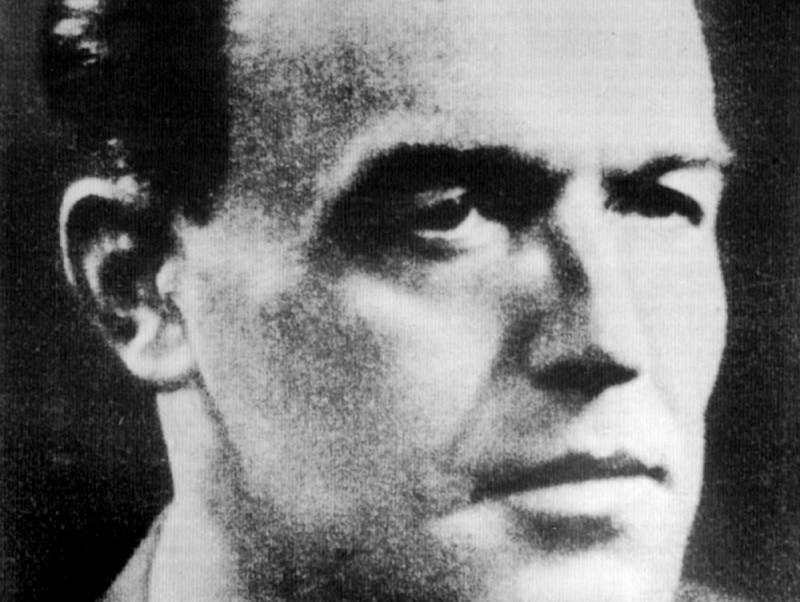
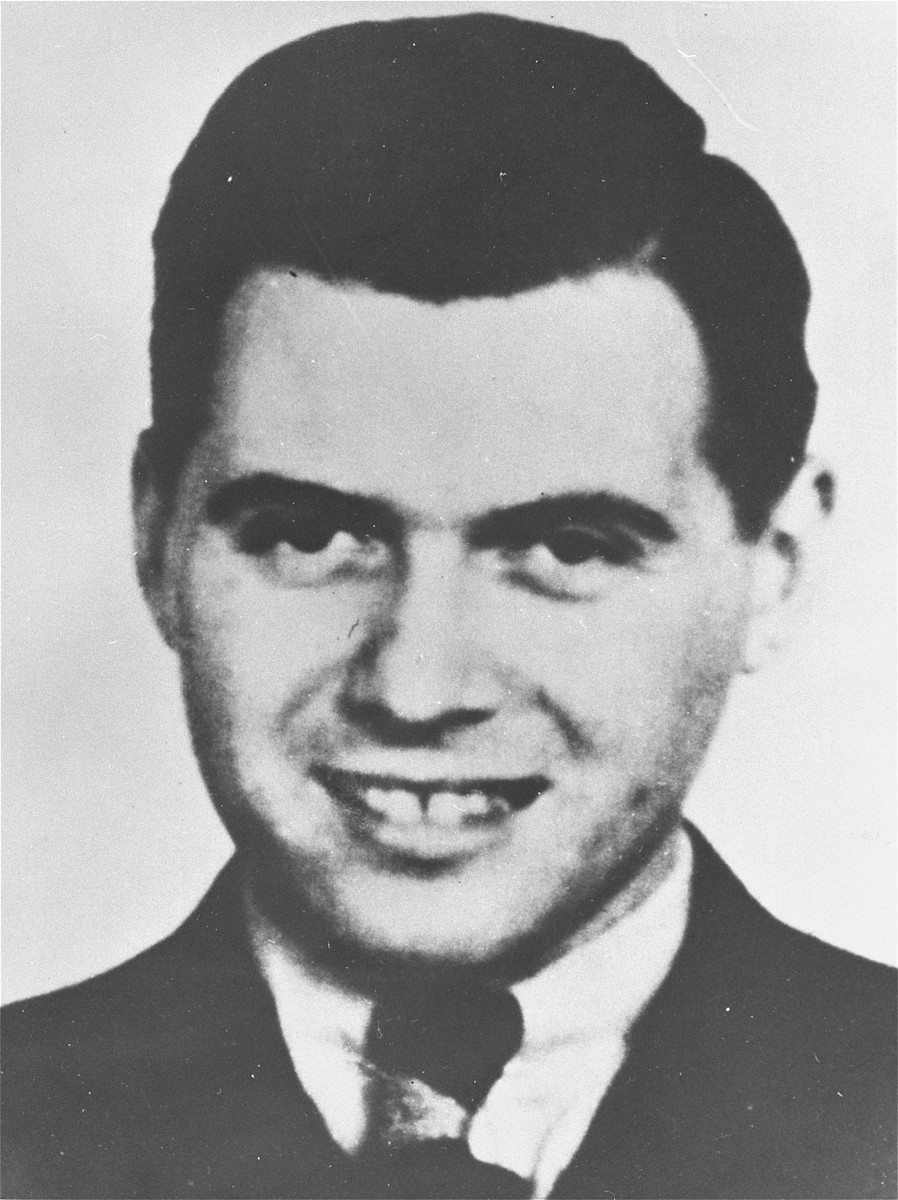
Josef Mengele SS physician — Auschwitz

Josef Mengele

Known as the "Angel of Death", he performed horrific experiments on prisoners, especially twins, dwarfs, and people with physical anomalies. He stood on the selection ramp deciding who lived and who went directly to the gas chambers. He showed particular cruelty toward children, whom he lured with candy before subjecting them to experiments without anesthesia. He fled to South America and drowned in Brazil in 1979, never facing justice.

Josef Mengele joven Young Mengele in SS-Hauptsturmführer uniform — with a doctorate in medicine and a second in anthropology from Munich, he arrived at Auschwitz in May 1943 looking like a matinee idol. Survivors remembered his elegance and his whistling of Wagner arias on the selection ramp.
Karl Gebhardt SS physician — Ravensbrück

Karl Gebhardt

Himmler's personal physician who conducted brutal surgical experiments on women prisoners at Ravensbrück. He deliberately inflicted wounds and infections to test sulfonamide drugs, and performed bone, muscle, and nerve transplant experiments. Many victims were young Polish women known as the "Ravensbrück Rabbits". He was convicted at the Doctors' Trial and hanged in 1948.

Sigmund Rascher SS physician — Dachau

Sigmund Rascher

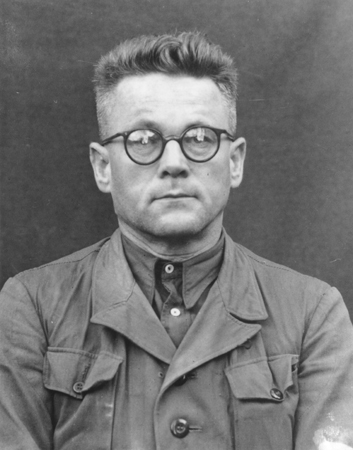
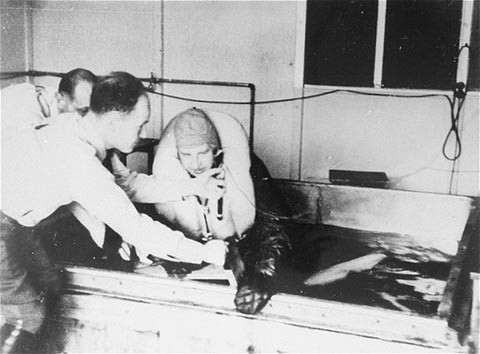
Conducted freezing and high-altitude pressure experiments on prisoners at Dachau for the Luftwaffe. Victims were submerged in ice water for hours or placed in low-pressure chambers simulating extreme altitude until they died. Around 100 prisoners died in the hypothermia experiments alone. He was eventually killed by the SS for unrelated personal crimes.

Karl Brandt Architect of Aktion T4

Karl Brandt

Hitler's personal physician and head of the T4 euthanasia program that murdered over 200,000 people with disabilities — the "rehearsal" for the Holocaust. He authorized the first use of gas chambers to kill people deemed "unworthy of life". Convicted as the principal defendant at the Doctors' Trial in Nuremberg and hanged in 1948.

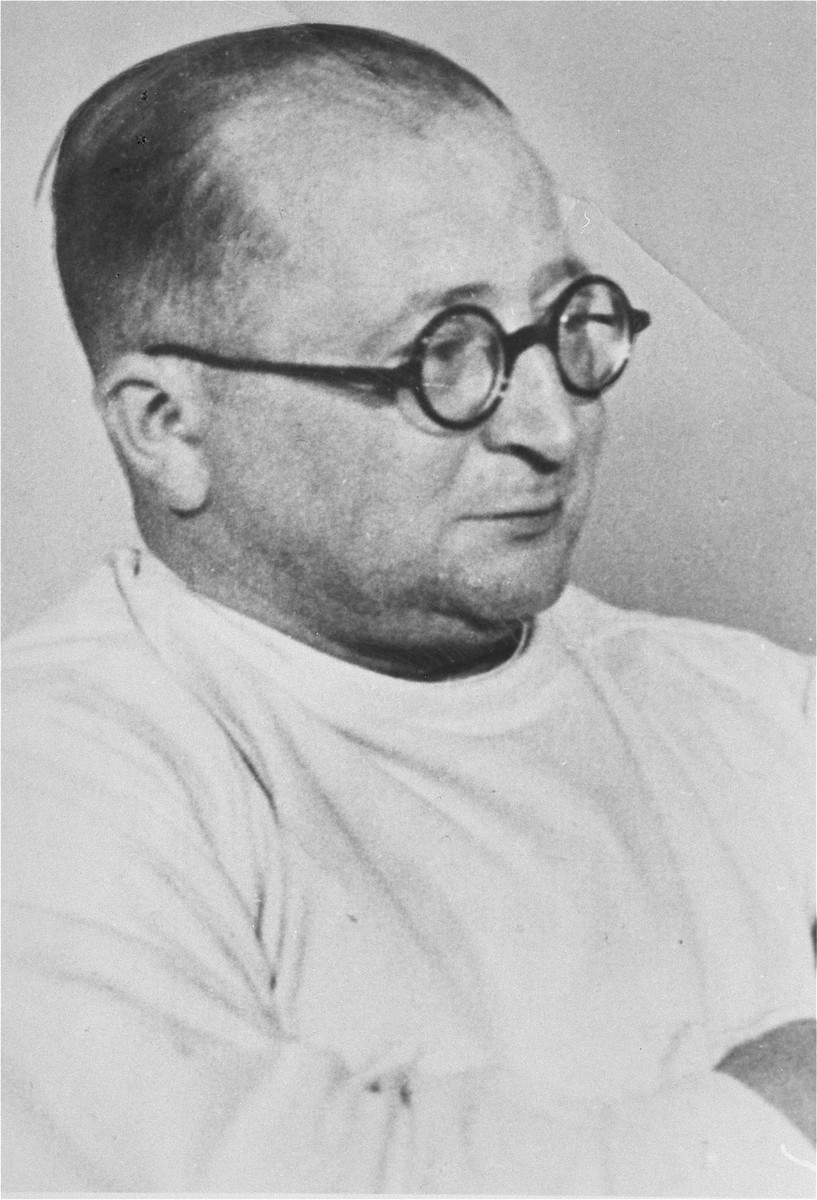
Carl Clauberg SS physician — Auschwitz

Carl Clauberg

Developed mass sterilization methods at Auschwitz, injecting caustic substances into women's uteruses without anesthesia. He aimed to create a method to sterilize 1,000 women per day as part of the Nazi plan to eliminate "inferior" populations. Captured by the Soviets, he was released in 1955 and rearrested in West Germany, where he died before trial in 1957.

Aribert Heim SS physician — Buchenwald

Aribert Heim

Known as "Dr. Death", he performed lethal operations on prisoners at Mauthausen without anesthesia, including removing organs from conscious patients and injecting toxic substances directly into hearts. He fled after the war and lived under a false identity in Egypt, where he died in 1992. His whereabouts remained unknown until 2009.

SS physician — Auschwitz / Grafeneck

Horst Schumann

Began his career in the T4 program killing disabled people, then moved to Auschwitz where he conducted mass sterilization experiments using X-rays on Jewish and Roma prisoners. Victims suffered severe radiation burns, and many died. He fled to Africa after the war, was extradited from Ghana in 1966, but was deemed too ill to stand trial.

The Doctors' Trial — 1946–1947

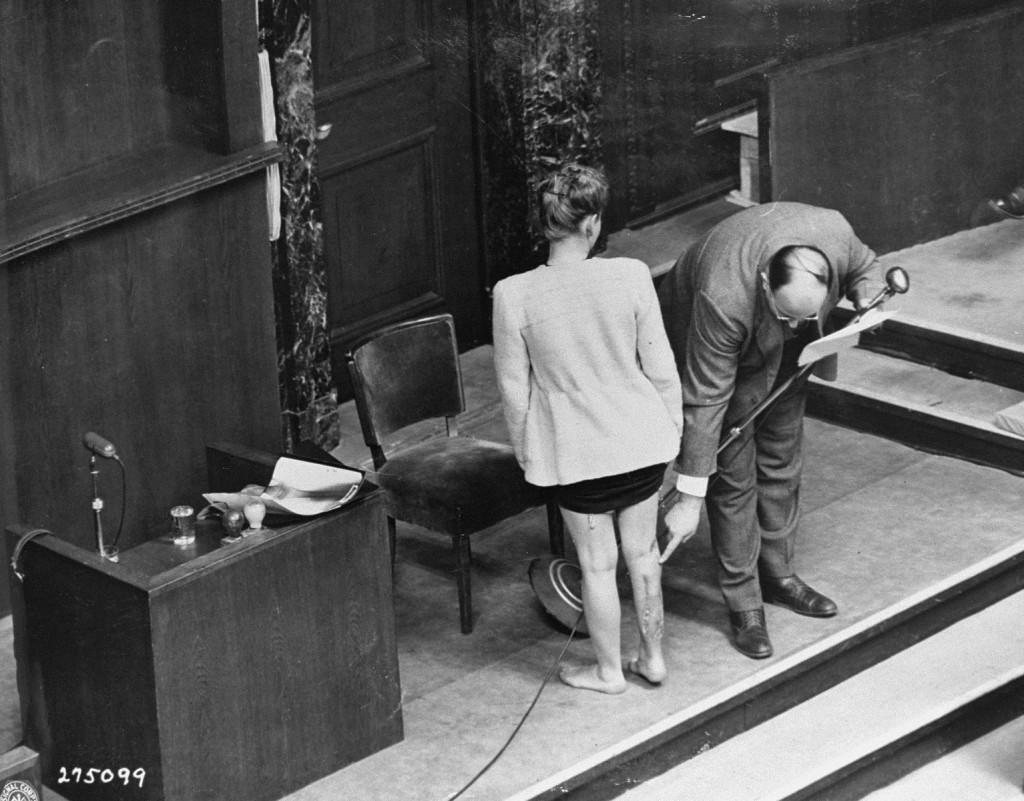
Nuremberg Doctors' Trial

Twenty-three Nazi doctors and officials were tried for crimes against humanity. Seven were sentenced to death and hanged. The trial led to the creation of the Nuremberg Code — ten ethical principles for medical experimentation on humans that remain the foundation of medical ethics today. It established that "voluntary consent of the human subject is absolutely essential".

Justice and trials

1945–1946

Nuremberg Trials

The International Military Tribunal tried 24 major Nazi leaders. Twelve were sentenced to death. These trials established the legal precedent that "following orders" is not a valid defense for crimes against humanity.

1961

Eichmann Trial — Jerusalem

After his capture in Argentina by the Mossad, Adolf Eichmann was tried in Jerusalem. Hannah Arendt covered the trial and coined the concept of the "banality of evil". He was found guilty and executed in 1962.

1963–1965

Frankfurt Auschwitz Trials

Twenty-two former Auschwitz personnel were tried in Frankfurt. These trials confronted German society with the reality of the camps and broke decades of silence.

The legal architecture of genocide

The Holocaust was not a sudden eruption of violence — it was built law by law, decree by decree, over twelve years. More than 2,000 anti-Jewish regulations transformed a modern European democracy into a machinery of exclusion, expropriation, and extermination, all under the veneer of legality.

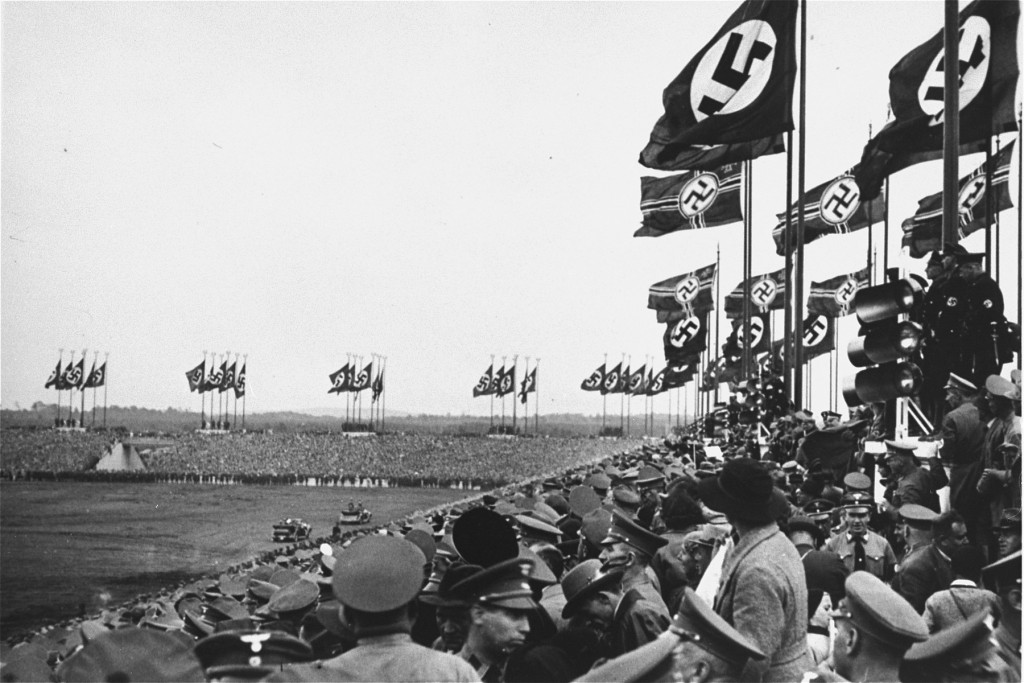
Nuremberg Rally 1935 where the race laws were proclaimed

The Nuremberg Rally, September 1935 — the annual Nazi Party congress where the Reichstag was convened in a special session to unanimously adopt the Nuremberg Race Laws.

1933 — Exclusion begins

April 1, 1933

Boycott of Jewish businesses

The first coordinated anti-Jewish action by the Nazi state. SA stormtroopers stood outside Jewish-owned shops, law offices, and medical practices throughout Germany with signs reading "Deutsche! Wehrt Euch! Kauft nicht bei Juden!" ("Germans! Defend yourselves! Do not buy from Jews!"). The boycott was organized by Julius Streicher and intended to be ongoing, but was called off after one day due to international backlash and German public indifference. Despite its limited duration, it sent an unmistakable signal: Jews were no longer protected by the state.

April 7, 1933

Law for the Restoration of the Professional Civil Service

The first major anti-Jewish law. The "Aryan Paragraph" (§3) excluded anyone of "non-Aryan descent" — defined as having at least one Jewish grandparent — from civil service positions. At Hindenburg's insistence, an exception was made for Jewish war veterans and those who had served since August 1914. This exception was eliminated in 1935. The law became the template: within weeks, similar exclusions were applied to lawyers (April 7), doctors (April 22), patent attorneys, tax consultants, and musicians. By 1933's end, Jews were excluded from journalism (the Editors Law of October 4) and university quotas limited Jewish students to 1.5% of new admissions.

May 10, 1933

Book Burnings (Bücherverbrennungen)

While not a law, the coordinated burning of books by Jewish, leftist, and "degenerate" authors across 34 university cities was organized by the German Student Union with state backing. In Berlin's Opernplatz (now Bebelplatz), 20,000 books were burned as Goebbels declared: "The age of exaggerated Jewish intellectualism has come to an end." Works by Freud, Einstein, Marx, Kafka, Brecht, Heinrich Heine, and Stefan Zweig were destroyed. Heine had written prophetically in 1820: "Where they burn books, they will ultimately burn people too" (Dort, wo man Bücher verbrennt, verbrennt man am Ende auch Menschen).

1934 — The Führerprinzip and the Oath to Hitler

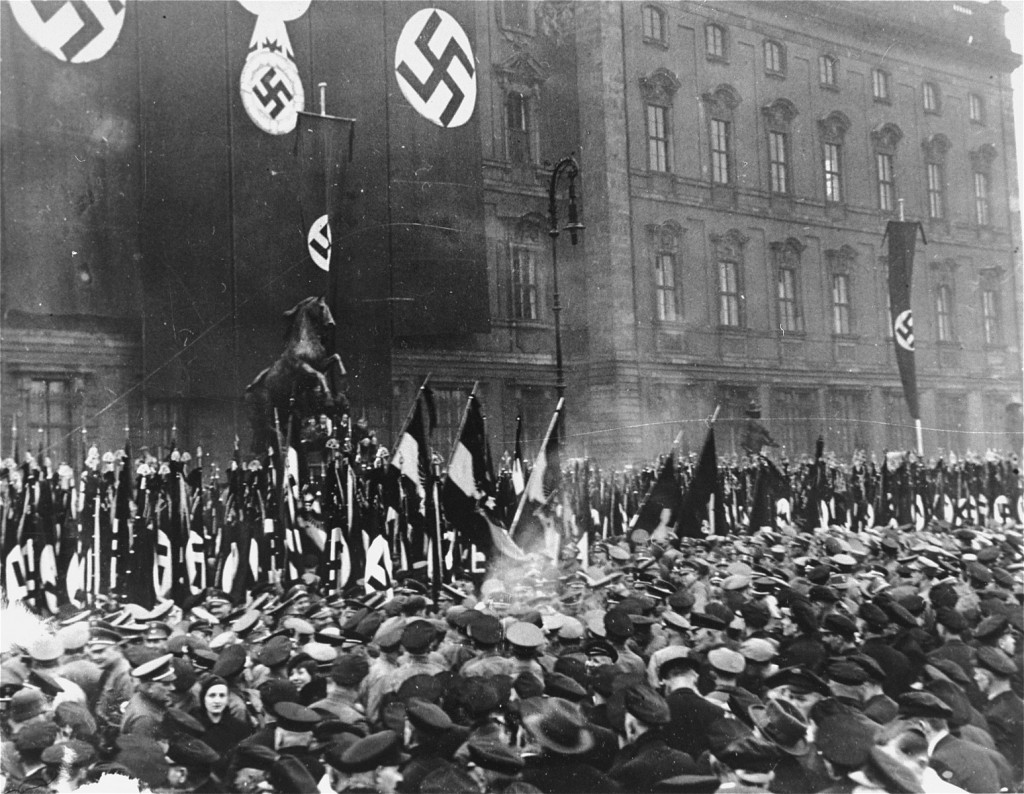
Thousands take an oath of loyalty to Hitler, Berlin, February 25, 1934

In Berlin, thousands of Party officials, Hitler Youth members, and Labor Service leaders take an oath of loyalty read by Rudolf Hess in Munich and broadcast across Germany. February 25, 1934. — USHMM

Core ideology

The Führerprinzip (Leadership Principle)

The Führerprinzip was the foundational political doctrine of the Nazi state. It established that absolute authority flowed downward from the Führer, and absolute obedience flowed upward. There was no separation of powers, no checks or balances, no independent judiciary in matters of state. Every official, from minister to village mayor, was both the unquestioning subordinate of the leader above and the absolute authority over those below. The principle was articulated by Nazi jurist Carl Schmitt and institutionalized by the Nazi Party from the 1920s onward, but it became the operating system of the entire German state after January 30, 1933.

The Führerprinzip was not merely a political theory — it was the mechanism that made the Holocaust possible. It replaced law with the will of the leader. Hitler rarely gave explicit written orders for the most criminal policies; instead, subordinates competed to "work towards the Führer" (dem Führer entgegenarbeiten) — anticipating his desires and radicalizing policy to please him. This "cumulative radicalization," as historian Ian Kershaw described it, meant that genocide could be carried out through initiative from below, guided by broad signals from above, without a single comprehensive written order.

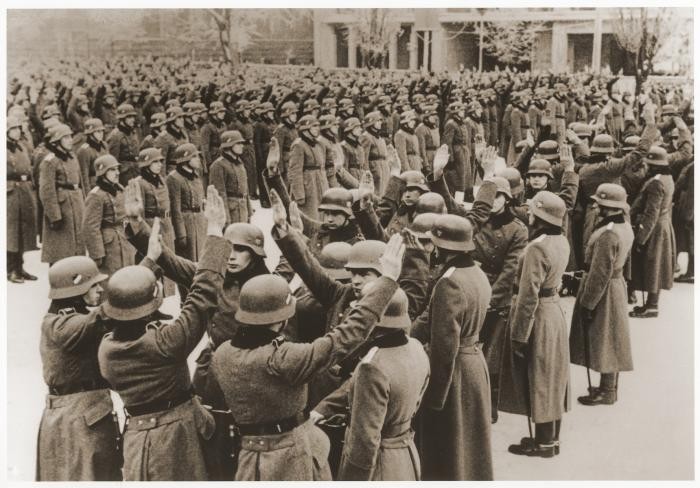
Ethnic German recruits swear allegiance to Adolf Hitler, Poznan, 1940 August 2, 1934

The Führereid (Oath to the Führer)

On August 2, 1934 — the day President Paul von Hindenburg died — Hitler merged the offices of President and Chancellor into one: Führer und Reichskanzler. Within hours, the entire Wehrmacht was ordered to swear a new oath of personal allegiance. The previous Weimar oath had been to the constitution and the nation. The new oath was to one man:

In German (original):

«Ich schwöre bei Gott diesen heiligen Eid, daß ich dem Führer des Deutschen Reiches und Volkes, Adolf Hitler, dem Oberbefehlshaber der Wehrmacht, unbedingten Gehorsam leisten und als tapferer Soldat bereit sein will, jederzeit für diesen Eid mein Leben einzusetzen.»

"I swear by God this sacred oath that I shall render unconditional obedience to the Führer of the German Reich and people, Adolf Hitler, the supreme commander of the armed forces, and that as a brave soldier I shall at all times be prepared to give my life for this oath."

The oath was not a formality — it was a chain. For millions of German soldiers, the Führereid became the moral justification for following criminal orders. At the Nuremberg Trials, defendant after defendant invoked their oath as a defense: "I was bound by my oath." Field Marshal Wilhelm Keitel, who signed orders for the execution of prisoners of war and the Commissar Order, cited his oath. Even officers involved in the July 20, 1944 assassination plot against Hitler — like Colonel Claus von Stauffenberg — had to overcome immense psychological resistance, precisely because breaking the oath was considered a mortal sin against honor.

On August 20, 1934, the oath was extended to all civil servants. By 1935, every public employee in Germany — from judges to teachers to postal workers — had sworn personal loyalty to Adolf Hitler. The Führerprinzip was no longer just ideology: it was now a legally binding personal obligation for every representative of the German state.

1935 — The Nuremberg Laws

September 15, 1935

The Nuremberg Race Laws (Nürnberger Rassengesetze)

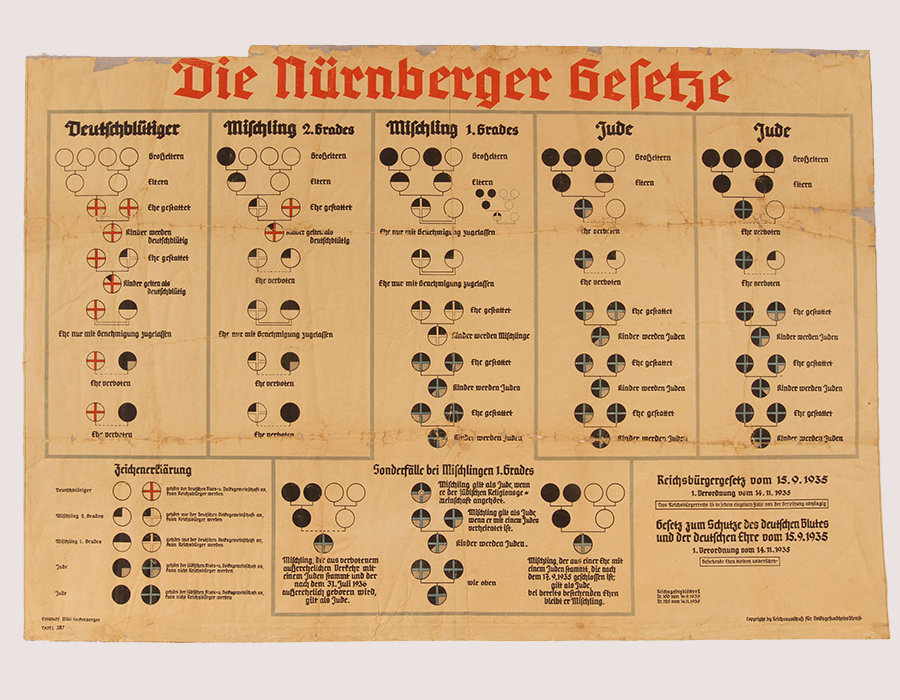
Nuremberg Laws racial classification chart showing categories: German, Mischling, and Jew

Official racial classification chart used to implement the Nuremberg Laws, showing categories of "Deutschblütiger" (German blood), "Mischling" (mixed blood, 1st and 2nd degree), and "Jude" (Jew) based on the number of Jewish grandparents. — U.S. National Archives

Unanimously adopted by the Reichstag at a special session during the annual Nazi Party rally in Nuremberg, the two laws became the legal foundation of racial persecution. The Reichsbürgergesetz (Reich Citizenship Law) stripped Jews of German citizenship, reducing them to "subjects" (Staatsangehörige) with no political rights. Only those of "German or kindred blood" could be Reichsbürger — citizens with full rights. The Blutschutzgesetz (Law for the Protection of German Blood and German Honor) prohibited marriages and sexual relations between Jews and "citizens of German or kindred blood," declared existing such marriages void, forbade Jews from employing female German servants under 45 years of age, and banned Jews from displaying the German flag.

The First Supplementary Decree (November 14, 1935) defined who was a "Jew": anyone with three or more Jewish grandparents, or two Jewish grandparents if they belonged to the Jewish religious community or were married to a Jew. Those with one or two Jewish grandparents were classified as Mischlinge ("mixed blood") — first degree (two grandparents) or second degree (one grandparent). This pseudo-scientific racial taxonomy created an absurd bureaucracy where ancestry determined everything: employment, marriage, property rights, freedom of movement, and ultimately, life or death. Violations of the Blutschutzgesetz — termed Rassenschande ("race defilement") — were punished with imprisonment; the Jewish partner typically received far harsher punishment, often being sent to a concentration camp.

1938 — Kristallnacht and Aryanization

Börnerplatz synagogue burning during Kristallnacht, November 10, 1938

The Börnerplatz Synagogue in Frankfurt burns during Kristallnacht, November 10, 1938. Across Germany, Austria, and the Sudetenland, 1,400 synagogues were destroyed in a single night.

Throughout 1938

The escalation of exclusion

1938 saw a relentless acceleration of anti-Jewish measures. The Decree on the Registration of Jewish Property (April 26) forced Jews to declare all assets exceeding 5,000 Reichsmarks — a prerequisite for systematic theft. The Third Regulation to the Reich Citizenship Law (June 14) required all Jewish businesses to be registered and marked. Jewish doctors were stripped of their licenses (July 25), and Jewish lawyers were barred from practice (September 27). On August 17, all Jews were compelled to add "Israel" (men) or "Sara" (women) to their legal names if they did not already bear a name from an approved list of "Jewish" names. On October 5, Jewish passports were invalidated and reissued stamped with a red "J" — a measure requested by Switzerland to identify and reject Jewish refugees at the border.

November 9–10, 1938

Kristallnacht (The Night of Broken Glass)

The assassination of German diplomat Ernst vom Rath in Paris by Herschel Grynszpan — a 17-year-old Polish-Jewish refugee whose parents had been deported to no-man's-land at the Polish border — gave the regime its pretext. On the night of November 9, Goebbels delivered an incendiary speech at the annual Beer Hall Putsch commemoration in Munich, unleashing what the regime presented as "spontaneous" popular fury. SA, SS, and Hitler Youth burned 1,400 synagogues and prayer houses across Germany, Austria, and the Sudetenland. 7,500 Jewish-owned businesses were destroyed, their windows shattered (hence "Kristallnacht"). Approximately 30,000 Jewish men were arrested and sent to Dachau, Buchenwald, and Sachsenhausen. At least 91 Jews were murdered, though the true number was likely far higher.

November 12, 1938

The punishment of the victims

In a supreme act of perversity, the regime punished the victims for the destruction it had unleashed. At a meeting chaired by Göring on November 12, a series of decrees was issued: the "Atonement Fine" (Sühneleistung) imposed a collective fine of 1 billion Reichsmarks on the entire Jewish community of Germany — for the "damage" caused by the pogrom the state itself had organized. Jewish property owners were required to pay for all repairs to their own buildings. Insurance payments owed to Jews for destroyed property were confiscated by the state. The Decree on the Elimination of Jews from German Economic Life (November 12) banned Jews from operating retail stores, selling goods or services, and working as independent craftsmen — effective January 1, 1939. Jewish children were expelled from all public schools (November 15). Jews were banned from theaters, cinemas, concerts, and exhibitions (November 12). Kristallnacht marked the transition from discrimination to outright expropriation — Aryanization became mandatory and total.

1939–1941 — Wartime radicalization

1939–1941

From exclusion to confinement

With the invasion of Poland on September 1, 1939, anti-Jewish measures escalated from exclusion to physical confinement and violence. The Decree on the Deployment of Jewish Property (December 3, 1938) had already authorized forced Aryanization of Jewish businesses. Now, Jews in Germany were subjected to a curfew (September 1939), had their radios confiscated (September 20, 1939), and received reduced food rations. The Decree on the Restriction of Jewish Residence (September 21, 1939) authorized the concentration of Jews in designated areas — the legal basis for ghettoization in occupied Poland. On February 6, 1940, Jews lost their clothing ration cards. On July 19, 1940, their telephone lines were disconnected.

September 1, 1941

The Yellow Star (Judenstern)

The Police Decree on the Marking of Jews (September 1, 1941) required all Jews over the age of six in the Reich to wear a yellow Star of David — "Jude" inscribed in mock-Hebrew lettering — sewn to the left side of the chest, visible at all times in public. Failure to wear the star was punishable by fine, imprisonment, or deportation. The star had already been imposed in occupied Poland since November 1939; its extension to Germany proper was both a tool of control and a mark of social death. It made every Jew visible, identifiable, and vulnerable — and it made every non-Jew a witness. The star completed the transformation: Jews were no longer merely excluded citizens, they were marked prey. Within weeks of the decree, the first deportation transports from the Reich to the ghettos of the East began.

November 25, 1941

The Eleventh Decree — Property seizure and deportation

The Eleventh Decree to the Reich Citizenship Law completed the legal framework for genocide: any Jew who "takes up habitual residence abroad" — including being deported to a ghetto or death camp — automatically lost German nationality and all property, which was "forfeited to the Reich." The deportees were thus legally stripped of citizenship and robbed of everything they owned the moment they crossed the border. Even their train tickets were paid for with their own confiscated assets. By 1943, the Thirteenth Decree extended this principle, declaring that upon a Jew's death, all property automatically reverted to the state. The Nazis had legalized theft at every stage: exclusion from professions (1933), forced registration of assets (1938), Aryanization (1938–39), and now automatic confiscation upon deportation or death. The machinery of murder was also a machinery of plunder.

Collaboration and complicity

The Holocaust was not carried out by Germany alone. Across occupied and allied Europe, governments, institutions, police forces, and individuals collaborated in the identification, persecution, deportation, and murder of Jews. The degree and nature of collaboration varied — from enthusiastic participation to bureaucratic complicity — but the result was the same: without local collaboration, the scale of the genocide would not have been possible.

Jews detained at the Vel d'Hiv roundup, Paris, July 1942

Jews detained during the Vel d'Hiv roundup, Paris, July 16-17, 1942. French police arrested 13,152 Jews — including 4,115 children — on behalf of the German occupiers.

Ustaše militia execute prisoners near Jasenovac

Ustaše militia execute prisoners near the Jasenovac concentration camp, Croatia. Between 77,000 and 100,000 people — Serbs, Jews, and Roma — were murdered at Jasenovac.

State collaboration

Vichy France

1940–1944

Following France's defeat and armistice in June 1940, Marshal Philippe Pétain established the État français at Vichy — a collaborationist regime that governed the unoccupied southern zone and maintained nominal sovereignty over the French colonial empire. Without German pressure, the Vichy government enacted its own Statut des Juifs (October 3, 1940) — drafted by Raphaël Alibert and personally hardened by Pétain — which defined Jews by racial rather than religious criteria, barred them from public service, teaching, journalism, and the military, and confiscated Jewish-owned businesses and property through the Commissariat général aux questions juives, headed first by Xavier Vallat and then by the virulently antisemitic Darquier de Pellepoix. The French police and gendarmerie became the primary instruments of persecution. On July 16–17, 1942, in the most infamous act of French collaboration, over 9,000 French police officers carried out the Vel d'Hiv roundup (Rafle du Vélodrome d'Hiver): 13,152 Jews — including 4,115 children — were arrested in Paris and held in the Vélodrome d'Hiver cycling stadium under inhuman conditions before being sent to Drancy and then Auschwitz. The children — French-born citizens — were separated from their parents at Vichy's initiative and deported in separate convoys to be gassed upon arrival. René Bousquet, secretary general of the police, negotiated these operations directly with the SS. In total, 75,721 Jews were deported from France; fewer than 2,500 returned. The French state's role was denied for decades under the Gaullist myth that 'Vichy was not France' until President Jacques Chirac's historic speech of July 16, 1995, in which he acknowledged: 'France, the homeland of the Enlightenment... committed the irreparable.' Bousquet was assassinated in 1993 before his trial; Maurice Papon, a senior Vichy official responsible for deportations from Bordeaux, was convicted of crimes against humanity in 1998 at age 87.

State collaboration

Romania — Antonescu regime

1940–1944

Under Marshal Ion Antonescu's military dictatorship — allied with Nazi Germany from November 1940 — Romania became the second-largest perpetrator of the Holocaust after Germany itself. Romanian forces carried out their own genocide with a ferocity that sometimes shocked even German observers. The violence began immediately with Romania's entry into Operation Barbarossa in June 1941. On June 29, 1941, Romanian and German soldiers perpetrated the Iași pogrom: between 13,266 and 14,850 Jews were murdered in the city and in the subsequent 'death trains' — sealed cattle cars that traveled aimlessly for days in the summer heat, packed with victims who died from suffocation, thirst, and heat. At one stop, 1,194 out of 2,530 passengers were found dead. In Odessa, after a partisan bombing of Romanian military headquarters on October 22, 1941, Antonescu ordered massive reprisals: over 25,000 Jews were shot, hanged, or burned alive in warehouses in the following days (the Odessa massacre). Romanian forces then deported 154,000–170,000 Jews from Bessarabia and Bukovina into Transnistria, where an estimated 90,000–120,000 perished in camps like Bogdanovka, Domanevka, and Vapniarka. The Romanian gendarmerie carried out these deportations and killings without German direction. However, in a paradox of the Romanian Holocaust, Antonescu resisted German pressure to deport the approximately 292,000 Jews of the Regat (Old Kingdom Romania) and southern Transylvania to the Nazi death camps — partly due to shifting military fortunes after Stalingrad, partly due to interventions by Queen Mother Elena, the Swiss ambassador René de Weck, and the papal nuncio Andrea Cassulo. This inconsistency meant that while Romania murdered more Jews than any country except Germany, a significant Jewish community survived in Bucharest. In total, between 280,000 and 380,000 Jews under Romanian authority were murdered. Antonescu was overthrown on August 23, 1944, tried by a People's Tribunal, and executed on June 1, 1946. Romania's official acknowledgment came in 2004 with the International Commission on the Holocaust in Romania (Wiesel Commission).

State collaboration

Hungary — Horthy and the Arrow Cross

1938–1945

Hungary's path through the Holocaust was distinctive: antisemitic legislation began early (the First and Second Jewish Laws of 1938–1939 restricted Jewish economic and professional participation), and the munkaszolgálat (forced labor service) sent tens of thousands of Jewish men to the Eastern Front, where approximately 42,000 perished. Yet Hungary's 825,000 Jews remained largely intact until March 19, 1944, when Germany launched Operation Margarethe and occupied its own ally. Within hours of the occupation, Adolf Eichmann arrived in Budapest with a small team and, with the enthusiastic cooperation of the Hungarian gendarmerie under László Endre and László Baky, organized the fastest mass deportation of the entire Holocaust. Between May 15 and July 9, 1944 — just 56 days — 437,402 Jews were deported from the Hungarian provinces in 147 trains to Auschwitz-Birkenau, where the vast majority were gassed immediately. The Hungarian gendarmerie, not the SS, carried out the roundups with extreme brutality — concentrating Jews in brick factories, stripping them of possessions, and beating them. Regent Miklós Horthy halted the deportations on July 7, 1944, under international pressure (including the Auschwitz Protocols, papal interventions, and threats from Roosevelt and the King of Sweden), saving Budapest's approximately 200,000 Jews — temporarily. After the Arrow Cross coup of October 15, 1944, under Ferenc Szálasi, the terror intensified: Arrow Cross militiamen roamed Budapest, dragging Jews from protected houses to the banks of the Danube, where they were shot and their bodies fell into the river — an estimated 10,000–15,000 were murdered this way. Approximately 76,000 Budapest Jews were forced on death marches toward Austria in November 1944. Raoul Wallenberg (Sweden), Carl Lutz (Switzerland), Angelo Rotta (Vatican), and Giorgio Perlasca (Italy) saved tens of thousands through protective passes and safe houses. Of Hungary's 825,000 Jews, approximately 565,000 were murdered. Szálasi was executed in 1946; Endre and Baky were hanged in 1946.

State collaboration

Croatia — the Ustaša regime

1941–1945

The Independent State of Croatia (Nezavisna Država Hrvatska, NDH), established in April 1941 as a puppet state under Ante Pavelić's fascist Ustaša movement, was the most murderous of all Axis satellite states. The Ustaša ideology targeted Serbs, Jews, and Roma for elimination — a program of ethnic cleansing and genocide that operated largely independently of the Nazi apparatus. Within weeks of taking power, the Ustaša enacted racial laws modeled on the Nuremberg Laws, established a network of concentration camps, and began mass killings. The Jasenovac camp complex — comprising five camps along the Sava River south of Zagreb — became the third-largest concentration camp in Europe and the largest not operated directly by the Germans. Under commandants Vjekoslav 'Maks' Luburić and Miroslav Filipović (a Franciscan friar known as 'Brother Satan'), Jasenovac became a site of killings of extraordinary savagery — victims were murdered with knives, hammers, axes, and a specially designed curved blade called a srbosjek ('Serb-cutter'). Killing competitions were held among guards. Between 77,000 and 100,000 people were murdered at Jasenovac: Serbs, Jews, Roma, and Croatian political opponents. In total, the Ustaša murdered approximately 30,000 of Croatia's 39,000 Jews (77%), between 320,000 and 340,000 Serbs, and virtually all of Croatia's Roma population (approximately 16,000–25,000). The Catholic Church's role was deeply compromised: Archbishop Alojzije Stepinac initially welcomed the NDH state, and Franciscan friars actively participated in killings — most notoriously at Jasenovac and during the forced conversions of Serbs. Pavelić escaped via the Vatican ratlines to Argentina in 1948, then to Spain, where he died in 1959 — never brought to justice. Luburić was assassinated in Spain in 1969 by a Yugoslav agent. Stepinac was tried and imprisoned in 1946; his subsequent beatification by Pope John Paul II in 1998 remains deeply controversial.

State collaboration

Slovakia — the Tiso regime

1939–1945

The Slovak Republic under President Jozef Tiso — a Catholic priest and leader of the Hlinka Slovak People's Party — became the first Axis ally to agree to deport its own Jewish citizens, and the only country to pay Germany for the privilege: 500 Reichsmarks per deportee as a 'resettlement fee,' with the understanding that the deported Jews would never return or claim their confiscated property. The 'Jewish Code' (Židovský kódex) of September 1941 was one of the most comprehensive antisemitic legal frameworks outside Germany — 270 articles that defined Jews racially, stripped them of citizenship, property, and rights, and mandated forced labor. Between March and October 1942, approximately 57,628 Slovak Jews were deported — roughly two-thirds of the community — primarily to Auschwitz and the Lublin district. Fewer than 300 survived. The Working Group (Pracovná skupina), a clandestine Jewish rescue committee led by Rabbi Michael Dov Weissmandl and Gisi Fleischmann, managed to temporarily halt the deportations in late 1942 through bribing SS-Hauptsturmführer Dieter Wisliceny with $50,000. They proposed the 'Europa Plan' — paying the SS $2–3 million to halt all deportations across Europe — but the plan ultimately failed. After the Slovak National Uprising (August 1944) and direct German occupation, a second wave of deportations (1944–1945) sent approximately 13,500 more Jews to their deaths. Alois Brunner was dispatched to Slovakia to accelerate the process. Fleischmann was deported to Auschwitz and murdered; Weissmandl escaped from a deportation train. In total, approximately 70,000 of Slovakia's 89,000 Jews were murdered. Tiso was tried by a Czechoslovak National Court and hanged on April 18, 1947 — the only head of state executed for Holocaust complicity.

Collaboration and resistance

The Netherlands

1940–1945

The Netherlands suffered the highest Jewish death rate in Western Europe: of approximately 140,000 Jews, over 102,000 were murdered — 75%. This devastating proportion resulted from a combination of factors unique to the Dutch case. The country's meticulous civil registry (Bevolkingsregister) — one of the most detailed in Europe — made the identification and tracking of Jews terrifyingly efficient. Dutch municipal officials, with few exceptions, compiled and handed over the registration data. The Dutch police and railway workers cooperated in arrests and transports. The NSB (Nationaal-Socialistische Beweging) provided a corps of ideological collaborators who served as camp guards and denounced hidden Jews. Higher SS and Police Leader Hanns Albin Rauter administered the persecution with Germanic thoroughness. The flat geography offered few hiding places, and the population density made concealment dangerous. However, the Dutch record was not solely one of collaboration: an estimated 25,000–30,000 Jews went into hiding (onderduikers), sheltered by approximately 60,000 Dutch helpers — more than in any other Western European country. The February Strike (Februaristaking) of February 25, 1941, in Amsterdam — a general strike protesting the first roundups of Jews — remains the only mass public protest against Jewish persecution in occupied Western Europe. Yet the strike was quickly suppressed, and the deportations proceeded. Amsterdam's Jewish quarter (Jodenbuurt) was emptied systematically. Of the hidden Jews, approximately 8,000–9,000 were betrayed and captured — Anne Frank's family among them, arrested on August 4, 1944, likely through an informant. The proportion of betrayals was high, driven by bounties of 7.50 guilders per Jew delivered to the authorities. After the war, the Netherlands was slow to confront its record: full acknowledgment came only in 2000, when Prime Minister Wim Kok recognized the 'cold reception' given to surviving Jews upon their return.

Collaboration

The Baltic States

1941–1944

Lithuania, Latvia, and Estonia witnessed some of the most rapid and complete destructions of Jewish communities in all of Europe — driven by a lethal combination of German Einsatzgruppen operations and extensive local collaboration. In Lithuania, which had a Jewish community of approximately 208,000, local collaborators played a decisive role from the very first days. Even before the Wehrmacht arrived, Lithuanian activists (the Lithuanian Activist Front) launched pogroms: the Kaunas pogrom of June 25–29, 1941, saw Lithuanian partisans murder approximately 3,800 Jews at the Lietūkis garage and the Seventh Fort — some beaten to death with iron bars while crowds watched and applauded. The subsequent operations of Einsatzkommando 3, under SS-Standartenführer Karl Jäger, relied heavily on Lithuanian auxiliary police battalions, particularly the notorious Ypatingasis būrys (Special Squad) in Vilna and the Tautinio Darbo Apsaugos (TDA) units. Jäger's meticulous report of December 1, 1941, listed the execution of 137,346 people — mostly Jews — with dates, locations, and exact numbers. By the end of 1941, most Lithuanian Jews outside the ghettos of Vilna, Kaunas, and Šiauliai had been murdered. In total, approximately 195,000 of Lithuania's 208,000 Jews were killed — over 94%. In Latvia, the Arājs Kommando — a Latvian auxiliary police unit commanded by Viktors Arājs — participated in the murder of approximately 26,000 Jews, including the Rumbula massacre (November 30 and December 8, 1941), where 25,000 Jews from the Riga ghetto were shot. Approximately 70,000 of Latvia's 83,000 Jews were murdered — 85%. In Estonia, which had the smallest Jewish population (approximately 4,300), the majority fled with the Soviet retreat; of the approximately 1,000 who remained, virtually all were killed by Einsatzgruppe A and Estonian collaborators by early 1942. Estonia was declared 'judenfrei' in January 1942. The postwar reckoning in the Baltic states has been complicated by the 'double genocide' narrative, which equates Soviet and Nazi crimes and has been used to obscure local participation in the Holocaust.

Collaboration — Latvia

The Arājs Kommando & Viktor Cukurs

Latvia, 1941–1944

The Arājs Kommando was a Latvian auxiliary police unit formed in July 1941 by Viktors Arājs, a former law student and minor police official. Operating under the direct authority of the German SD and Einsatzgruppe A, the unit grew from approximately 100 initial volunteers to over 1,200 men. The Kommando's first major action was the burning of Riga's Great Choral Synagogue on July 4, 1941, with Jewish men locked inside — an act carried out on the unit's own initiative, before formal German orders. Over the following months, the Arājs Kommando became one of the most prolific killing units in the Holocaust: they participated in the murder of approximately 26,000 Jews across Latvia, including mass shootings in the Biķernieki forest and the Rumbula massacre of November 30 and December 8, 1941, where approximately 25,000 Jews from the Riga ghetto were systematically shot at prepared pits. The unit also operated in Belarus, conducting anti-partisan operations that were in reality the mass murder of Jewish communities. Arājs himself oversaw executions personally and was observed shooting victims at close range. After the war, he fled to West Germany under a false name, living undiscovered until 1975. He was tried by a Hamburg court in 1979 and sentenced to life imprisonment, dying in prison in 2004. Among the most notorious members of the Kommando was Herberts Cukurs (known as Viktor Cukurs), a pre-war Latvian aviation hero celebrated for a solo flight from Riga to Gambia in 1933. During the German occupation, Cukurs actively participated in the burning of the Riga synagogue and in mass executions of Jews, personally shooting victims and leading groups of Jews to execution sites. Survivors testified that Cukurs tortured Jewish prisoners, beat women and elderly people, and participated with particular cruelty in the liquidation of the Riga ghetto. After the war, Cukurs fled through France to Brazil, settling in São Paulo where he operated a small aviation business. Despite being identified by survivors and named in multiple war crimes investigations, he evaded justice for two decades. In 1965, Israeli Mossad agents, operating under the codename 'Operation Donauvörth,' lured Cukurs to Montevideo, Uruguay, with a fake business proposal. On February 23, 1965, Mossad agents executed him in a house in the Shangrilá neighborhood. They left his body in a trunk with a note reading: 'Considering his personal responsibility for the murder of 30,000 men, women, and children, Herberts Cukurs has been executed.' The Cukurs case became a symbol of how the passage of time could not erase the crimes of the Holocaust — and of how justice, whether through courts or through the actions of those who refused to forget, eventually found the perpetrators.

The geography of horror

From forced confinement in ghettos to systematic extermination in death camps, the Nazi regime built an unprecedented infrastructure of persecution and murder across occupied Europe.

Concentration camps

Aerial view of Dachau concentration camp

Aerial photograph of Dachau concentration camp, the first Nazi camp (est. March 22, 1933) and the prototype for the entire camp system. U.S. Army Air Force reconnaissance.

Concentration camp

Dachau

Germany — 1933–1945

The first Nazi concentration camp, established on March 22, 1933, just weeks after Hitler became Chancellor, in a former munitions factory northwest of Munich. Originally created to hold political opponents — communists, social democrats, trade unionists — it became the prototype for the entire concentration camp system. SS-Oberführer Theodor Eicke, its second commandant (June 1933–July 1934), created the Dachau model: the rigid system of rules, punishments, prisoner hierarchies, and guard protocols that would be replicated in every subsequent camp. Eicke was later appointed Inspector of Concentration Camps, exporting Dachau's blueprint across the Reich. Other commandants included Alexander Reiner, Heinrich Deubel, Hans Loritz, Alex Piorkowski, Martin Weiss, and finally Eduard Weiter (1943–1945). Over 200,000 prisoners from more than 30 countries passed through Dachau and its 140+ subcamps. Prisoners were subjected to forced labor, starvation, medical experiments (including hypothermia, high-altitude, and malaria experiments by Dr. Sigmund Rascher and Dr. Claus Schilling), and random executions. Over 41,500 people died here. Liberated by the U.S. 42nd and 45th Infantry Divisions on April 29, 1945 — the liberating soldiers were so horrified by what they found, including 39 railcars full of decomposing corpses, that some executed SS guards on the spot in what became known as the Dachau massacre.

Concentration camp

Buchenwald

Germany — 1937–1945

Established in July 1937 on the Ettersberg hill near Weimar — the city of Goethe and Schiller, a bitter irony the Nazis either ignored or relished. Its first commandant was SS-Oberführer Karl-Otto Koch (1937–1941), whose wife Ilse Koch became infamous as the 'Witch of Buchenwald' for allegedly collecting tattooed human skin. Koch was succeeded by Hermann Pister (1942–1945). The camp held political prisoners, Jews, Roma, homosexuals, Jehovah's Witnesses, Soviet POWs, and common criminals. Over 280,000 prisoners passed through Buchenwald and its 139 subcamps. Prisoners were forced to work in armament factories and quarries. Medical experiments included testing vaccines for typhus, typhoid, and cholera on prisoners. The camp had an internal resistance organization led by communist prisoners that played a crucial role in the final days. Over 56,000 people died from executions, medical experiments, starvation, and brutal forced labor. Liberated on April 11, 1945 by the U.S. 6th Armored Division and the 80th Infantry Division, though the underground prisoner resistance had already seized partial control of the camp. General Eisenhower ordered German civilians from nearby Weimar to walk through the camp and witness the atrocities their government had committed.

Concentration camp

Ravensbrück

Germany — 1939–1945

The largest concentration camp primarily for women, established in May 1939 near Fürstenberg, 90 km north of Berlin. Commandants: SS-Hauptsturmführer Max Koegel (1939–1942) and SS-Sturmbannführer Fritz Suhren (1942–1945). Around 132,000 women and 20,000 men passed through the camp and its over 40 subcamps. Prisoners included political opponents, Jehovah's Witnesses, Roma, 'asocials,' Jews, and resistance fighters from across occupied Europe. The camp served as a training ground for female SS guards (Aufseherinnen), including Irma Grese and Dorothea Binz. Forced labor included textile production for the SS and armament work for Siemens. Medical experiments were conducted by Dr. Karl Gebhardt on Polish women — the 'Ravensbrück Rabbits' (Króliki) — testing sulfonamide drugs by deliberately inflicting wounds and infecting them with bacteria. In late 1944, a gas chamber was constructed, where between 5,000 and 6,000 women were gassed in the final months. An estimated 28,000–50,000 prisoners died. Liberated by the Red Army on April 30, 1945. Suhren fled, was captured by the French, and executed in 1950.

Concentration camp

Mauthausen

Austria — 1938–1945

Classified as a 'Grade III' camp (Stufe III) — the harshest category, reserved for 'incorrigible' prisoners, meaning it was designed to kill through labor. Established in August 1938 near Linz, Austria, shortly after the Anschluss, on a site chosen for its granite quarries. Commandants: SS-Oberführer Albert Sauer (1938–1939), Franz Ziereis (1939–1945). Ziereis ruled with extreme brutality for nearly six years. The infamous 'Stairs of Death' (Todesstiege) — 186 stone steps leading from the Wiener Graben quarry — became a symbol of the camp's horror: prisoners were forced to carry granite blocks weighing up to 50 kg up the steps, and guards regularly pushed exhausted prisoners off the cliff edge, calling them 'parachutists.' Mauthausen and its 49 subcamps (including Gusen, which some historians consider even more lethal) held approximately 190,000 prisoners, including Spanish Republicans captured in France, Soviet POWs, Jews, and resistance fighters from across Europe. Over 90,000 people perished. Liberated by the U.S. 11th Armored Division on May 5, 1945. Ziereis was shot while fleeing and died on May 24, 1945, after giving a partial confession.

Concentration camp

Bergen-Belsen

Germany — 1940–1945

Originally a POW camp (Stalag XI-C) where over 18,000 Soviet prisoners died of starvation in 1941–42. Converted to a concentration camp in April 1943 under SS-Hauptsturmführer Adolf Haas (1943–1944), then SS-Hauptsturmführer Josef Kramer (1944–1945) — the 'Beast of Belsen.' Initially designated as an 'exchange camp' for Jews with foreign passports who might be traded for German POWs. From late 1944, as the Eastern Front collapsed, tens of thousands of evacuees from other camps — including from Auschwitz — were crammed into Bergen-Belsen without food, water, or sanitation. The camp became an apocalyptic hellscape of disease: typhus, typhoid, and dysentery killed thousands weekly. Anne Frank and her sister Margot, transferred from Auschwitz, died of typhus in February–March 1945. When the British 11th Armoured Division liberated the camp on April 15, 1945, they found 60,000 emaciated prisoners and 13,000 unburied corpses. Over 52,000 people died here — most in the final months. The liberating troops forced captured SS guards to bury the dead. Kramer was tried, convicted, and hanged on December 13, 1945.

Concentration camp

Sachsenhausen

Germany — 1936–1945

Established in July 1936 in Oranienburg, 35 km north of Berlin, designed as the 'ideal' concentration camp — its triangular layout allowed guards in a single tower to oversee the entire compound. Located adjacent to the Inspectorate of Concentration Camps (IKL), it served as both a functioning camp and the administrative model for the entire system. Commandants: Karl-Otto Koch (1936–1937), Hans Helwig (1937–1938), Hermann Baranowski (1938–1940), Hans Loritz (1940–1942), Anton Kaindl (1942–1945). Over 200,000 prisoners passed through, including political opponents, Jews, homosexuals, Roma, and Soviet POWs. The camp housed Operation Bernhard — a counterfeiting scheme using Jewish prisoners to forge British banknotes. In autumn 1941, over 10,000 Soviet POWs were executed in the 'Station Z' killing facility using a specially designed neck-shooting device (Genickschussanlage). Over 30,000 prisoners died. Liberated by Soviet and Polish troops on April 22–23, 1945, after SS guards had forced 33,000 prisoners on a death march days earlier. Kaindl was tried by a Soviet military tribunal and sentenced to life imprisonment; he died in Vorkuta in 1948.

Concentration camp

Neuengamme

Germany — 1938–1945

Established in December 1938 as a subcamp of Sachsenhausen in the marshlands southeast of Hamburg, it became an independent camp in June 1940. Commandant: SS-Oberführer Max Pauly (1942–1945). Over 100,000 prisoners from across Europe passed through Neuengamme and its 85+ subcamps, forced to work in brick production, armaments, and clearing rubble from Allied bombing. Medical experiments were conducted on prisoners, including tuberculosis tests on children — 20 Jewish children were transported to the Bullenhuser Damm school in Hamburg and murdered on April 20, 1945 to destroy evidence. Over 42,900 prisoners died. As the British advanced, the SS evacuated prisoners onto ships in Lübeck Bay — the Cap Arcona, the Thielbek, and the Athen. On May 3, 1945, the RAF, unaware the ships held prisoners, bombed them; over 7,000 prisoners burned or drowned in one of the war's worst friendly-fire tragedies. Pauly was tried by a British military tribunal and hanged on October 8, 1946.

Concentration camp

Flossenbürg

Germany — 1938–1945

Established in May 1938 near the Czech border in Bavaria, built around granite quarries owned by the SS-controlled Deutsche Erd- und Steinwerke (DESt). Commandants: SS-Sturmbannführer Jakob Weiseborn (1938–1939), Karl Künstler (1939–1943), Max Koegel (1943–1945). Over 100,000 prisoners passed through the camp and its 97 subcamps, forced into quarry labor and later armaments production for Messerschmitt. The camp held political prisoners, Jews, Soviet POWs, and homosexuals. On April 9, 1945, just weeks before liberation, Admiral Wilhelm Canaris, General Hans Oster, and the theologian Dietrich Bonhoeffer — all members of the anti-Hitler resistance — were hanged here on Hitler's direct orders. Over 30,000 prisoners died. Liberated by the U.S. 90th and 97th Infantry Divisions on April 23, 1945. Koegel committed suicide in June 1946 before his trial.

Concentration camp

Mittelbau-Dora

Germany — 1943–1945

Established in August 1943 as a subcamp of Buchenwald near Nordhausen in the Harz mountains, it became independent in October 1944. Commandant: SS-Obersturmbannführer Otto Förschner (1943–1945). Created to produce the V-2 rocket (Vergeltungswaffe 2) in vast underground tunnels of the Kohnstein mountain, safe from Allied bombing. Prisoners excavated and expanded the tunnel system under horrifying conditions — in the first months, they lived and died underground without ever seeing daylight, sleeping in the tunnels alongside machinery and corpses. Over 60,000 prisoners from 21 nations passed through Mittelbau-Dora and its 40 subcamps. Around 20,000 died from exhaustion, starvation, disease, executions, and tunnel collapses. More people died building the V-2 than were killed by the weapon itself (approximately 9,000 combat deaths vs. 20,000 slave laborers). Wernher von Braun, the rocket engineer later celebrated by NASA, personally visited the tunnels and selected prisoners from Buchenwald. Liberated by the U.S. 104th Infantry Division on April 11, 1945. Förschner was tried by a U.S. military tribunal and executed in 1952.

Concentration and extermination camp

Jasenovac

Independent State of Croatia — 1941–1945

The largest extermination camp in the Balkans, established in August 1941 by the Ustasha regime of Ante Pavelić in the Independent State of Croatia (NDH), a Nazi puppet state. Located at the confluence of the Sava and Una rivers near the town of Jasenovac, 100 km southeast of Zagreb. Unlike the Nazi camps, Jasenovac was not commanded by Germans but by Croatian Ustasha officers, including Maks Luburić (supreme commander of all Croatian camps) and individual camp commandants Vjekoslav 'Maks' Luburić, Dinko Šakić, and Miroslav Filipović — a Franciscan friar nicknamed 'Brother Satan.' The killing at Jasenovac was marked by extreme personal brutality — victims were murdered with knives, axes, hammers, and a specially designed curved blade called the 'Srbosjek' (Serb-cutter). The camp complex consisted of five sub-camps (III-Brickworks being the main site). Between 77,000 and 100,000 people were murdered: Serbs (the majority), Jews (approximately 13,000–20,000 of Croatia's 40,000 Jews), Roma (an estimated 15,000–20,000), and Croatian political opponents. The camp included a facility at Stara Gradiška specifically for women and children. On April 22, 1945, remaining prisoners staged a desperate breakout — of approximately 1,073 inmates, only 89 survived. The Ustasha demolished much of the camp before fleeing. Filipović was hanged in 1946; Šakić fled to Argentina, was extradited in 1998, and convicted in Croatia in 1999.

Concentration camp

Stutthof

Occupied Poland — 1939–1945

The first Nazi camp established outside German borders, created on September 2, 1939 — the day after the invasion of Poland — 34 km east of Gdańsk. Initially a civilian internment camp for Polish intellectuals and political leaders from the Danzig area, it became a concentration camp in January 1942. Commandants: SS-Sturmbannführer Max Pauly (1939–1942) and SS-Sturmbannführer Paul Werner Hoppe (1942–1945). Over 110,000 prisoners passed through Stutthof and its 105 subcamps — Poles, Jews, Soviet POWs, and prisoners from across occupied Europe. From mid-1944, it received transports of Jews from the Baltic ghettos and Auschwitz, and a gas chamber using Zyklon B was constructed. Prisoners were also killed by lethal injection and in a narrow-gauge railway car converted into a mobile gas chamber. Around 65,000 people died from executions, starvation, epidemics, and the brutal death marches of January 1945, when thousands of prisoners froze to death or were shot in columns along the Baltic coast. Liberated by Soviet forces on May 9, 1945. Hoppe fled, lived under a false name until 1952, was tried in Bochum in 1957, and sentenced to just 9 years — released in 1962.

Concentration camp

Gross-Rosen

Occupied Poland — 1940–1945

Established in August 1940 as a subcamp of Sachsenhausen near Rogoźnica in Lower Silesia, it became independent in May 1941. Built around granite quarries of the SS enterprise DESt. Commandants: SS-Obersturmbannführer Arthur Rödl (1940–1942), Wilhelm Gideon (1942–1943), Johannes Hassebroek (1943–1945). Under Hassebroek, the camp expanded massively to over 100 subcamps — one of the largest subcamp networks in the system — supplying forced labor to armaments factories including those of Organisation Todt. Over 125,000 prisoners from 22 nations passed through. In late 1944, as the Eastern Front advanced, Gross-Rosen absorbed thousands of evacuees from Auschwitz and Płaszów. Around 40,000 prisoners died from forced labor, starvation, executions, and the chaotic death marches of February 1945. Liberated by Soviet forces on February 13, 1945. Hassebroek was arrested in 1945 but received only a light sentence and was released in 1954.

Concentration camp

Natzweiler-Struthof

Occupied France (Alsace) — 1941–1944

The only concentration camp on French soil, established in May 1941 on an alpine slope at 800 meters altitude in the Vosges mountains, Alsace. Commandants: SS-Obersturmführer Hans Hüttig (1941–1942), SS-Hauptsturmführer Egon Zill (1942–1943), SS-Sturmbannführer Josef Kramer (1943–1944, before transferring to Bergen-Belsen), SS-Hauptsturmführer Fritz Hartjenstein (1944). The camp had a gas chamber used by Professor August Hirt of the Reich University of Strasbourg for experiments on living prisoners, including the murder of 86 Jews whose skeletons were collected for Hirt's planned 'Jewish skeleton collection' at the Anatomical Institute. Over 52,000 prisoners from 31 nations passed through Natzweiler and its 50+ subcamps on both sides of the Rhine. Approximately 22,000 died from forced labor in granite quarries, medical experiments (including mustard gas and typhus inoculations), and executions. The camp also held captured SOE agents — four British women were executed here by lethal injection and cremated in 1944. Evacuated by the SS in September 1944 as Allied forces advanced; the main camp was discovered by the French 1st Army on November 23, 1944, already empty. Hartjenstein was sentenced to death by a French court but died in prison in 1954.

Transit and concentration camp

Westerbork

Occupied Netherlands — 1939–1945

Originally built in 1939 by the Dutch government as a refugee camp for German Jews who had fled to the Netherlands illegally, Westerbork was taken over by the German occupiers in July 1942 and transformed into a Polizeiliches Judendurchgangslager (police transit camp for Jews). Located in the remote Drenthe province, the camp was commanded by SS-Obersturmführer Albert Konrad Gemmeker (October 1942–April 1945), who ran it with a chilling bureaucratic efficiency — he maintained an orderly camp with cultural activities and a hospital, yet every Tuesday oversaw the departure of transport trains to the death camps. Between July 1942 and September 1944, 93 trains left Westerbork: 65 to Auschwitz-Birkenau (54,930 deportees), 19 to Sobibór (34,313 deportees — almost none survived), 9 to Bergen-Belsen, and others to Theresienstadt and Ravensbrück. In total, over 107,000 Jews passed through the camp. The internal administration was run by Jewish inmates, creating an agonizing hierarchy where the Judenältester and a Jewish Order Service (OD) were forced to compile the weekly transport lists. Each Monday night, the list was read aloud — a ritual of terror. Those with 'Sperre' (exemption stamps) were temporarily spared; the rest boarded the trains at dawn. The camp had a remarkable cultural life — a cabaret group performed revues, there was an orchestra, a school for children, and even a small 'punishment barracks.' Anne Frank, her family, and the other residents of the Secret Annex arrived on September 3, 1944, on the last transport to Auschwitz. Etty Hillesum, the diarist, worked as a social worker in the camp before being deported to Auschwitz on September 7, 1943. The comedian Max Ehrlich performed at the cabaret before being sent to Auschwitz. Of the approximately 140,000 Jews living in the Netherlands before the war, over 102,000 were murdered — a 75% mortality rate, the highest in Western Europe, attributed in part to the efficiency of the Dutch civil registry and Westerbork's role as the funnel of deportation. Gemmeker was sentenced to only 10 years in 1949 and released in 1951. The camp was liberated by Canadian forces on April 12, 1945. Today, 102,000 stones mark the former railway track at the Camp Westerbork Memorial.

Transit camp

Drancy

Occupied France — 1941–1944

Located in an unfinished modernist housing project (the Cité de la Muette) in the northeastern suburb of Paris, Drancy became the central hub of the French deportation machine. The camp was initially run by French gendarmes under Vichy authority, with German SS oversight. From June 22, 1942, it was placed under direct SS command: SS-Hauptsturmführer Theodor Dannecker (1942), then SS-Obersturmführer Heinz Röthke, and finally SS-Hauptsturmführer Alois Brunner (June 1943–August 1944), who intensified the terror — he eliminated Red Cross visits, introduced collective punishments, and personally tortured prisoners to extract information about hidden Jews. The camp's U-shaped buildings surrounded a concrete courtyard where prisoners endured roll calls, heat, cold, and despair. Conditions were catastrophic: extreme overcrowding (up to 7,000 in spaces designed for 700), starvation rations, inadequate sanitation, and rampant disease. Between March 27, 1942 and August 17, 1944, 64 convoys departed Drancy carrying 62,000 Jews to Auschwitz-Birkenau, and smaller numbers to Sobibór and Majdanek. Of the 76,000 Jews deported from France during the war, the vast majority — over 63,000 — passed through Drancy. Among them were 11,400 children, many arrested in the notorious Vel d'Hiv roundup of July 16–17, 1942, when 13,152 Jews (including 4,115 children) were arrested by French police — children as young as two were later separated from their mothers at Drancy and deported alone to Auschwitz. Of the 76,000 deportees from France, only 2,500 returned. The camp also served as a holding site for looted Jewish property — art, jewelry, and furniture — catalogued under Operation Furniture (Möbel-Aktion). Brunner escaped after the war and lived under protection in Syria until at least the 1990s, never brought to justice. Drancy was liberated on August 17, 1944. The French state's responsibility was officially acknowledged by President Jacques Chirac on July 16, 1995. Today, a memorial and a railway wagon mark the site.

Transit camp

Mechelen (Dossin)

Occupied Belgium — 1942–1944

The SS-Sammellager für Juden (assembly camp for Jews) was established in July 1942 in the Dossin Barracks, a former 18th-century Austrian military caserne in the city of Mechelen (Malines), strategically located midway between Brussels and Antwerp — the two cities with the largest Jewish populations in Belgium. The camp was commanded by SS-Sturmbannführer Philipp Schmitt, under the authority of the Judenreferat led by SS-Obersturmführer Kurt Asche. Jews and Roma were registered, stripped of possessions, and held in the barracks — up to 2,200 at a time in a building designed for far fewer. Between August 4, 1942 and July 31, 1944, 28 transports departed Mechelen for Auschwitz-Birkenau, carrying 25,257 Jews and 352 Roma. Of these, only 1,207 survived — a mortality rate of over 95%. Transport XX, which departed on April 19, 1943, became famous as the only deportation train in all of Western Europe to be attacked: three young men — Youra Livchitz, Jean Franklemon, and Robert Maistriau — armed with a single pistol and a red lantern, stopped the train near Boortmeerbeek and freed 231 deportees, of whom 118 managed to escape permanently. The youngest deportee from Mechelen was Suzanne Kaminsky, just 39 days old; the oldest was 93. Belgium's Jewish community had been predominantly immigrants from Eastern Europe, which meant fewer had Belgian citizenship and thus fewer institutional protections. The Antwerp diamond district Jews were particularly targeted. Of the roughly 66,000 Jews in Belgium before the war, 25,257 were deported — approximately 40%, a lower rate than the Netherlands, partly due to greater civilian resistance and the role of the Belgian underground in hiding Jews. Kurt Asche was tried in Kiel in 1981 and sentenced to only 7 years. The Dossin Barracks today house the Kazerne Dossin Memorial, Museum, and Documentation Center, opened in its current form in 2012.

Concentration camp

Fossoli

Italy — 1942–1945

Originally established by the Italian Royal Army in 1942 as a prisoner-of-war camp near Carpi in the province of Modena, Fossoli was transformed after the German occupation of northern Italy (September 1943) into the main transit camp for Jews and political prisoners in the Republic of Salò. In December 1943, the Italian Social Republic began using it to intern Jews arrested under the racial laws. From March 1944, the SS took direct control, and SS-Untersturmführer Karl Friedrich Titho became commandant. The camp consisted of two sections: the 'old camp' with brick buildings and the 'new camp' with wooden barracks surrounded by barbed wire. Between February and August 1944, eight transports departed Fossoli for Auschwitz-Birkenau, Bergen-Belsen, Buchenwald, Ravensbrück, Mauthausen, Dachau, and Flossenbürg, carrying approximately 5,000 prisoners — of whom 2,844 were Jews. Primo Levi, arrested as a partisan in December 1943, was held in Fossoli for about a month. He described the camp in the opening pages of 'If This Is a Man': the relative normality, the illusion of safety, and then the announcement of deportation — 'the dawn came on us like a betrayal.' He was deported to Auschwitz on February 22, 1944, in a transport of 650 people; only 20 survived. On July 12, 1944, the SS executed 67 political prisoners at the Cibeno shooting range near the camp — an event known as the Cibeno massacre — in retaliation for partisan activity. After August 1944, the transit function was transferred to Bolzano-Gries camp, closer to the Brenner Pass. After the war, Fossoli served as a displaced persons camp (1945–1947), then as a settlement for refugees from Istria and Dalmatia, and briefly as a community for Don Zeno Saltini's Nomadelfia project. Titho was sentenced to life imprisonment by an Italian military court in 1947, but the sentence was never enforced. The site was declared a national monument and is today preserved as the Fondazione Fossoli memorial.

Concentration camp

Kaiserwald

Occupied Latvia — 1943–1944

Established in March 1943 in the Mežaparks district on the outskirts of Riga, Kaiserwald (officially KZ Riga-Kaiserwald) was the central concentration camp in Latvia, commanded by SS-Obersturmbannführer Albert Sauer. It served as the administrative hub for a network of 16 subcamps across Latvia, primarily exploiting Jewish forced labor for the Wehrmacht and private German companies. Prisoners came from the liquidated ghettos of Riga, Daugavpils, and Liepāja, as well as from Vilna, Kaunas, and Hungary. At its peak, approximately 18,000 prisoners — mostly Jews — labored in the system. Conditions were brutal: prisoners worked 12-hour shifts in factories, peat bogs, and military installations. The camp implemented a system of selections similar to Auschwitz — those deemed unable to work were sent to the nearby Bikernieki Forest, where an estimated 35,000 people were shot between 1941 and 1944 in one of the largest mass execution sites in the Baltic states. As the Red Army approached in the summer of 1944, the SS liquidated the camp system: beginning in August, prisoners were evacuated by sea to Stutthof concentration camp near Danzig, where many perished. The final evacuation took place on October 1, 1944; those too weak to travel were shot. Sauer was tried by a Soviet military tribunal and executed.

Concentration camp

Vaivara

Occupied Estonia — 1943–1944

Established in September 1943 in northeastern Estonia, Vaivara was the central camp in a network of approximately 20 subcamps spread across the oil-shale mining region. The camp was commanded by SS-Hauptsturmführer Hans Aumeier (previously second commandant at Auschwitz) and later SS-Sturmbannführer Helmut Schnabel. An estimated 20,000 prisoners — primarily Jews from the liquidated ghettos of Vilna and Kaunas in Lithuania — were brought here to extract oil shale, a strategic resource for the German war economy as it could be processed into synthetic fuel. The work was extraordinarily grueling: prisoners labored in open-pit mines and underground shafts in brutal conditions, inhaling toxic dust, with minimal food and clothing. The Estonian winter, with temperatures dropping to -30°C, was lethal for prisoners dressed in thin camp uniforms. The subcamp system included Klooga, Kiviõli, Ereda, Lagedi, and others — each a pocket of horror. At Klooga, the SS carried out a mass execution on September 19, 1944, just hours before the Red Army arrived: approximately 2,000 prisoners were shot and their bodies stacked on pyres of logs and set ablaze. Soviet soldiers photographed the partially burned pyres — images that became iconic evidence of Nazi crimes. At Lagedi, 300 prisoners were locked in a building that was set on fire. The mortality rate across the Vaivara system was staggering — of the estimated 20,000 prisoners, approximately 7,000–10,000 died from labor, starvation, exposure, and executions. Survivors were evacuated by sea to Stutthof in August–September 1944. After the war, Aumeier was extradited to Poland and executed in 1948.

Extermination site

Maly Trostinets

Occupied Belarus — 1941–1944

Located 12 km southeast of Minsk near the village of Maly Trostinets, this was the largest extermination site in the occupied Soviet Union and one of the deadliest in all of Nazi-occupied Europe — yet it remains one of the least known. The site operated from 1941 to 1944 under the authority of the Kommandeur der Sicherheitspolizei und des SD (KdS) in Minsk. It consisted of three interconnected killing sites: the Maly Trostinets estate (a forced labor farm where the SS commandeered a former Soviet collective), the Blagovshchina forest (the primary mass shooting site from 1941), and the Shashkovka forest (used from late 1943 for cremation of bodies). Jews from the Minsk ghetto — which at its peak held over 100,000 people — were regularly brought here for execution. Beginning in November 1941, transports from the Reich also arrived: Jews from Hamburg, Bremen, Düsseldorf, Berlin, Vienna, Brno, and Theresienstadt were shipped to Minsk. Many were killed immediately upon arrival in gas vans — modified Diamond T and Saurer trucks with exhaust piped into sealed compartments. Others were shot at Blagovshchina, where massive pits had been dug. In the summer of 1944, as the Red Army launched Operation Bagration, the SS frantically attempted to destroy evidence: in a Sonderaktion 1005 operation, they forced prisoners to exhume and burn tens of thousands of corpses. On June 28–30, 1944, in the final days before liberation, the SS burned the Trostinets estate with 6,500 prisoners locked inside barns and buildings. The total death toll is estimated between 60,000 and 206,000 — the wide range reflects the destruction of records and decades of Soviet-era neglect of the specifically Jewish dimension of the site. Belarus lost approximately 800,000 Jews during the war — over 80% of its Jewish population. A memorial was erected at Blagovshchina in 2015 and at Trostinets in 2018.

Concentration camp / Ghetto

Theresienstadt (Terezín)

Occupied Czechoslovakia — 1941–1945

Established in November 1941 in the 18th-century Habsburg fortress town of Terezín, 60 km north of Prague. Functioning as both a ghetto and a concentration camp, it served a unique dual purpose in the Nazi system: as a transit camp from which Jews were deported to extermination camps, and as a cynical propaganda tool. SS-Obersturmführer Siegfried Seidl (1941–1943), SS-Obersturmführer Anton Burger (1943–1944), and SS-Obersturmführer Karl Rahm (1944–1945) commanded the camp. Approximately 140,000 Jews were sent to Theresienstadt — Czech, German, Austrian, Dutch, and Danish Jews, many of them elderly, war veterans, or prominent cultural figures. The Nazis promoted it as a 'model Jewish settlement' (Vorzugslager) — the ultimate deception. In June 1944, before a visit by the International Red Cross, the Nazis orchestrated an elaborate beautification campaign: buildings were painted, gardens planted, a café and bank facade created, cultural events staged, and 7,500 prisoners were deported to Auschwitz beforehand to reduce overcrowding. The Red Cross delegates were fooled. The Nazis then filmed the propaganda film 'Der Führer schenkt den Juden eine Stadt' (The Führer gives the Jews a city); most of its 'actors' were deported to Auschwitz immediately after filming. Despite the horrors, prisoners maintained an extraordinary cultural life — concerts, operas (including the children's opera 'Brundibár' by Hans Krása), lectures, art, and poetry — an act of spiritual resistance. Of the 15,000 children who passed through, fewer than 1,500 survived. In total, 33,000 died in the camp and 88,000 were deported to extermination camps, mostly Auschwitz. Liberated by the Red Army on May 8, 1945. Rahm was tried and executed in 1947.

Concentration camp

Kistarcsa

Hungary — 1942–1944

Located 25 km northeast of Budapest, Kistarcsa had been used as a detention center for 'politically unreliable' individuals since 1940 by the Hungarian gendarmerie. After the German occupation of Hungary on March 19, 1944 (Operation Margarethe), it became a key transit camp in the deportation of Hungarian Jews — the last major Jewish community in Europe, numbering approximately 825,000. Eichmann arrived in Budapest on March 21, 1944, with his Sonderkommando and immediately began organizing the deportations with the eager cooperation of the Hungarian authorities, particularly László Endre (State Secretary of the Interior) and László Baky (State Secretary for Political Affairs), who mobilized the Hungarian gendarmerie. The deportations proceeded zone by zone, from the periphery inward toward Budapest, between May 15 and July 9, 1944 — in just 56 days, 437,402 Jews were deported in 147 trains, almost all to Auschwitz-Birkenau. Kistarcsa served as one of the collection points in the Budapest zone. When Hungarian Regent Miklós Horthy briefly ordered a halt to the deportations in early July 1944, Eichmann defied the order: on July 14, he personally arranged a train of 1,220 Jews from Kistarcsa, concealing it from Hungarian authorities until it was already en route to Auschwitz. A second unauthorized transport of 1,450 left on July 19. This brazen act demonstrated Eichmann's fanaticism — he prioritized the killing program above even diplomatic relations with an allied government. After the Arrow Cross coup of October 15, 1944, Budapest's remaining Jews endured death marches toward Austria and the Budapest ghetto. Of Hungary's 825,000 Jews, approximately 565,000 were murdered. The Kistarcsa camp was liberated by Soviet forces in early 1945.

Labor camp system

Transnistria camps

Romanian-occupied Ukraine — 1941–1944

Transnistria — the territory between the Dniester and Bug rivers in occupied southwestern Ukraine — was granted to Romania by Germany as a reward for joining Operation Barbarossa. Under the authority of Marshal Ion Antonescu, Romania carried out its own Holocaust largely independently of the German extermination system. Beginning in the fall of 1941, Romanian forces and gendarmes deported approximately 154,000–170,000 Jews from Bessarabia, Bukovina, and the Dorohoi region, along with approximately 25,000 Roma, into Transnistria. The deportees were forced to march hundreds of kilometers on foot — those who fell behind were shot by Romanian gendarmes on the roadside. Upon arrival, they were dispersed across a chaotic network of over 100 camps, ghettos, and open-air holding sites — including Bogdanovka, Domanevka, Akhmetchetka, Vapniarka, Peciora, and Bershad. Bogdanovka was the site of one of the most horrific massacres of the war: between December 21, 1941 and January 1942, approximately 48,000–54,000 Jews were shot and burned by Romanian gendarmes and Ukrainian auxiliaries — many were forced into animal stalls that were set on fire. At Vapniarka, a camp for Jewish political prisoners, inmates were fed animal fodder containing a toxic plant (Lathyrus sativus) that caused lathyrism — permanent paralysis of the lower limbs. Conditions across Transnistria defied description: deportees lived in pigsties, abandoned buildings, and open fields; thousands froze to death during the brutal winters; typhus epidemics swept through the camps. An estimated 90,000–120,000 Jews and approximately 11,000 Roma died in Transnistria from shootings, starvation, disease, and exposure. Additionally, the Romanian army participated in the massacres of local Ukrainian Jews, notably at Odessa, where at least 25,000 Jews were murdered in October 1941. In 1943, under international pressure and as the military tide turned, Antonescu permitted limited repatriation — approximately 15,000 orphans and deportees from Transnistria returned to Romania. After the war, Antonescu was tried by a Romanian People's Tribunal and executed on June 1, 1946. Romania's official acknowledgment of its role came only in 2004 with the Wiesel Commission report.

Forced labor camp

Bor

Occupied Serbia — 1943–1944

The Bor labor camp complex in eastern Serbia was operated under a German-Hungarian agreement to supply forced labor for the Organisation Todt's copper mining operations — copper being essential for ammunition production. Between June 1943 and September 1944, approximately 6,000 Hungarian Jewish men from the munkaszolgálat (labor service system) were sent to Bor in successive groups. Hungary's labor service was a uniquely cruel institution: Jewish men of military age were drafted not as soldiers but as forced laborers — stripped of uniforms, given yellow armbands, and subjected to the arbitrary cruelty of their Hungarian military overseers. At Bor, they worked in the copper mines under devastating conditions: 12-hour shifts in the underground shafts, systematic beatings, inadequate food, and summary executions for minor infractions. In September 1944, as partisan forces and the Red Army approached, the Germans ordered the evacuation of the camp. Approximately 3,600 surviving laborers were forced to march northwest toward Hungary and Germany — a death march across hundreds of kilometers. Along the route, those who collapsed were shot or beaten to death. At Cservenka (Crvenka) on October 7–8, 1944, Hungarian guards massacred approximately 700–1,000 prisoners. At Szentkirályszabadja, near Lake Balaton, another mass execution took place. Among the victims was the poet Miklós Radnóti, one of the greatest Hungarian poets of the 20th century. When his body was exhumed from a mass grave near Abda in 1946, a small notebook was found in his trench coat pocket containing his last poems — the 'Bor Notebook' (Bori notesz). These final poems, written during the march with full awareness of his impending murder, are among the most powerful literary testimonies of the Holocaust. The last poem, 'Razglednica (4),' dated October 31, 1944, describes the shooting of his companion Miklós Lorsi: 'I fell beside him; his body turned over, / already taut as a string about to snap. / Shot in the neck. That's how you'll end too, / I whispered to myself; just lie quietly. / Patience now flowers into death.' Of the 6,000 laborers sent to Bor, approximately 2,800 were murdered.

Internment camp

Les Milles

Vichy France — 1939–1942

Established in September 1939 in a disused brick and tile factory near Aix-en-Provence, Les Milles was the largest French internment camp in southeastern France. Its three-story industrial building, still bearing the stamp of its original function with kilns and clay dust, became a prison for over 10,000 people across three distinct phases. In the first phase (1939–1940), it held 'enemy aliens' — German and Austrian nationals living in France, many of them anti-Nazi refugees and Jews who had fled Hitler. Among the internees were the painters Max Ernst, Hans Bellmer, and Ferdinand Springer, the writer Lion Feuchtwanger, and the Nobel laureate Otto Meyerhof. The walls of the factory were covered with paintings and murals by internee artists — many survive to this day. In the second phase (1940–1942), under Vichy, the camp shifted to holding Jews and other 'undesirables' awaiting emigration — some managed to obtain visas through the efforts of Varian Fry and the Emergency Rescue Committee, which operated from nearby Marseille. In the third and darkest phase (August–September 1942), Les Milles became a deportation camp. Following the Vel d'Hiv roundup and agreements between Vichy and the Reich, 2,000 Jews — including over 100 children — were deported from Les Milles in five convoys to Auschwitz via Drancy and Rivesaltes. The camp's director, Robert Maulavé, and the pastor Henri Manen attempted to save children by calling on charitable organizations, and some were pulled from the trains at the last moment. The writer Walter Benjamin, detained at Les Milles before the war, later killed himself at the Spanish border in September 1940 when denied entry. The camp closed in December 1942. The Site-Mémorial du Camp des Milles opened in 2012 as the only preserved French internment camp — its exhibition explicitly traces the mechanisms of prejudice from exclusion to extermination, designed as a warning for the future.

Internment camp

Rivesaltes

Vichy France — 1941–1942

Originally constructed in 1938 as a military camp on a vast 612-hectare windswept plateau near Perpignan in the Pyrénées-Orientales, Camp Rivesaltes became one of the most emblematic sites of French wartime internment. From 1939 it held Spanish Republican refugees; after France's defeat, the Vichy regime interned Jews, Roma, and other 'undesirables' there from January 1941. The camp's 150 barracks were divided into multiple îlots, separated by barbed wire, spread across an arid landscape battered by the Tramontane wind — temperatures reached extremes in both summer and winter. Approximately 21,000 people passed through the camp between 1941 and 1942, including entire families deported from the Wagner-Bürckel-Aktion. Conditions were devastating: starvation rations (800–900 calories per day), rampant dysentery, and a child mortality rate that shocked even Vichy inspectors. Relief workers from the OSE (Œuvre de secours aux enfants), the Quakers, Secours suisse, and the CIMADE worked within the camp to save lives. Between August and November 1942, nine convoys departed from Rivesaltes to Drancy, carrying 2,313 Jews to their eventual murder at Auschwitz. The most harrowing scenes involved the separation of children from their parents: Vichy initially deported entire families, but under pressure from relief organizations, agreed to 'spare' children under certain conditions — leading to agonizing choices where mothers had to decide whether to leave their children behind or take them to an unknown fate. Friedel Bohny-Reiter, a Swiss Red Cross nurse, kept a diary documenting these scenes: mothers throwing their children over the barbed wire to waiting aid workers, screaming as they boarded the trains. Many of the 'saved' children were later hidden by French families and religious institutions across southern France. After the war, the camp continued as a military base, then held Harkis (Algerian soldiers loyal to France) in the 1960s. The Mémorial du Camp de Rivesaltes, designed by architect Rudy Ricciotti as a massive concrete monolith half-buried in the earth, opened in 2015 — it addresses all populations interned there across the 20th century.

Labor camp

North Africa camps

Libya, Tunisia, Algeria, Morocco — 1940–1943

The Holocaust's reach extended to North Africa — a chapter often omitted from standard narratives. In Libya, under Italian colonial rule, Jews were subjected to increasing persecution after the 1938 Italian racial laws. In 1942, approximately 2,600 Jews from Benghazi and Cyrenaica were deported to the Giado camp (Jadu) in the Libyan desert, 230 km south of Tripoli. At Giado, approximately 562 Jews died from typhus, starvation, and harsh conditions in a camp designed as slow death through neglect. Other Libyan Jews were sent to labor camps at Bukbuk and Sidi Azaz near the Egyptian border. In French North Africa, the Vichy government implemented the Statut des Juifs (October 1940) across Algeria, Morocco, and Tunisia — stripping Jews of citizenship (in Algeria, reversing the 1870 Crémieux Decree), expelling them from professions, and confiscating property. Thousands of Jewish and other men were sent to forced labor camps in the Sahara to work on the Trans-Saharan Railway project — camps at Djelfa, Boghari, Berrouaghia, Colomb-Béchar, and Hadjerat M'Guil, where conditions were horrific: extreme heat, forced marches, and violent guards. The writer and artist Max-Pol Fouchet documented these camps. In Tunisia, after the German occupation (November 1942–May 1943), SS-Obersturmbannführer Walter Rauff — the inventor of the gas vans — arrived to implement anti-Jewish measures. Approximately 5,000 Tunisian Jewish men were conscripted into forced labor battalions working on fortifications and airfields under Allied bombing. The Jewish community was fined 20 million francs. Had Rommel won at El Alamein, Eichmann had prepared a Sonderkommando to extend the Final Solution to the 700,000 Jews of North Africa and Palestine. The Allied victory in North Africa in May 1943 saved these communities — but at least 5,000 North African Jews perished in camps, labor battalions, and deportations. Some Tunisian and Libyan Jews were even deported to camps in Europe, including Bergen-Belsen.

Concentration camp

Sajmište

Occupied Serbia — 1941–1944

Located on the left bank of the Sava River in Zemun, directly across from central Belgrade, Sajmište (Judenlager Semlin) was established in December 1941 in the buildings of the former Belgrade International Fair. It was initially designated as a camp for Jewish women, children, and the elderly — the men had already been shot in mass executions at Jabuka and Zasavica during the autumn of 1941, when the Wehrmacht's 342nd Infantry Division and Einsatzgruppe Serbia systematically murdered approximately 8,000 Jewish and Roma men under the pretext of 'reprisal' for partisan attacks. By January 1942, approximately 6,400 Jews were imprisoned in the unheated exhibition halls — primarily women and children who suffered from extreme cold, starvation, and disease during one of the coldest winters on record. In March 1942, a Saurer gas van was sent from Berlin — the same type used at Chełmno. Over the following weeks, between March and May 1942, groups of approximately 50–100 prisoners were loaded into the van each morning under the pretense of being transferred to a 'better camp.' The van drove across the bridge over the Sava while the passengers were asphyxiated, then unloaded the bodies at a mass grave site near Jajinci, south of Belgrade. By May 10, 1942, all Jewish prisoners had been murdered. SS-Untersturmführer Herbert Andorfer oversaw the operation. Serbia was declared 'judenfrei' (free of Jews) in August 1942 — one of the first occupied territories to achieve this status. In the second phase (May 1942–July 1944), the camp was converted into an Anhaltelager for Serbian political prisoners, partisans, and forced laborers. An estimated 32,000–47,000 prisoners passed through; thousands died from disease, malnutrition, and executions. Allied bombing damaged the camp in April 1944. Of approximately 16,000 Jews in Serbia before the war, over 14,500 were murdered — a death rate of approximately 90%. Andorfer was tried after the war and received a light sentence. The site, scandalously, has never been properly memorialized — as of 2024, the buildings still stand in various states of disrepair.

Concentration camp

Banjica

Occupied Serbia — 1941–1944

Officially the Anhaltelager Dedinje, Banjica was established in June 1941 in a former Yugoslav Army barracks in the Belgrade suburb of Banjica-Dedinje. It was jointly operated by the German SS and the Serbian collaborationist administration under Milan Aćimović and later Milan Nedić. The camp served as a holding and execution facility for Jews, Roma, Communists, partisans, hostages, and anyone deemed an enemy of the occupation. Approximately 23,697 prisoners were registered in the camp's meticulous records (the Banjica Logbook — one of the few surviving camp registries in the Balkans), of whom an estimated 3,849 were executed at the Jajinci shooting range south of Belgrade. Prisoners were transported to Jajinci in covered trucks and shot at the edge of mass graves. The camp's commanders — Svetozar Vujković of the Serbian Special Police and Willi Friederich of the Gestapo — maintained a bureaucratic regime of terror where prisoners were categorized and selected for execution based on quotas. Under the Wehrmacht's infamous 'ratio order' of October 1941, 100 Serbian civilians were to be shot for every German soldier killed by partisans, and 50 for every one wounded — one of the most brutal reprisal policies in occupied Europe. Many Banjica prisoners were killed under this order. Jewish prisoners were particularly targeted: the majority of Belgrade's Jewish men were arrested and shot at Jajinci during the mass executions of autumn 1941. Roma families were likewise rounded up and executed. The camp operated until October 1944, when Belgrade was liberated by joint Yugoslav Partisan and Soviet forces. Vujković was tried and executed in 1946.

Concentration camp

Haidari

Occupied Greece — 1943–1944

Located in a former Greek Army barracks in the western Athens suburb of Haidari, this was the primary concentration camp in occupied Greece, operational from September 1943 to September 1944 under the command of SS-Hauptsturmführer Karl Fischer. The camp held a diverse prisoner population: Greek political prisoners, hostages taken for reprisal executions, EAM/ELAS resistance fighters, British SOE agents, and Jews from Athens, the Peloponnese, and the Greek islands. Conditions were characterized by extreme brutality: systematic torture during interrogations, starvation rations, and regular mass executions. On May 1, 1944, 200 prisoners were taken from Haidari and executed at the Kaisariani shooting range in reprisal for resistance activity — one of the largest mass executions in Athens. The camp played a central role in the deportation of Greek Jews. While the destruction of Thessaloniki's Jewish community (March–August 1943) was organized directly from the train station under SS-Hauptsturmführer Dieter Wisliceny and Alois Brunner, the Jews of Athens and southern Greece were first concentrated at Haidari before being sent north. On April 2, 1944, approximately 800 Jews from Athens were assembled at Haidari; they were deported to Auschwitz-Birkenau in the following days. Jews from the islands — Rhodes, Kos, Corfu, and Crete — were also routed through mainland transit points. The destruction of Greek Jewry was nearly total in certain communities: of 50,000 Jews in Thessaloniki, over 46,000 were deported and approximately 43,000 murdered at Auschwitz — a community that had flourished since 1492 when Sephardic Jews expelled from Spain had settled there, earning the city the name 'Mother of Israel.' The Ladino language and Sephardic culture of Thessaloniki were virtually annihilated. In total, approximately 59,000 of Greece's 77,000 Jews were murdered — over 76%. The camp was evacuated by the Germans in September 1944 as they withdrew from Greece.

Concentration camp

Risiera di San Sabba

Italy (Trieste) — 1943–1945

Established in October 1943 in a former rice-husking factory (pileria del riso) in the San Sabba quarter of Trieste, the Risiera was the only Nazi camp in Italy equipped with a crematorium — making it both a transit camp and an extermination site. Trieste and the surrounding Adriatic Littoral (Operationszone Adriatisches Küstenland) were placed under direct German administration after September 1943, commanded by Higher SS and Police Leader Odilo Globocnik — the same SS officer who had directed Operation Reinhard and the extermination of 1.5 million Jews in Poland. Globocnik brought with him a team of Aktion Reinhard veterans from Treblinka, Sobibór, and Bełżec, including SS-Oberscharführer Josef Oberhauser, Erwin Lambert (who designed the gas chambers at Treblinka), and Franz Stangl's associates. These men built and operated the crematorium at the Risiera — a converted oven installed in early 1944, used to burn the bodies of those executed in the camp. Approximately 3,000–5,000 people were killed at the Risiera: Italian partisans, Slovenian and Croatian resistance fighters, political prisoners, and Jews. Victims were typically killed by being bludgeoned with clubs or shot in the neck; some were gassed in vehicles before cremation. The camp also functioned as a transit point: approximately 8,000 Jews from the Trieste region, Istria, Dalmatia, and the Veneto were held here before deportation to Auschwitz, Ravensbrück, Dachau, and Bergen-Belsen. Among the deportees was the writer and Auschwitz survivor Liliana Segre, who was briefly held here. The Risiera was declared a national monument in 1965, and a trial was held in Trieste in 1976 — the only Italian trial for Nazi war crimes. August Dietrich Allers was convicted in absentia; Josef Oberhauser, by then living in Munich, was sentenced to life imprisonment by the Italian court but the sentence was never enforced by Germany. The architect Romano Boico designed the current memorial, opened in 1975, preserving the industrial structure as a stark reminder.

Concentration camp

Grini

Occupied Norway — 1941–1945

Located in Bærum, just west of Oslo, Grini detention camp was established in April 1941 in the buildings of a former women's prison. It was the largest German prison camp in Norway, holding a peak population of 5,400 and processing approximately 19,788 prisoners throughout the occupation. The camp was commanded by a succession of German officers and served primarily as a holding facility for Norwegian resistance members, political prisoners, hostages, and teachers who refused to join the Quisling regime's nazified teachers' union. In February 1942, 1,100 Norwegian teachers were arrested for refusing to sign a loyalty declaration — many were sent to Grini before being deported to forced labor camps in northern Norway. While conditions at Grini were harsh — forced labor, overcrowding, and periodic torture during interrogations — they were generally less lethal than camps in Eastern Europe. However, for Norway's small Jewish community, Grini and other Norwegian camps became waypoints to annihilation. The Norwegian Holocaust was carried out with the active collaboration of the Quisling government and Norwegian police. On October 26, 1942, all Jewish men in Norway were arrested; on November 26, 1942, 532 Jewish men, women, and children were rounded up in Oslo and transported directly to the German cargo ship SS Donau at the Oslo harbor — the largest single deportation from Norway. They arrived at Auschwitz on December 1; of the 532, only 9 survived. A second transport on the SS Gotenland in February 1943 carried 158 more. In total, 773 Norwegian Jews were deported — 742 to Auschwitz and 31 to other camps — of whom only 38 survived. Of Norway's pre-war Jewish population of approximately 2,100, at least 773 were murdered — 37%. The Norwegian police's role in the arrests remained a painful national reckoning for decades. The Grini camp was liberated on May 8, 1945; today, a memorial and museum mark the site.

Concentration camp

Breendonk

Occupied Belgium — 1940–1944

Fort Breendonk, a massive brick fortress built in 1906 as part of Belgium's ring of fortifications around Antwerp, was requisitioned by the SS in September 1940 and transformed into an Auffanglager (reception camp) — in practice, a site of systematic torture and murder. Located between Brussels and Antwerp, the fortress's dank underground chambers, moats, and windowless cells created an environment of particular horror. Approximately 3,590 prisoners passed through Breendonk: Belgian resistance fighters, political opponents, common criminals, and approximately 300 Jews. The camp was commanded by SS-Sturmbannführer Philipp Schmitt (who simultaneously oversaw Mechelen) and run on a daily basis by SS-Oberscharführer Fernand Wyss and a team of SS guards and Flemish collaborationist auxiliaries. Torture was systematic and inventive: prisoners were suspended from hooks with their arms behind their backs (the 'Breendonk method'), beaten with rubber truncheons, subjected to near-drowning in the moat, and forced to perform agonizing 'sport' exercises while being kicked and whipped. The Jewish prisoners were singled out for the worst treatment — many were beaten to death or shot. Forced labor was another instrument of cruelty: prisoners were made to excavate the fortress's moat by hand, hauling tons of mud in wooden carts, collapsing from exhaustion. At least 303 prisoners were executed at Breendonk or in nearby locations; many more were deported to Buchenwald, Sachsenhausen, Neuengamme, and other concentration camps, from which few returned. Among the notable prisoners were the poet Paul Heger, executed in 1943, and the Jewish French painter Félix Nussbaum, who was later deported from Mechelen to Auschwitz and murdered. After the war, Breendonk was designated a national memorial in 1947 — one of the first Holocaust and war crime memorial sites in Europe. Schmitt was executed in 1950; Wyss was sentenced to death but later reprieved. The fort has been preserved virtually intact, with its torture chambers, cells, execution posts, and forced labor sites open to visitors — making it one of the most viscerally impactful memorial sites in Western Europe.

Labor and transit camp

Vught (Herzogenbusch)

Occupied Netherlands — 1943–1944

Officially designated KZ Herzogenbusch, Vught was the only SS-run concentration camp in the Netherlands, operational from January 1943 to September 1944. Located near the city of 's-Hertogenbosch in the south, it was established on the personal initiative of Higher SS and Police Leader Hanns Albin Rauter. The camp was commanded by SS-Sturmbannführer Adam Grünewald (January–October 1943), who was later removed for corruption, and SS-Obersturmbannführer Hans Hüttig (October 1943–February 1944). Approximately 31,000 prisoners passed through Vught: Dutch Jews, political prisoners, resistance fighters, hostages, black marketeers, and Nacht und Nebel ('Night and Fog') prisoners — resistance members who were made to disappear without trace. The camp contained a separate Judendurchgangslager (Jewish transit section) that held up to 8,684 Jews, who were subjected to forced labor in Philips electronics workshops — the Dutch company Philips operated a factory inside the camp where Jewish prisoners assembled radios, making it one of the most explicit examples of corporate complicity in the Netherlands. On the night of June 6–7, 1943 — known as the 'Bunker Drama' — 74 women were crammed into a single punishment cell measuring approximately 9 square meters, as punishment for smuggling letters. By morning, 10 had suffocated to death and the rest were near death. The incident caused such outrage that even the SS launched an investigation, and Grünewald was removed. On June 3, 1944, the entire Jewish section — 1,269 children, women, and men — was deported to Westerbork and from there to Auschwitz and Sobibór. Of the children's transport of June 6, 1944, carrying 329 children and their parents, almost none survived. In September 1944, as Allied forces approached, the camp's remaining prisoners were deported to Sachsenhausen, Ravensbrück, and other camps. The Vught site today houses the National Monument Kamp Vught, with a new memorial center opened in 2002.

Concentration camp

Płaszów

Occupied Poland — 1942–1945

Established in late 1942 as a forced labor camp on the site of two Jewish cemeteries in the Podgórze district of Kraków, using tombstones as building material — a deliberate desecration. Commandant: SS-Hauptsturmführer Amon Göth (February 1943–September 1944), one of the most sadistic camp commanders in the Nazi system. Göth personally shot prisoners from the balcony of his villa overlooking the camp, often before breakfast, and kept two Great Danes trained to attack inmates. On March 13, 1943, Göth personally oversaw the liquidation of the Kraków ghetto, murdering those deemed unfit for labor on the spot. The camp held up to 25,000 prisoners — Jews and Poles — forced to work in quarries and factories. At its Hujowa Górka hill, thousands were executed by firing squad. Made world-famous by Steven Spielberg's 'Schindler's List' (1993), which depicted the contrast between Göth's cruelty and Oskar Schindler's efforts to save 1,200 Jewish workers. In early 1945, the camp was evacuated and dismantled, with prisoners sent to Auschwitz, Gross-Rosen, and other camps. The SS attempted to exhume and burn the mass graves. Göth was arrested by the Americans, extradited to Poland, tried in Kraków, and hanged on September 13, 1946, at the former Montelupich prison — he was 36 years old.

Labor camp

Janowska

Occupied Ukraine (Lwów) — 1941–1943

Established in October 1941 on Janowska Street in Lwów (now Lviv, Ukraine) as a forced labor camp attached to the Deutsche Ausrüstungswerke (DAW — SS-owned German Equipment Works), Janowska evolved into one of the most horrific sites in the Nazi system — simultaneously a labor camp, a transit camp for deportations to Bełżec, and an execution site. The camp was commanded by SS-Obersturmführer Fritz Gebauer and later SS-Hauptsturmführer Friedrich Warzok, but the most feared figures were SS-Untersturmführer Adolf Willhaus and SS-Untersturmführer Richard Rokita. Willhaus was infamous for shooting prisoners from the balcony of his office for amusement — sometimes targeting children in the camp. Rokita, a trained musician, forced Jewish prisoners to form an orchestra — the 'Death Tango Orchestra' — that was compelled to play during roll calls, selections, forced marches to execution sites, and during the shootings themselves. The repertoire included the 'Tango of Death' (Tango Śmierci), a melody composed by prisoners that became the camp's signature horror. Prisoners selected for execution at the Piaski ravine (the 'Sands') outside the camp were marched to the site to the sound of music. Janowska served as the hub of the destruction of Lwów's Jews: the city had approximately 160,000 Jews before the war — the third largest Jewish community in Poland. Through a combination of pogroms (the Lwów pogrom of July 1941, carried out by Ukrainian nationalists and Wehrmacht soldiers, killed approximately 4,000), ghetto liquidations, deportations to Bełżec (approximately 65,000 deported in 1942), and mass shootings at Janowska, the community was virtually annihilated. In the autumn of 1943, as part of Sonderaktion 1005, prisoners were forced to exhume and burn the bodies from the mass graves — an estimated 40,000 corpses. When the work was nearly complete, the Sonderkommando prisoners attempted a breakout on November 19, 1943: of approximately 100 who ran, only a handful survived. The total death toll at Janowska is estimated at 100,000–200,000. The camp was liquidated in November 1943. After the war, Warzok was extradited to the Soviet Union and executed.

Internment camp

Gurs

Vichy France — 1939–1945

Built hastily in April 1939 in the mud flats of the Béarn region at the foot of the Pyrenees, Gurs was originally a camp for Spanish Republican refugees and members of the International Brigades fleeing Franco's victory. The camp consisted of 382 primitive wooden barracks arranged in 13 îlots (blocks) across 80 hectares of clay soil that turned into impassable mud during the frequent rains. After France's defeat in 1940, the Vichy government repurposed it for 'undesirable aliens' — primarily Jews. On October 22–23, 1940, the Gauleiter of Baden and the Saarpfalz, Robert Wagner and Josef Bürckel, carried out the Wagner-Bürckel-Aktion: the deportation of 6,538 Jews from southwestern Germany to unoccupied France, dumping them in Gurs without prior agreement from Vichy. These were German citizens — elderly men and women, families with children — expelled from their homes with only what they could carry. Among them was the philosopher Hannah Arendt, who was interned briefly before escaping. Conditions in Gurs were appalling: the barracks had no floors, no heating, and leaked constantly; prisoners slept on straw in the mud. An average of 6 people died daily during the winter of 1940–1941 — over 1,000 perished from dysentery, typhoid, and malnutrition in the first year. Between August 1942 and March 1943, six convoys departed Gurs via Drancy to Auschwitz, carrying approximately 3,907 Jews to their deaths. In total, more than 6,000 Jews were deported from Gurs. Relief organizations — the Quakers, the OSE (Œuvre de secours aux enfants), the YMCA, and Elsbeth Kasser of Swiss Aid — worked heroically to save children from deportation, smuggling hundreds to hiding places, convents, and orphanages across southern France. The camp's cemetery, with 1,073 marked graves arranged in Star of David formation, remains the largest Jewish cemetery in France outside Paris. The painter and Bauhaus teacher Friedl Dicker-Brandeis passed through Gurs before being deported to Auschwitz, where she was murdered; in Theresienstadt she had taught art to children — 4,500 of their drawings survived the war. The camp was liberated in August 1944 and demolished in 1946.

Transit camp

Sered'

Slovakia — 1941–1945

One of three main transit camps in the Slovak State (along with Nováky and Vyhne), Sereď was established in September 1941 as a Jewish labor camp in the town of Sereď, western Slovakia. Under the collaborationist government of President Jozef Tiso — a Catholic priest — the Slovak State became the first Axis ally to agree to deport its own Jewish citizens, and even paid the Reich 500 Reichsmarks per deportee as a 'resettlement fee.' The deportations were organized by the Slovak Interior Ministry's Department 14, headed by Anton Vašek, with the advice of SS-Hauptsturmführer Dieter Wisliceny, Eichmann's representative in Bratislava. In the first wave (March–October 1942), approximately 57,628 Slovak Jews were deported — roughly two-thirds of the country's Jewish population — primarily to Auschwitz and the Lublin district (Majdanek, Sobibór). Of these, fewer than 300 survived. Sereď served as the primary collection point: Jews from across Slovakia were brought here, held in overcrowded barracks, and loaded onto cattle cars. The deportations halted in late 1942 after a coalition of Jewish community leaders (the Working Group, led by Rabbi Michael Dov Weissmandl and Gisi Fleischmann) bribed Wisliceny with $50,000 in what became known as the Europa Plan — an attempt to halt deportations across the continent by paying the SS. The pause lasted until the Slovak National Uprising of August 1944, after which the Germans occupied Slovakia directly. The second wave of deportations (September 1944–March 1945) sent approximately 13,500 more Jews to Auschwitz, Sachsenhausen, and Theresienstadt. Alois Brunner — the same SS officer who had terrorized Drancy — was sent to Slovakia to accelerate the deportations. Fleischmann was deported to Auschwitz and murdered. In total, approximately 70,000 of Slovakia's 89,000 Jews were murdered. The Sereď camp site today houses the Museum of the Holocaust in Slovakia, opened in 2016.

Concentration camp

Lager Sylt (Alderney)

Occupied Channel Islands — 1942–1944

The only Nazi concentration camp on British soil, Lager Sylt was one of four camps on the Channel Island of Alderney (the others being Lager Norderney, Lager Borkum, and Lager Helgoland — all named after German North Sea islands). Alderney had been evacuated of its civilian population in June 1940 before the German occupation, leaving the island empty for military use. Lager Sylt, operational from March 1943 to June 1944, was administered as a subcamp of the Neuengamme concentration camp and commanded by SS-Hauptsturmführer Maximilian List. Approximately 1,000 prisoners were held at Sylt at any given time — primarily Soviet, Polish, French, and Spanish political prisoners and forced laborers, brought to build fortifications for Hitler's Atlantic Wall defensive system. The Organisation Todt oversaw the construction projects, while the SS ran the camp itself. Conditions were exceptionally brutal even by concentration camp standards: prisoners were beaten, starved, forced to work in all weather without adequate clothing, and subjected to sadistic punishments. List was known for extreme cruelty — prisoners were beaten to death, drowned, and hanged for minor infractions. Hundreds died from maltreatment, exhaustion, and disease. The exact death toll remains disputed due to the deliberate destruction of records and the British government's controversial handling of the evidence. A 1945 investigation by Major Theodore Pantcheff gathered testimony but the findings were largely suppressed, and no prosecutions resulted. In 2024, the Alderney Review by Sir Geoffrey Nice concluded that at least 641 people died on the island, though other historians have suggested higher figures. The camps were dismantled before the island's liberation on May 9, 1945. The former site of Lager Sylt is marked by a simple memorial plaque. The Alderney camps represent a troubling gap in British Holocaust remembrance — for decades, the story received minimal public attention, raising questions about why the only Nazi concentration camp on British territory was so thoroughly forgotten.

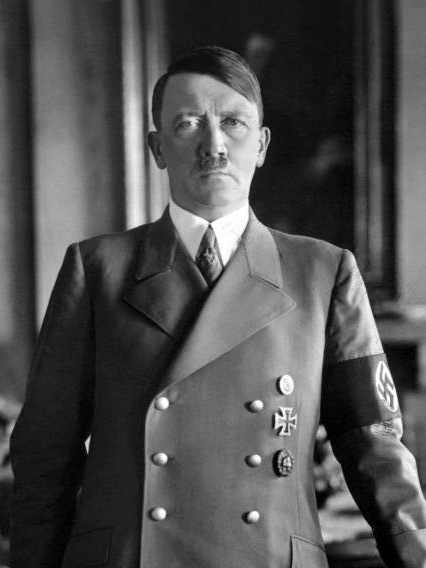
Extermination camps

Extermination camp

Auschwitz-Birkenau

Occupied Poland — 1940–1945

The largest and most lethal site in the Nazi system, a complex of three main camps near Oświęcim in occupied Poland. Auschwitz I was established in June 1940 in former Polish army barracks as a camp for Polish political prisoners. Auschwitz II-Birkenau, built from October 1941, became the principal extermination center with four large gas chamber-crematorium complexes (Krematorien II–V) using Zyklon B. Auschwitz III-Monowitz served the IG Farben synthetic rubber and fuel plant. Commandants: SS-Obersturmbannführer Rudolf Höss (May 1940–November 1943), SS-Obersturmbannführer Arthur Liebehenschel (November 1943–May 1944), SS-Sturmbannführer Richard Baer (May 1944–January 1945). At least 1.1 million people were murdered: approximately 1 million Jews (from Hungary — 438,000; Poland — 300,000; France — 69,000; Netherlands — 60,000; Greece — 55,000; Czechoslovakia — 46,000; and other countries), 70,000–75,000 Poles, 21,000 Roma, 15,000 Soviet POWs, and 10,000–15,000 others. The first gassing test with Zyklon B was conducted on September 3, 1941, on 600 Soviet POWs and 250 sick prisoners. At peak operation in summer 1944, during the Hungarian deportations overseen by Adolf Eichmann, up to 10,000 Jews were gassed and cremated per day. The Sonderkommando — Jewish prisoners forced to operate the gas chambers and crematoria — staged a revolt on October 7, 1944, destroying Krematorium IV. Liberated by the Soviet 60th Army on January 27, 1945 — now commemorated as International Holocaust Remembrance Day. Höss was tried in Warsaw and hanged at Auschwitz on April 16, 1947.

Extermination camp

Treblinka

Occupied Poland — 1942–1943

The deadliest of the three Operation Reinhard extermination camps, established in July 1942 in a forested area 80 km northeast of Warsaw, near the village of Treblinka. Part of Aktion Reinhard — the systematic extermination of Jews in the General Government, directed by SS-Brigadeführer Odilo Globocnik from Lublin under Himmler's orders, named after Reinhard Heydrich following his assassination in June 1942. Commandants: SS-Obersturmführer Dr. Irmfried Eberl (July–August 1942) — the only physician to command a death camp, removed for incompetence when the killing overwhelmed the camp's capacity and corpses piled up in the open — and SS-Obersturmführer Franz Stangl (August 1942–August 1943). The camp used carbon monoxide gas from tank engines piped into sealed chambers disguised as showers. The path from the undressing barracks to the gas chambers was called the 'Schlauch' (tube) or 'Himmelfahrtstraße' (Road to Heaven). Between July 1942 and October 1943, approximately 870,000–925,000 people were murdered — the vast majority Jews from the Warsaw Ghetto (over 300,000 during the 'Großaktion' of July–September 1942), from other Polish ghettos (Radom, Częstochowa, Białystok), and from Theresienstadt, Greece, Macedonia, and Thrace. Approximately 2,000 Roma were also murdered. The entire camp staff consisted of only 20–30 German and Austrian SS men and 90–120 Trawniki guards (mostly Ukrainian, recruited from POW camps). On August 2, 1943, the Jewish Sonderkommando staged an armed revolt — they seized weapons from the armory, set buildings ablaze, and approximately 300 prisoners escaped, though most were hunted down; about 70 survived the war. The Nazis then dismantled the camp entirely, ploughed the ground, planted lupins, and installed a Ukrainian farmer's house over the site. Stangl fled to Brazil after the war; he was extradited in 1967, tried in Düsseldorf, convicted of co-responsibility for the murder of 900,000 people, and sentenced to life imprisonment. He died in prison in 1971.

Extermination camp

Sobibór

Occupied Poland — 1942–1943

The second Operation Reinhard extermination camp, established in April 1942 in a remote forested area near the village of Sobibór in the Lublin district, close to the Bug River and the Soviet border. Commandants: SS-Obersturmführer Franz Stangl (April–August 1942, before transferring to Treblinka) and SS-Obersturmführer Franz Reichleitner (August 1942–October 1943). Like Treblinka and Bełżec, it used carbon monoxide from diesel engines piped into gas chambers. The camp was tiny — only about 600 × 400 meters — designed solely for immediate extermination: transports arrived by rail, victims were forced through the 'Schlauch' to the gas chambers, and their bodies were initially buried in mass graves, then exhumed and burned on open-air pyres from autumn 1942. Between April 1942 and October 1943, approximately 170,000–250,000 Jews were murdered — from Poland, the Netherlands (34,000 Dutch Jews), France, Slovakia, Germany, Austria, the Czech Protectorate, and the Soviet Union. The camp employed only 20–30 SS men and approximately 100 Trawniki guards. On October 14, 1943, the Jewish prisoner underground, led by Soviet-Jewish POW Lieutenant Alexander 'Sasha' Pechersky together with Polish-Jewish prisoner Leon Feldhendler, staged one of the most successful revolts in any Nazi camp — they silently killed 11 SS men one by one with axes, seized weapons, and approximately 300 prisoners stormed the gates. About 50–60 survived the war. The Nazis liquidated the camp immediately after, planting pine trees over the site. Reichleitner was killed by Italian partisans in January 1944.

Extermination camp

Bełżec

Occupied Poland — 1942–1943

The first Operation Reinhard extermination camp, established in March 1942 near the village of Bełżec in southeastern Poland, along the Lublin–Lwów railway line. It was the prototype for the Reinhard killing method. Commandants: SS-Hauptsturmführer Christian Wirth (March–August 1942) — known as 'Christian the Terrible,' a former T4 euthanasia specialist who designed the gassing system for all three Reinhard camps — and SS-Obersturmführer Gottlieb Hering (August 1942–June 1943). Wirth rejected Zyklon B in favor of carbon monoxide from engine exhaust, which he considered more practical for mass operations. The camp had three, later six, gas chambers. Between March 1942 and December 1942 — only nine months of operation — approximately 434,000–600,000 Jews were murdered, primarily from the ghettos of Galicia and the Lublin district (Lwów, Kraków, Zamość, Lublin, Tarnów). An estimated 1,000 Roma were also killed. The camp was so efficient at killing that very few prisoners were kept alive even temporarily — making Bełżec the camp with the fewest survivors of any in the Nazi system: only 7 are known to have survived, of whom just 2 — Rudolf Reder and Chaim Hirszman — gave testimony (Hirszman was murdered the day after giving his testimony in 1946, likely by anti-Semitic Polish nationalists). The camp employed only about 20 SS men and 90–120 Trawniki guards. Dismantled between spring and summer 1943 under Sonderaktion 1005: bodies were exhumed and burned, structures demolished, the terrain planted with trees. Wirth was transferred to command anti-partisan operations in Trieste and was killed by partisans in May 1944.

Extermination camp

Chełmno (Kulmhof)

Occupied Poland — 1941–1945

The first Nazi extermination camp and the first place where Jews were murdered by gassing on an industrial scale, operational from December 8, 1941 — weeks before the Wannsee Conference. Located in the village of Chełmno nad Nerem (Kulmhof) in the Wartheland, 70 km northwest of Łódź. Commandant: SS-Hauptsturmführer Herbert Lange (December 1941–March 1942, who had previously conducted the T4 euthanasia killings using gas vans in the Wartheland) and SS-Hauptsturmführer Hans Bothmann (April 1942–January 1945). Unlike the Reinhard camps, Chełmno used mobile gas vans (Gaswagen) — three large sealed trucks in which exhaust fumes were piped into the cargo compartment. Victims were told they would be taken to labor camps, ordered to undress in the basement of the Chełmno manor house, and then forced through a ramp into the vans. The vans drove 4 km to forest clearings at Rzuchów, where Jewish Sonderkommando prisoners were forced to unload and bury (later burn) the bodies. The camp operated in two phases: December 1941–March 1943 and June 1944–January 1945. At least 152,000 people were murdered — primarily Jews from the Łódź ghetto (including the children surrendered during the infamous 'Gehsperre' of September 1942) and from smaller ghettos in the Wartheland, plus approximately 4,300 Roma from the Łódź Roma camp. Only 4 prisoners are known to have survived. Bothmann committed suicide in April 1945 while in British custody.

Extermination camp

Majdanek

Occupied Poland — 1941–1944

Both a concentration and extermination camp, established in October 1941 on the outskirts of Lublin — so close to the city that its horrors were visible and smelled by the civilian population. Originally planned by Himmler as a massive POW camp for 50,000 Soviet prisoners, it was repurposed for the extermination of Jews. Commandants: SS-Standartenführer Karl-Otto Koch (1941–1942, transferred from Buchenwald, later arrested by the SS itself for corruption and executed in 1945), SS-Obersturmbannführer Max Koegel (1942, briefly), SS-Oberführer Hermann Florstedt (1942–1943, also arrested by the SS for corruption), SS-Obersturmbannführer Martin Weiss (1943–1944), and SS-Obersturmbannführer Arthur Liebehenschel (1944). The camp had seven gas chambers — some using Zyklon B, others carbon monoxide — and a crematorium. On November 3, 1943, during 'Aktion Erntefest' (Operation Harvest Festival), the SS murdered approximately 18,000 Jews at Majdanek in a single day — the largest single-day, single-location massacre of the entire Holocaust, exceeded only by the two-day Babi Yar massacre. Simultaneously, 25,000 more Jews were shot at the Trawniki and Poniatowa labor camps, totaling 43,000 killed in one coordinated operation across the Lublin district. Approximately 150,000 prisoners passed through Majdanek; around 78,000 died (59,000 Jews, 19,000 others). Liberated by the Soviet 1st Belorussian Front on July 23, 1944 — the first major camp to be liberated. The rapid Soviet advance prevented the Nazis from fully dismantling the camp, preserving its gas chambers, crematoria, and warehouses filled with victims' belongings, including an enormous pile of shoes. The evidence from Majdanek provided the world with some of the first direct proof of the extermination program.

Ghettos

Ghetto

Warsaw Ghetto

Occupied Poland — 1940–1943

The largest ghetto in occupied Europe, established on October 16, 1940 in the heart of Warsaw. Over 400,000 Jews — approximately 30% of the city's population — were crammed into an area of 3.4 km², roughly 2.4% of the city's total area. Walled off with a 3-meter-high brick wall topped with barbed wire and guarded by German and Polish police, the ghetto became a death trap of starvation and disease: an average of 6–7 people per room, a daily ration of 184 calories per person (compared to 2,613 for Germans), and over 80,000 deaths from hunger and typhus before the deportations even began. The Judenrat was led by Adam Czerniaków, who committed suicide on July 23, 1942 — the day he was ordered to sign the deportation lists for children. Between July 22 and September 21, 1942, during the 'Großaktion Warschau,' approximately 265,000–300,000 Jews were deported to Treblinka and gassed upon arrival — the largest single deportation action of the Holocaust, overseen by SS-Sturmbannführer Hermann Höfle under Globocnik's command. On April 19, 1943, when the SS entered the ghetto to deport the remaining 56,000 Jews, the Jewish Combat Organization (ŻOB) under 24-year-old Mordechai Anielewicz and the Jewish Military Union (ŻZW) launched the Warsaw Ghetto Uprising — the first urban uprising in Nazi-occupied Europe. With only pistols, a few rifles, Molotov cocktails, and one machine gun, the fighters held out for 27 days against SS-Brigadeführer Jürgen Stroop's forces. Stroop systematically burned the ghetto block by block. On May 16, 1943, he dynamited the Great Synagogue of Warsaw and reported: 'The Jewish quarter of Warsaw no longer exists.' Anielewicz died on May 8 in the ŻOB bunker at Miła 18. Stroop was hanged in Warsaw in 1952.

Ghetto

Łódź Ghetto

Occupied Poland — 1940–1944

The second-largest ghetto in occupied Europe and the longest-lasting, established on February 8, 1940 in the industrial city of Łódź (renamed Litzmannstadt by the Germans) in the Wartheland. Over 160,000 Jews were sealed inside an area of 4 km² in the poorest northern districts of the city — completely cut off from the outside world with no contact whatsoever, making it the most hermetically sealed of all ghettos. Led by Mordechai Chaim Rumkowski, the 'Elder of the Jews' (Judenälteste), one of the most controversial figures of the Holocaust — he ran the ghetto as a virtual autocracy, transforming it into a vast labor camp producing goods for the Wehrmacht, believing that making Jews economically indispensable would save them. On September 4, 1942, Rumkowski delivered his agonizing 'Give Me Your Children' speech, pleading with parents to surrender children under 10 and the elderly for deportation to Chełmno — approximately 15,000 were deported and gassed in the 'Gehsperre' (curfew action). The ghetto also received 20,000 Jews from Germany, Austria, the Czech Protectorate, and Luxembourg, plus 5,000 Roma (who were quickly deported to Chełmno). Between January 1942 and September 1942, approximately 70,000 Jews were deported to Chełmno. In August 1944, when the ghetto was finally liquidated, the remaining 67,000 Jews were deported to Auschwitz-Birkenau. Rumkowski himself was deported on one of the last transports and died in Auschwitz. The Łódź ghetto was the last ghetto to be liquidated — liberated by the Red Army on January 19, 1945, with only 877 Jews found alive, hidden in the ruins.

Ghetto

Kraków Ghetto

Occupied Poland — 1941–1943

Established on March 3, 1941 in the Podgórze district of Kraków, the seat of the General Government under Hans Frank. Around 15,000–20,000 Jews were confined behind walls that were cynically designed to resemble Jewish tombstones. Kraków's pre-war Jewish population of 60,000–68,000 had already been reduced through forced expulsions; only those with work permits were allowed to remain. The Judenrat was led by Artur Rosenzweig. Conditions were severe but initially less catastrophic than in Warsaw due to the smaller size. On June 1, 1942, the first deportation sent 7,000 Jews to Bełżec. On October 28, 1942, a second deportation sent 4,500 to Bełżec and 600 were shot in Plac Zgody (Harmony Square). The final liquidation occurred on March 13–14, 1943, personally overseen by SS-Hauptsturmführer Amon Göth: those deemed fit for labor were marched to the newly expanded Płaszów camp, and approximately 2,000 elderly, sick, and children were shot on the streets and in the ghetto hospital. The ghetto's liquidation is vividly depicted in Steven Spielberg's 'Schindler's List,' including the iconic scene of the girl in the red coat. The pharmacist Tadeusz Pankiewicz, the only Pole allowed to remain in the ghetto, secretly aided Jews throughout and was later recognized as Righteous Among the Nations.

Ghetto

Vilna Ghetto

Occupied Lithuania — 1941–1943

Vilna (Vilnius) was known as the 'Jerusalem of Lithuania' — home to the world-renowned YIVO Institute, a Yiddish cultural capital, and a Jewish community of approximately 57,000. Two ghettos were established on September 6, 1941: Ghetto No. 1 (the 'large ghetto,' approximately 29,000 Jews) and Ghetto No. 2 (the 'small ghetto,' approximately 11,000 Jews). Before the ghettos were even sealed, Einsatzkommando 9 and Lithuanian Ypatingasis būrys auxiliaries had already murdered 21,000 Vilna Jews at the Ponary forest between July and September 1941. Ghetto No. 2 was liquidated by October 1941, its inhabitants shot at Ponary. The Judenrat of Ghetto No. 1 was led by Jacob Gens, a controversial former Lithuanian army officer who collaborated with the Germans while secretly supporting the resistance — believing that making the ghetto productive would save some lives. The ghetto became an extraordinary center of cultural resistance: a library processing 100,000 loans, a theater staging 111 performances, schools, a symphony orchestra, and literary competitions — all while Ponary's killing pits lay 10 km away. The United Partisan Organization (FPO), led by Yitzhak Wittenberg and later Abba Kovner, was the first armed Jewish resistance organization in occupied Europe, formed on January 21, 1942. Kovner's manifesto declared: 'Let us not go like sheep to the slaughter!' — words that became a rallying cry for Jewish resistance everywhere. Gens was shot by the Gestapo on September 14, 1943. The ghetto was liquidated on September 23–24, 1943: remaining Jews were sent to concentration camps in Estonia and Latvia, or shot at Ponary. Of Vilna's 57,000 Jews, only 2,000–3,000 survived.

Ghetto

Budapest Ghetto

Hungary — 1944–1945

One of the last ghettos created and the only major ghetto to be liberated with a significant surviving population. After the German occupation of Hungary on March 19, 1944, Adolf Eichmann arrived in Budapest to personally oversee the deportation of Hungarian Jews — the last large Jewish community in Europe, numbering approximately 825,000. Between May 15 and July 9, 1944, 437,000 Jews from the Hungarian countryside were deported to Auschwitz-Birkenau in 147 trains — the fastest, most concentrated deportation of the entire Holocaust. Budapest's 200,000 Jews were initially spared due to international pressure, but after the Arrow Cross (Nyilaskereszt) fascist coup on October 15, 1944, under Ferenc Szálasi, the terror intensified: Arrow Cross gangs marched thousands of Jews to the Danube riverbank, shot them, and let their bodies fall into the water. An estimated 10,000–15,000 Jews were murdered this way. The Budapest Ghetto was formally established on November 29, 1944 in the VII District (Erzsébetváros), confining approximately 70,000 Jews behind wooden fences. In an extraordinary rescue effort, the Swedish diplomat Raoul Wallenberg issued thousands of protective 'Schutzpässe,' the Swiss consul Carl Lutz created a system of 'glass houses' sheltering Jews, the Italian Giorgio Perlasca impersonated a Spanish diplomat to save thousands, and the papal nuncio Angelo Rotta issued Vatican protective letters. Wallenberg personally confronted Eichmann and Arrow Cross leaders, saving an estimated 20,000–100,000 lives. The ghetto was liberated by the Red Army on January 18, 1945 with approximately 69,000 survivors — making it one of the few ghettos not completely annihilated. Wallenberg was arrested by the Soviets and disappeared; his fate remains one of the great mysteries of the 20th century.

Ghetto

Minsk Ghetto

Occupied Belarus — 1941–1943

Established on July 20, 1941, just three weeks after the German capture of Minsk. Approximately 80,000–100,000 Belarusian Jews were confined in 40 blocks of the city's northwestern quarter. A separate 'Sonderghetto' was created in November 1941 to house approximately 24,000 Jews deported from Germany, Austria, and the Czech Protectorate — they were kept separate from the local Jews and systematically murdered at Maly Trostinets and in the Tuchinka ravine. The Judenrat was led by Ilya Mushkin, later Moshe Yoffe. The Minsk ghetto had one of the most active underground resistance organizations of any ghetto, led by Hersh Smolar and connected to Soviet partisan units in the Naliboki and Lipiczany forests. The underground smuggled approximately 10,000 Jews out of the ghetto to the forests — one of the largest rescue operations from any ghetto. On November 7, 1941, approximately 12,000 Jews were massacred in a pogrom. On July 28–31, 1942, another 25,000–30,000 were murdered in a massive Aktion. Periodic massacres continued through 1942 and 1943, with victims shot in pits at Tuchinka or gassed at Maly Trostinets. The ghetto was finally liquidated on October 21, 1943: the last 2,000 Jews were taken to Maly Trostinets and killed. Of the original 80,000–100,000 Belarusian Jews plus 24,000 deportees, fewer than a few hundred survived.

Ghetto

Kaunas (Kovno) Ghetto

Occupied Lithuania — 1941–1944

Established on August 15, 1941, the Kaunas Ghetto confined approximately 29,760 Jews in the Slobodka (Vilijampolė) district. Even before the ghetto was sealed, Lithuanian auxiliary forces and Einsatzkommando 3 under Karl Jäger had murdered thousands — the Lietūkis garage massacre of June 27, 1941, killed 68 Jews with iron bars as crowds watched. Jäger's meticulous report documented 137,346 victims by December 1, 1941.

The Ninth Fort, a tsarist-era fortress 4 km from the city, became the primary killing site. On October 29, 1941, the "Great Action" murdered 9,200 Jews (2,007 men, 2,920 women, 4,273 children) in a single day. The ghetto was governed by the Ältestenrat under Dr. Elchanan Elkes, a physician who tried to save lives through diplomacy while secretly supporting the underground. The ghetto maintained a remarkable hidden cultural life: an orchestra, theater performances, a secret archive, and clandestine schools.

An armed underground operated from 1941, smuggling approximately 350 fighters into the forests to join Soviet partisans. On December 25, 1943, 64 Jewish prisoners at the Ninth Fort — forced to burn bodies under Sonderaktion 1005 — escaped through a tunnel they had dug over weeks; most were recaptured, but several survived to testify. In October 1943, the ghetto was converted into KZ Kauen concentration camp under SS control, removing the Judenrat's remaining autonomy.

During the final liquidation on July 8–13, 1944, the SS set the ghetto ablaze, burning alive those hiding in bunkers. Approximately 2,000 Jews were sent to Stutthof and Dachau. Dr. Elkes died in Dachau in October 1944. Of the pre-war Jewish population of 37,000 in Kaunas, approximately 8% survived — around 3,000 people.

Ghetto

Riga Ghetto

Occupied Latvia — 1941–1943

Established on October 25, 1941, the Riga Ghetto confined approximately 30,000 Latvian Jews in the Moscow Vorstadt district. Before the ghetto was even operational, the Nazis needed to "make room" — on November 30 and December 8, 1941, SS-Obergruppenführer Friedrich Jeckeln organized the Rumbula massacre: 25,000 Jews were marched 10 km to the Rumbula forest and shot into pre-dug pits by Einsatzgruppe A, Latvian Arajs Kommando, and Order Police. It was the largest two-day massacre of the Holocaust after Babi Yar.

After Rumbula, the "emptied" ghetto was split: the small Latvian ghetto held the roughly 5,000 surviving Latvian Jews deemed fit for labor, while the "German ghetto" received approximately 20,000 Jews deported from Germany, Austria, and the Protectorate of Bohemia and Moravia between November 1941 and February 1942. A transport of 1,000 Berlin Jews arriving on November 30 was taken directly to Rumbula and shot alongside the Latvian Jews — the so-called Jeckeln "shortcut" that embarrassed Himmler, who had ordered the transport not killed. Jeckeln was reprimanded but not punished.

The Latvian Arajs Kommando — a 300-man Latvian auxiliary unit led by Viktors Arājs — participated in nearly every major killing action in Latvia, murdering an estimated 26,000 Jews. The ghetto was progressively liquidated: the German ghetto was closed in November 1943, its remaining inmates transferred to KZ Riga-Kaiserwald. The Latvian ghetto was dissolved in stages through 1943. Of Latvia's pre-war Jewish population of 93,000, approximately 1,000 survived the war — a 99% annihilation rate, one of the highest in Europe. Jeckeln was hanged in Riga on February 3, 1946.

Ghetto

Lwów (Lviv) Ghetto

Occupied Ukraine — 1941–1943

Lwów (Lviv), with its pre-war population of 160,000 Jews — the third-largest Jewish community in Poland — suffered from the very first day of German occupation. On June 30, 1941, as Wehrmacht troops entered the city, Ukrainian nationalists and German forces unleashed the "Prison Pogrom": using the discovery of NKVD-murdered prisoners as pretext, mobs murdered approximately 4,000 Jews in three days. A second pogrom, the "Petliura Days" (July 25–27), killed another 2,000.

The ghetto was formally established in November 1941 in the Zamarstynów district, confining over 100,000 Jews. The Judenrat was led by Dr. Henryk Landsberg, who was murdered by the SS in 1942. The nearby Janowska concentration camp, established in October 1941 as a forced labor camp for the DAW (Deutsche Ausrüstungswerke), became a killing center where an estimated 40,000 Jews were murdered — including mass shootings at the "Sands" (Piaski) ravine behind the camp. Deportations to Bełżec began in March 1942: approximately 65,000 Lwów Jews were sent to the gas chambers between March and August 1942.

The ghetto was liquidated in June 1943 under the command of SS-Gruppenführer Fritz Katzmann, who submitted a triumphant report titled "Lösung der Judenfrage im Distrikt Galizien" ("Solution of the Jewish Question in the District of Galicia"). Of 160,000 pre-war Jews, approximately 800 survived the war — many hidden by Polish and Ukrainian rescuers. Janowska was also a major Sonderaktion 1005 site, where prisoners were forced to exhume and burn tens of thousands of bodies. The "Death Tango" — an orchestra of Jewish prisoners forced to play while their fellow inmates were murdered — became one of the most haunting symbols of Nazi depravity.

Ghetto

Białystok Ghetto

Occupied Poland — 1941–1943

Established on August 1, 1941, the Białystok Ghetto confined approximately 50,000 Jews in a small section of the city. The ghetto's establishment came after the Wehrmacht's first major atrocity in the city: on June 27, 1941, Police Battalion 309 locked between 700 and 2,000 Jews inside the Great Synagogue and burned it to the ground. In the following days, another 2,000 Jews were shot in mass executions.

The Judenrat was led by Efraim Barasz, an engineer who believed that making the ghetto economically indispensable through its textile factories could save its inhabitants. The ghetto became one of the most productive in the East, employing thousands in workshops producing goods for the Wehrmacht. The first major Aktion came on February 5–12, 1943, when 10,000 Jews were deported to Treblinka and approximately 1,000 were shot on the spot. An underground resistance led by Mordechai Tenenbaum (sent from Warsaw) and Daniel Moszkowicz prepared for armed resistance.

The final liquidation began on August 16, 1943. The underground launched an uprising with approximately 300 fighters armed with a handful of pistols, rifles, and one machine gun — far less weaponry than Warsaw. The fighting lasted several days but was crushed by overwhelming German force. Tenenbaum died during the uprising (likely suicide). The remaining 30,000–35,000 Jews were deported: most to Treblinka, but also to Auschwitz and Majdanek. A group of children was sent to Theresienstadt as a deception. Of Białystok's 50,000 ghetto Jews, approximately 1,000 survived — some in hiding, some as partisans in the Knyszyń Forest.

Ghetto

Lublin Ghetto

Occupied Poland — 1941–1942

Established in March 1941, the Lublin Ghetto confined approximately 34,000 Jews in the old town and Podzamcze district. Lublin had been one of the great centers of Jewish civilization in Poland — home to the famed Yeshivat Chachmei Lublin founded by Rabbi Meir Shapiro, a center of Hasidic life, and a community that traced its roots to the 14th century. By 1939, Jews constituted over one-third of the city's population.

Lublin was chosen as the headquarters of Operation Reinhard under SS-Brigadeführer Odilo Globocnik, making it the administrative nerve center of the industrialized murder of Polish Jewry. The ghetto was one of the first to be liquidated: between March 17 and April 11, 1942, approximately 26,000 Jews were deported to Bełżec — among the first transports to the newly operational death camp. Another 4,000 "unfit for transport" were shot at the Majdan Tatarski execution site outside the ghetto. Approximately 4,000 skilled workers were initially kept alive and transferred to the Majdanek camp on the city's outskirts.

These surviving workers were murdered during Aktion Erntefest on November 3, 1943, the single deadliest day for Jews in the entire Holocaust at any single location: 18,000 Jews were shot at Majdanek in one day, with music played through loudspeakers to drown out the gunfire, while simultaneously 25,000 were shot at Trawniki and Poniatowa — 43,000 Jews murdered in a single day. Of Lublin's pre-war Jewish population of approximately 42,000, fewer than 300 survived.

Ghetto

Thessaloniki Ghetto

Occupied Greece — 1943

Thessaloniki — the "Jerusalem of the Balkans" — was home to approximately 56,000 Sephardic Jews who had lived there since their expulsion from Spain in 1492. For centuries, Ladino (Judeo-Spanish) was the city's lingua franca, and Jews had constituted a majority of the population into the early 20th century. The community had its own newspapers, schools, hospitals, and a vibrant cultural and religious life spanning over 450 years.

Germany occupied Thessaloniki on April 9, 1941. SS-Hauptsturmführer Dieter Wisliceny and Alois Brunner were dispatched by Eichmann to organize deportations. In February 1943, Jews were ordered to wear the Star of David and were confined to ghettos near the railway station — the Baron Hirsch quarter became the main assembly point. Between March 15 and August 18, 1943, 19 transports carrying 48,533 Jews made the agonizing 4-day journey to Auschwitz-Birkenau. Upon arrival, approximately 37,000 were sent directly to the gas chambers. Many did not even know where they were being taken — Brunner told them they were being "resettled in Poland."

Of the 48,533 deported, approximately 1,950 survived. Including those who escaped to the mountains and joined partisans, or fled to Athens (where the Italian occupation was less murderous), approximately 10,000–12,000 Thessaloniki Jews survived the war — a mortality rate of nearly 80%. The centuries-old Jewish cemetery, one of the largest in Europe with 300,000 graves, was destroyed by the Greek authorities during the occupation; the stones were used for building materials and the land became part of the Aristotle University campus. Alois Brunner, one of the most wanted Nazi criminals, was never brought to justice — he fled to Syria, where he lived under the protection of the Assad regime until his death, believed to have occurred around 2001–2010.

Ghetto

Czernowitz (Chernivtsi) Ghetto

Romania/Occupied Ukraine — 1941

Czernowitz (Chernivtsi), capital of northern Bukovina, had a pre-war Jewish population of approximately 50,000 — nearly one-third of the city. It was a center of German-language Jewish culture, home to poets Paul Celan and Rose Ausländer. On October 11, 1941, Romanian authorities under Governor Corneliu Calotescu established the ghetto, cramming 50,000 Jews into a small area within 24 hours. The Romanians, unlike the Germans, carried out their own genocide without direct Nazi supervision.

Beginning October 14, 1941, deportations to Transnistria commenced — the Romanian-administered territory between the Dniester and Bug rivers. Approximately 28,000 Czernowitz Jews were deported in cattle cars and on foot on death marches through freezing conditions. Mayor Traian Popovici intervened to save approximately 20,000 Jews by issuing work permits, one of the few Romanian officials to resist. In Transnistria, deportees were confined in camps and ghettos such as Mogilev-Podolsky, Sharhorod, and Bershad, where thousands died from typhus, starvation, and exposure. The deadliest sites were Bogdanovka (48,000 murdered), Domanovka, and Akhmetchetka. Of the 28,000 deported from Czernowitz, approximately half perished. Celan's parents were among the dead — his father of typhus, his mother shot. Celan survived in a Romanian labor camp; his poem "Todesfuge" became one of the most important literary works about the Holocaust.

Ghetto

Radom Ghetto

Occupied Poland — 1941–1942

Established in April 1941, the Radom Ghetto divided approximately 32,000 Jews into two separate ghettos: the "Large Ghetto" in the city center with 27,000 Jews, and the "Small Ghetto" in the Glinice district with 5,000. Radom, capital of its own district in the Generalgouvernement, had a Jewish community dating to the 15th century. Jews constituted roughly one-third of the pre-war population.

During the liquidation of August 5–18, 1942, approximately 18,000 Jews were deported to Treblinka. The Small Ghetto was liquidated first on August 5 — nearly all 5,000 inhabitants were sent directly to the gas chambers. During the Large Ghetto liquidation on August 16–18, those unable to walk were shot on the spot; eyewitnesses reported hundreds of bodies in the streets. Approximately 4,000 Jews deemed fit for labor were kept in the Szwarlikowska Street labor camp and in weapons factories (including a HASAG munitions plant). These surviving workers endured until July 1944, when they were deported to Auschwitz as the Soviet front advanced. Of 32,000 ghetto inhabitants, approximately 1,500 survived the war.

Ghetto

Częstochowa Ghetto

Occupied Poland — 1941–1943

Established on April 9, 1941, the Częstochowa Ghetto — known as the "Large Ghetto" — confined approximately 45,000 Jews, nearly all of the city's Jewish population. Częstochowa was famous as a center of both Catholic pilgrimage (Jasna Góra monastery) and Jewish life; Jews had lived there since the early 19th century. A "Small Ghetto" of approximately 5,000 workers was maintained separately.

The "Great Deportation" took place September 22–October 7, 1942 (Yom Kippur fell during this period): approximately 39,000 Jews were deported to Treblinka, where almost all were gassed upon arrival. During the Aktion, approximately 2,000 Jews were shot on the spot — the sick, the elderly, children who resisted separation. The Small Ghetto, with its HASAG munitions factory workers, survived as a labor camp. On June 25–27, 1943, the remaining workers launched an armed uprising led by Mordechai Zilberberg — one of the lesser-known ghetto revolts. The uprising was suppressed; 1,500 Jews were shot and 4,000 deported to various labor camps. A remnant of approximately 5,200 workers at HASAG-Pelcery survived until liberation by the Red Army on January 17, 1945. Of 45,000 ghetto Jews, approximately 5,200 survived — almost exclusively those in the HASAG factory.

Ghetto

Tarnów Ghetto

Occupied Poland — 1941–1943

Established in March 1941, the Tarnów Ghetto confined approximately 25,000 Jews in the old town. Tarnów's Jewish community — one of the oldest in Galicia, dating to the mid-15th century — constituted nearly half the city's pre-war population. The first mass execution in Tarnów came even before the ghetto: on June 11, 1942 (the "First Aktion"), approximately 3,500 Jews were rounded up in the Rynek (market square), selected, and either shot in the Buczyna forest or deported to Bełżec.

The ghetto was liquidated in stages: the June 1942 Aktion sent approximately 3,500 to Bełżec; further deportations in September 1942 sent another 8,000 to Bełżec and Auschwitz. The final liquidation on September 2, 1943, saw the remaining 8,000–10,000 Jews deported to Auschwitz-Birkenau and the Szebnie labor camp; approximately 3,000 who could not march were shot in the streets and in the Jewish cemetery. The old Jewish cemetery — with gravestones dating to the 16th century — and the bimah (synagogue platform) are among the few physical remnants of 500 years of Jewish life. Of 25,000 ghetto inhabitants, approximately 700 survived.

Ghetto

Debrecen Ghetto

Hungary — 1944

After Operation Margarethe — the German occupation of Hungary on March 19, 1944 — Eichmann's Sonderkommando arrived to implement the "Final Solution" with terrifying speed. Debrecen, Hungary's second-largest city, had approximately 9,000 Jews. In late April 1944, they were confined to a ghetto in the Hatvan-utca area and a brick factory on the city's outskirts, where conditions were deliberately brutal — beatings, starvation, and the confiscation of all valuables.

Between June 25–28, 1944, all Jews from Debrecen and the surrounding area were deported to Auschwitz-Birkenau in three transports coordinated by László Endre and László Baky — Hungarian officials who collaborated enthusiastically with Eichmann. The Hungarian gendarmerie (csendőrség) carried out the round-ups and loading with exceptional brutality. The speed of the Hungarian Holocaust was unprecedented: between May 15 and July 9, 1944, 437,000 Hungarian Jews were deported in 147 trains — an average of over 12,000 people per day. Debrecen was liberated by the Soviet Army on October 20, 1944, but by then its Jewish community had been destroyed. Approximately 500 Debrecen Jews survived the war.
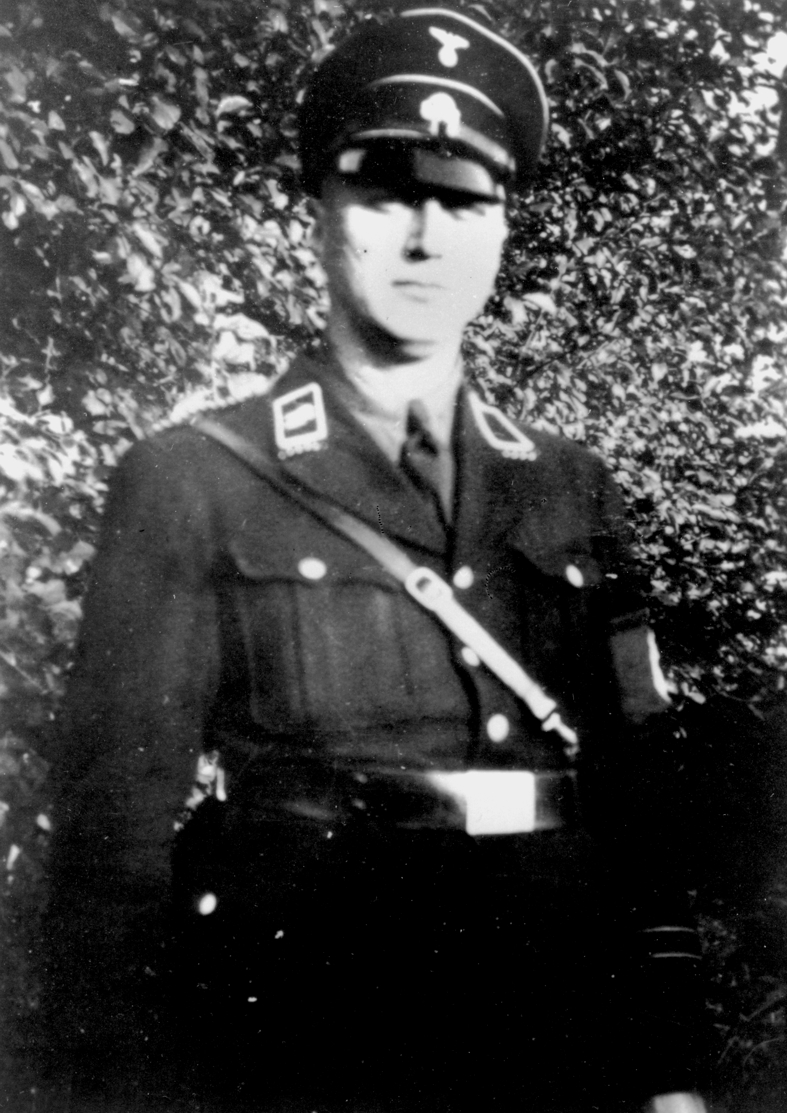
Ghetto

Sighet Ghetto

Hungary (occupied Romania) — 1944
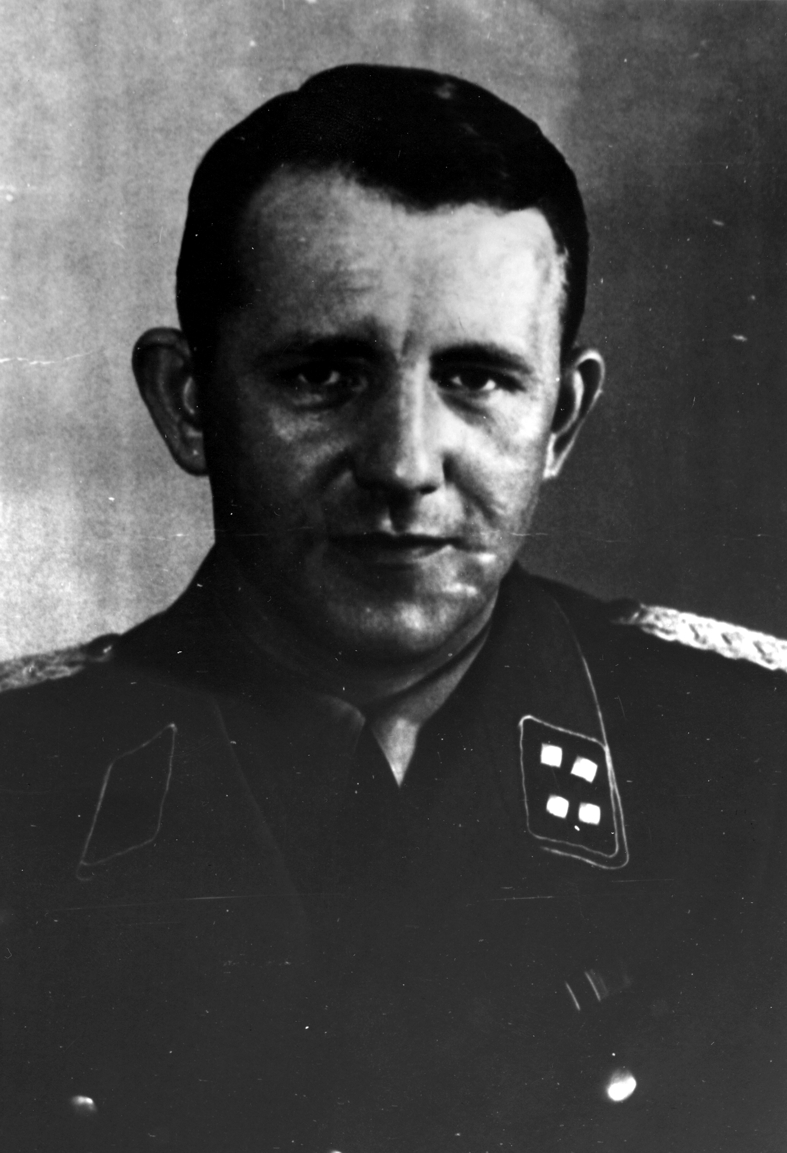
Sighet (Sighetu Marmației), in northern Transylvania — part of Hungary after the 1940 Vienna Award — was home to approximately 10,000 Jews and the hometown of Elie Wiesel, whose memoir "Night" became one of the defining testimonies of the Holocaust. In April 1944, all Jews from Sighet and the surrounding Máramaros region — approximately 13,000 people — were confined in two ghettos: the main ghetto in the Jewish quarter and a smaller one in the Kossuth Garden area.

Between May 16–22, 1944, all of Sighet's Jews were deported to Auschwitz in four transports. The Máramaros region — Zone I in Eichmann's deportation plan — was among the very first areas cleared. Wiesel, 15 years old, arrived at Birkenau with his family; his mother Sarah and 7-year-old sister Tzipora were gassed upon arrival. His father Shlomo survived months of forced labor but died at Buchenwald in January 1945, just weeks before liberation. Of Sighet's 13,000 deported Jews, approximately 2,500 survived. Wiesel was awarded the Nobel Peace Prize in 1986; the memorial museum in his childhood home preserves the memory of Sighet's vanished community.

Ghetto

Iași Ghetto and Pogrom

Romania — 1941

Iași (Jassy), capital of Romanian Moldavia, had a Jewish community of approximately 45,000 — nearly half the city's population. On June 29, 1941, Romanian soldiers, police, German troops, and local civilians unleashed one of the deadliest pogroms of the entire war. Triggered by false claims of Jewish "signal lights" to Soviet bombers, mobs swept through Jewish neighborhoods. Jews were rounded up at police headquarters, where Romanian and German soldiers massacred approximately 8,000 people in the courtyard and surrounding streets.

The horror continued with the "Death Trains": approximately 4,330 surviving Jews were crammed into sealed freight cars — over 100 people per car — and sent on aimless journeys across Romania in the summer heat. The first train, with 2,530 people, traveled for 17 hours to Călărași; approximately 1,194 died from suffocation, dehydration, and heat. The second train, with 1,800 Jews, wandered for 6 days before reaching Podu Iloaiei, a 20-minute journey that became a death ride — approximately 650 died en route. In total, the Iași pogrom killed approximately 13,266 Jews according to Romanian government figures. Unlike German-organized massacres, the Iași pogrom was an initiative of Romanian authorities under Ion Antonescu, who had declared the need for "ethnic purification" of Romania. Antonescu was executed on June 1, 1946.

Ghetto

Shanghai Ghetto

Japanese-occupied China — 1943–1945

Shanghai occupies a unique place in Holocaust history as one of the few cities in the world that accepted Jewish refugees without requiring visas. Between 1938 and 1941, approximately 18,000–20,000 European Jews — predominantly from Germany, Austria, and Poland — fled to Shanghai's International Settlement, which required no entry papers. Many came via the Trans-Siberian Railway with visas issued by Chiune Sugihara (Japanese consul in Kaunas) or Ho Feng-Shan (Chinese consul in Vienna).

On February 18, 1943, under Nazi pressure, the Japanese occupying authorities proclaimed the "Designated Area for Stateless Refugees" in Hongkou — a roughly 1-square-mile area of bombed-out buildings in one of Shanghai's poorest districts. Approximately 16,000 Jews were forced to relocate there, joining Chinese residents in extreme overcrowding. Conditions were harsh — poverty, disease, and tropical heat — but there were no mass executions, no deportations, no gas chambers. The refugees established synagogues, schools, a Yiddish newspaper, cafés, and even a theater. The Kadoorie family (Sephardic Jews already established in Shanghai) and international relief organizations provided essential support.

When SS-Colonel Josef Meisinger ("the Butcher of Warsaw") visited Shanghai in 1942, he proposed to the Japanese that the Jews be exterminated — either by mass drowning in the Huangpu River or by working them to death on salt mines. The Japanese rejected the plan. The ghetto was liberated in August 1945 with the Japanese surrender. Nearly all 18,000–20,000 refugees survived — making Shanghai one of the very few places on earth where a large Jewish community emerged from the war essentially intact. Most emigrated to Israel, the United States, and Australia in the late 1940s.

Methods of extermination

The industrialization of murder — from the T4 "euthanasia" program to the gas chambers of Auschwitz — represents the most systematic escalation of genocide in human history. Each method was designed, tested, refined, and scaled by men who treated mass murder as an engineering problem.

Phase I — 1939–1941

Aktion T4 — The "Euthanasia" Program

Germany & Austria — Tiergartenstraße 4, Berlin

The Holocaust did not begin with Jews — it began with the disabled. In October 1939, Hitler signed a backdated authorization (to September 1, 1939) for the killing of people deemed "unworthy of life" (lebensunwertes Leben). Administered from Tiergartenstraße 4 in Berlin (hence "T4"), the program was directed by Philipp Bouhler (head of the Führer's Chancellery) and Dr. Karl Brandt (Hitler's personal physician). Six killing centers were established: Grafeneck, Brandenburg, Bernburg, Hartheim, Sonnenstein, and Hadamar.

The method was carbon monoxide (CO) gas, piped from cylinders into sealed rooms disguised as showers — the prototype for all subsequent gas chambers. Victims — psychiatric patients, the physically disabled, and "asocials" — were selected by questionnaires filled out by physicians who never examined them. Approximately 70,273 people were murdered in the official T4 program (January 1940–August 1941). After public protests — notably the sermon by Catholic Bishop Clemens August von Galen on August 3, 1941 — Hitler officially halted T4. But the killing never stopped: it continued covertly as "Aktion 14f13" in concentration camps and as "wild euthanasia" (Nachfolgeaktionen) through starvation and lethal injection, killing an estimated 200,000 more by 1945.

T4's greatest legacy to the Holocaust was its personnel. When Operation Reinhard began in 1942, at least 92 T4 operatives — men who had already learned to gas human beings — were transferred to Bełżec, Sobibór, and Treblinka. Christian Wirth, who had designed T4's gas chambers at Brandenburg and Hartheim, became the inspector of all three Reinhard camps. Franz Stangl, commandant of both Sobibór and Treblinka, came from Hartheim. Kurt Franz, the last commandant of Treblinka, came from T4. The institutional knowledge of industrial murder flowed directly from the disability killings to the Jewish genocide.

👶 Kinder-Euthanasie — The Children's Killing Program (1939–1945) — Click to view

Before the adult T4 program even began, the Nazis launched a separate killing program targeting children. It was the first systematic mass murder of the Third Reich — and it lasted until the very end of the war.

The origins trace to a single case: the "Kind Knauer" — a severely disabled infant born in late 1938 near Leipzig. The father petitioned Hitler directly for a "mercy death." Hitler sent Dr. Karl Brandt to investigate. Brandt authorized the killing. This single case became the catalyst for a bureaucratic killing machine.

On August 18, 1939 — two weeks before the invasion of Poland — the Reich Ministry of the Interior issued the Decree on the Mandatory Reporting of Deformed Newborns (Meldepflicht). All physicians and midwives were required to report any newborn or child under three with conditions including: Down syndrome, microcephaly, hydrocephalus, missing or deformed limbs, paralysis, and spasticity. Reports were sent to the Reichsausschuss — a deliberately innocuous name concealing its true purpose.

Three "medical experts" — none of whom ever examined the children — reviewed each questionnaire and marked it with a "+" (death), "−" (survival), or a request for further observation. Two "+" marks sealed the child's fate. Children were transferred to approximately 30 "special pediatric wards" (Kinderfachabteilungen) across Germany and Austria, including Am Spiegelgrund in Vienna, Brandenburg-Görden, Eichberg, Eglfing-Haar, Kaufbeuren-Irsee, Leipzig-Dösen, and Lüneburg.

The killing methods were deliberately slow to simulate natural death: starvation diets, overdoses of barbiturates (especially Luminal/phenobarbital), and morphine-scopolamine injections. Parents received letters stating their child had died of pneumonia. Many children's brains were preserved for "research" — at Am Spiegelgrund in Vienna, Dr. Heinrich Gross kept hundreds of children's brain specimens in jars, only given proper burial in 2002. Gross was never convicted and practiced medicine in Austria until the 1990s.

As the war progressed, the age limit was raised — first to 8, then 12, eventually 16. By the end, some wards killed Jewish and "half-Jewish" children regardless of disability. An estimated 5,000 children were murdered between 1939 and 1945. The program never formally ended — it continued until Allied armies physically liberated the institutions, one by one.

⛔ The Six T4 Killing Centers — Click to view
📜 T4 Propaganda — "Lives Unworthy of Life" — Click to view

Before the killing began, the Nazi regime launched a systematic propaganda campaign to dehumanize disabled people — portraying them as a financial burden on the community, as "useless eaters" consuming resources without contributing. These posters and slides were used in schools, Hitler Youth meetings, and public exhibitions to build acceptance for the murders to come.

Phase II — 1941–1942

Gas Vans (Gaswagen)

Eastern Front, Chełmno, Serbia

As the Einsatzgruppen discovered that mass shootings caused severe psychological damage to the killers — alcoholism, mental breakdowns, and desertions — the SS sought a more "humane" method (for the perpetrators, not the victims). In late 1941, the RSHA's motor pool chief Walter Rauff coordinated the development of mobile gas vans: modified trucks in which the exhaust pipe was redirected into the sealed cargo compartment. Victims were told they were being "transported"; instead, they were gassed during the drive to the burial site.

Three models existed: the smaller Diamond T (25–30 victims) and the larger Saurer and Magirus-Deutz (50–60 victims). Death took 15–30 minutes. At least 20 gas vans were deployed: to the Einsatzgruppen on the Eastern Front, to Chełmno (where 3 vans killed at least 152,000 people), and to the Sajmište camp in Serbia. At Chełmno, victims from the Łódź Ghetto were loaded at the Schlosslager manor house, driven 4 km to the Rzuchów forest, where Jewish prisoners (the Waldkommando) unloaded the bodies and burned them. The vans were operational but problematic — drivers complained of "leaks," the floors corroded from bodily fluids, and unloading the tangled, contorted corpses traumatized even the SS. Approximately 700,000 people were murdered in gas vans across all sites. Rauff escaped to Chile after the war and died there in 1984 without facing trial, despite extradition requests.

Phase III — 1942–1943

Carbon Monoxide — Operation Reinhard

Bełżec, Sobibór, Treblinka

The three Operation Reinhard extermination camps used carbon monoxide from engine exhaust — not bottled CO as in T4, but exhaust piped from captured Soviet tank engines (at Treblinka) or large diesel engines (at Bełżec and Sobibór) into sealed gas chambers. Christian Wirth, the T4 veteran who became inspector of all three camps, designed the system: victims were forced to undress, women had their hair shaved, and they were driven through a narrow fenced corridor (the "Schlauch" or "tube" — called Himmelfahrtstraße, "Road to Heaven," at Treblinka) into the gas chambers.

The chambers were relatively small — Treblinka's original 3 chambers held 200 people each; the new building (completed September 1942) had 10 chambers holding 400 each. Death from engine exhaust CO took 20–30 minutes — longer and more agonizing than Zyklon B. The engines sometimes failed or sputtered, extending the agony to over an hour. Sonderkommando prisoners (Jewish forced laborers) extracted the bodies, removed gold teeth, and buried or burned the corpses. The three Reinhard camps killed approximately 1.5–1.8 million Jews in just 20 months (March 1942–November 1943), operated by only 450 Germans and approximately 1,000 Trawniki guards. After the camps were dismantled, Wirth was transferred to Trieste, where Italian partisans killed him in May 1944.

Phase IV — 1941–1945

Zyklon B — Auschwitz-Birkenau & Majdanek

Auschwitz I, Birkenau, Majdanek

Zyklon B (Zyklon Blausäure — "Cyclone Prussic Acid") was a commercial pesticide based on hydrogen cyanide (HCN), originally manufactured by Degesch (Deutsche Gesellschaft für Schädlingsbekämpfung) for delousing clothing and buildings. In pellet form, it released lethal HCN gas upon exposure to air and warmth. The first experimental gassing of humans with Zyklon B took place on September 3, 1941, in the basement of Block 11 at Auschwitz I: approximately 600 Soviet POWs and 250 sick prisoners were killed. SS-Hauptsturmführer Karl Fritzsch, the Schutzhaftlagerführer, conducted the experiment. Camp commandant Rudolf Höss later wrote that this "set his mind at ease" — he had found a method that avoided the direct shooting that disturbed his men.
At Birkenau, the killing apparatus reached industrial scale. Krematorien II and III (operational March–June 1943) each contained an underground undressing room (Auskleideraum), a gas chamber (Leichenkeller 1 — "corpse cellar") capable of holding 2,000 people, and 15-muffle cremation ovens. Krematorien IV and V (operational March–April 1943) had ground-level gas chambers. SS guards wearing gas masks dropped Zyklon B pellets through openings in the roof; death came in 15–20 minutes. The four crematoria could burn approximately 4,756 bodies per day. During the Hungarian deportations (May–July 1944), the killing rate peaked at approximately 10,000 per day — the crematoria could not keep pace, and open-air burning pits were used.
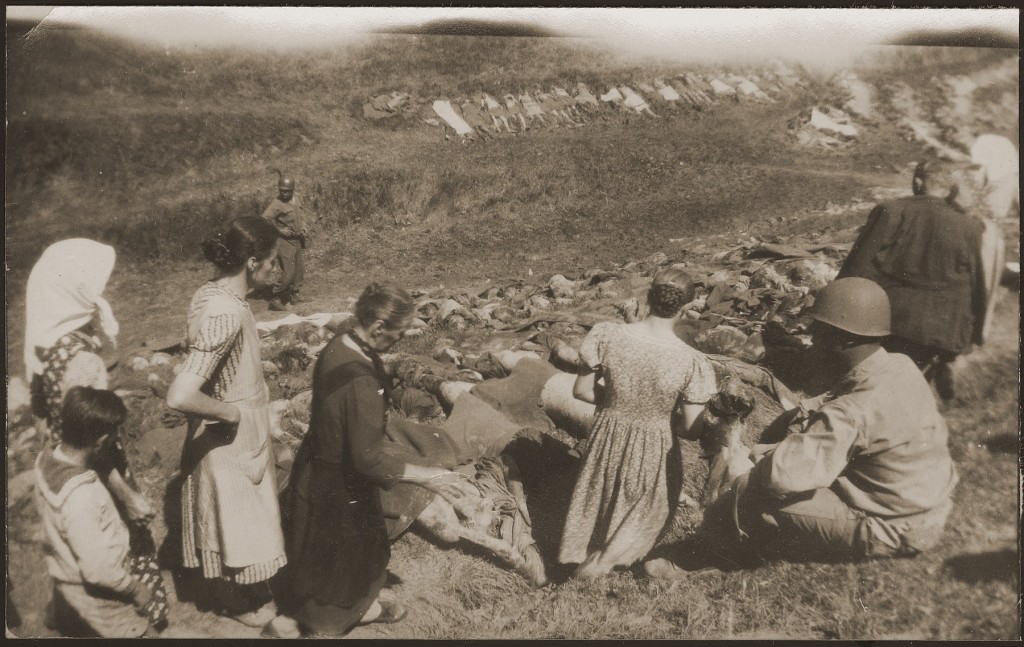
Zyklon B was also used at Majdanek, which had 7 gas chambers — some using Zyklon B, others using CO — and at Stutthof. The SS purchased approximately 27 tonnes of Zyklon B during the war, of which an estimated 6 tonnes were used for murder (the rest for delousing). The pellets were supplied by two licensed distributors: Tesch & Stabenow (Testa) in Hamburg and Heerdt-Lingler (Heli) in Frankfurt. After the war, Bruno Tesch and Karl Weinbacher of Testa were convicted and hanged on May 16, 1946, for knowingly supplying poison for murder — one of the few cases where a commercial supplier was held criminally responsible for the Holocaust.

Industrial Complicity

IG Farben — The Business of Extermination

Frankfurt am Main / Auschwitz III-Monowitz — 1925–1945 Heinrich Himmler visits the IG Farben plant at Auschwitz III, July 1942

Heinrich Himmler (second from left) inspects the IG Farben Buna-Werke plant at Auschwitz III-Monowitz, July 17–18, 1942. With him: Rudolf Brandt (left), Max Faust (IG Farben chief engineer), and Rudolf Höß (Auschwitz commandant, far right). During this same visit, Himmler observed a gassing at Birkenau. — Auschwitz-Birkenau State Museum

IG Farben (Interessen-Gemeinschaft Farbenindustrie AG) was no ordinary corporation — it was the largest chemical conglomerate in the world and the fourth-largest company on Earth. Formed in 1925 through the merger of six major German chemical firms — including BASF, Bayer, Hoechst, and Agfa — it controlled the production of synthetic fuels, rubber, explosives, pharmaceuticals, dyes, and pesticides. By the 1930s, IG Farben was deeply intertwined with the Nazi state: the company donated 400,000 Reichsmarks to Hitler's 1933 election campaign and became the regime's indispensable industrial partner.

IG Farben's complicity in the Holocaust operated on two levels simultaneously. First, its subsidiary Degesch (Deutsche Gesellschaft für Schädlingsbekämpfung) manufactured the Zyklon B used to murder over one million people in the gas chambers of Auschwitz-Birkenau and Majdanek. IG Farben held 42.5% of Degesch shares and had representatives on its board. The company knew the purpose of the orders — in 1943, Degesch even removed the warning odorant from Zyklon B destined for Auschwitz, a modification that only made sense if the gas was being used on humans, not lice.

Second, IG Farben built and operated its own slave labor complex. Auschwitz III-Monowitz (Buna) was the only concentration camp in history built and financed by a private corporation. IG Farben invested over 700 million Reichsmarks — the company's largest single investment — and paid the SS 3–4 Reichsmarks per day per slave laborer. The prisoners received nothing. Approximately 10,000 prisoners worked at peak capacity building the Buna-Werke synthetic rubber and fuel plant. The average life expectancy was 3–4 months: those too weak to work were "selected" and sent to Birkenau's gas chambers — gassed with the Zyklon B that the same corporation had manufactured. At least 10,000 Monowitz prisoners were murdered at Birkenau.

Primo Levi, the Italian chemist and writer, survived 11 months at Monowitz; his masterwork "If This Is a Man" (Se questo è un uomo, 1947) is one of the most important testimonies of the camp system. Elie Wiesel also spent time at Monowitz-Buna. The Buna-Werke plant was never completed — despite consuming thousands of lives, it never produced a single kilogram of synthetic rubber.

🏭 IG Farben — Corporate complicity, trial & legacy — Click to view

IG Farben was not alone. Beyond Monowitz, at least 40 Auschwitz subcamps supplied slave labor to German industry: Krupp (armaments), Siemens (electronics), BMW (aircraft engines), Volkswagen (vehicles), and numerous mining and construction firms. Deutsche Bank financed the construction of Auschwitz. The entire German industrial establishment profited from slave labor — an estimated 12 million forced laborers worked in the German war economy by 1944.

After the war, IG Farben was dissolved by the Allies in 1952 into its original constituent companies — BASF, Bayer, Hoechst (now part of Sanofi), and others — which became pillars of West Germany's "economic miracle" (Wirtschaftswunder). Fritz ter Meer, convicted at Nuremberg of plunder and slavery, became chairman of Bayer's supervisory board in 1956. Carl Wurster, who had overseen Zyklon B production, led BASF until 1965. The IG Farben company was not formally liquidated until 2012 — 67 years after the end of the war. It had continued to exist as a shell company, its shares traded on the Frankfurt stock exchange. In 2001, IG Farben's successor companies agreed to contribute to a German government foundation compensating former slave laborers — but the payments were a convenient arrangement for the corporations, not an act of justice.

In 2000, after decades of pressure from survivors and class-action lawsuits in US courts, the German government established the Foundation "Remembrance, Responsibility and Future" (Stiftung EVZ). The total fund was 10 billion Deutsche Marks (approximately €5.2 billion), split evenly between the German government and some 6,500 German companies — including IG Farben's successors BASF, Bayer, Hoechst/Aventis, and Degussa (successor of Degesch, the Zyklon B manufacturer), alongside Siemens, BMW, Volkswagen, Deutsche Bank, Allianz, and ThyssenKrupp.

Between 2001 and 2007, payments were distributed to approximately 1.66 million people in nearly 100 countries. But the amounts were miserable: former concentration camp slave laborers received a maximum of €7,669, while forced laborers received up to €2,556. Many survivors had already died before the payments began — 55 years had passed since the end of the war. The most obscene aspect: the companies contributed in exchange for legal immunity. The agreement required survivors to waive all future lawsuits. The corporations paid to close the matter, not to achieve justice. Companies that had profited billions from slave labor — and whose stock value had grown exponentially in the postwar decades — bought their way out of accountability for the price of a used car per survivor.

The Sonderkommando

The men forced to operate the machinery of death

All extermination camps — 1941–1945

At every killing site, Jewish prisoners were forced to do the work the SS would not: dragging bodies from gas chambers, extracting gold teeth, shaving hair, sorting clothing, and burning corpses. These prisoners — the Sonderkommando ("special unit") — lived in total isolation from other inmates and were systematically murdered every few months to eliminate witnesses, then replaced with new arrivals. At Birkenau, the Sonderkommando numbered approximately 400–900 men at any given time.

📷 The Sonderkommando Photographs — The only images from inside the extermination process (August 1944)

In August 1944, at the height of the Hungarian deportations — when the crematoria could not keep pace and bodies were being burned in open-air pits — members of the Sonderkommando at Crematorium V in Birkenau risked their lives to photograph what no one was meant to see. A camera was smuggled into the camp by the Polish resistance. Alberto Errera (code-named "Alex"), a Greek Jewish prisoner and former military officer, took four photographs from inside and around Crematorium V while fellow Sonderkommando members — Alter Fajnzylberg, Shlomo and Josel Dragon, and David Szmulewski — stood guard.

Sonderkommando photograph 282 — Women being driven toward the gas chamber at Crematorium V, Birkenau, August 1944

Photo 282 — Women being driven naked toward the gas chamber of Crematorium V. Taken from a concealed position.

Sonderkommando photograph 281 — Open-air burning of bodies in pits near Crematorium V, Birkenau, August 1944

Photo 281 — Open-air burning of bodies in pits behind Crematorium V. The crematoria ovens could not keep pace with the killing during the Hungarian deportations.

Sonderkommando photograph 280 — Bodies on the ground near burning pits, taken from inside the gas chamber, Birkenau, August 1944

Photo 280 — Taken from inside the gas chamber doorway: bodies on the ground near the burning pits. The dark frame of the doorway is visible — the photographer was hiding inside the chamber.

After taking the photographs, the film was removed from the camera and hidden inside a tube of toothpaste. Helena Dantón, a prisoner who worked in the SS canteen, smuggled the tube out of the camp to the Polish underground resistance, who developed the negatives and transmitted copies to the Polish government-in-exile in London. These four images — catalogued as numbers 280, 281, 282, and 283 by the Auschwitz-Birkenau State Museum — remain the only photographic evidence taken by prisoners from inside the extermination process itself. They are among the most important documents of the Holocaust.

On October 7, 1944, the Sonderkommando of Krematorium IV at Birkenau launched a desperate revolt. Roza Robota, Ella Gärtner, Regina Safirsztajn, and Ester Wajcblum — four Jewish women working in the Union-Werke munitions factory — had smuggled tiny amounts of gunpowder to the Sonderkommando over months. The prisoners attacked the SS guards, set Krematorium IV on fire (it was never repaired), and attempted to cut through the perimeter fence. Approximately 250 Sonderkommando members were killed in the fighting; another 200 were executed afterward. The four women were tortured for weeks but revealed nothing. They were hanged publicly on January 6, 1945 — just 20 days before liberation. Despite their efforts, several Sonderkommando members survived to give testimony, including Shlomo Venezia, Filip Müller, and the authors of the "Scrolls of Auschwitz" — manuscripts buried in the ground near the crematoria, discovered after the war.

Mass execution sites

Execution site

Ponary (Paneriai)

Occupied Lithuania — 1941–1944

A forest near Vilna where approximately 70,000 Jews were shot and buried in mass graves. Victims were taken from the Vilna Ghetto. In 1943, prisoners were forced to exhume and burn the bodies to destroy evidence.

Execution site

Babi Yar

Occupied Ukraine (Kyiv) — 1941–1943

On September 29–30, 1941, the Einsatzgruppen murdered 33,771 Jews in just two days — one of the largest single massacres of the Holocaust. Over the following months, the ravine became a mass grave for over 100,000 victims.

Execution site

Rumbula

Occupied Latvia — 1941

On November 30 and December 8, 1941, approximately 25,000 Jews from the Riga Ghetto were marched to the Rumbula forest and shot. It was one of the largest two-day massacres of the Holocaust after Babi Yar.

Execution site

Ninth Fort (Kaunas)

Occupied Lithuania — 1941–1944

A 19th-century fortress where over 50,000 people were murdered, mostly Jews from the Kaunas Ghetto. On October 29, 1941, over 9,000 Jews were killed in a single day in what is known as the "Great Action".

Execution site

Kamianets-Podilskyi

Occupied Ukraine — 1941

On August 27–28, 1941, approximately 23,600 Jews were shot — the first five-figure massacre of the Holocaust. Many victims were Hungarian Jews who had been deported to occupied Ukraine.

Execution site

Bogdanovka

Transnistria (Romanian-occupied Ukraine) — 1941

In December 1941, Romanian forces and local collaborators murdered approximately 48,000 Jews in one of the largest massacres perpetrated by Romanian authorities during the Holocaust.

Science without conscience

Nazi physicians and researchers used concentration camp prisoners as human guinea pigs in experiments that had no scientific value and served only to torture and kill. Thousands of men, women, and children were subjected to procedures designed to cause maximum suffering — all in the name of "medical science." The perpetrators were not fringe fanatics but credentialed doctors from Germany's most prestigious universities.

Jadwiga Dzido shows her scarred leg at the Doctors' Trial, Nuremberg, 1946

Ravensbrück survivor Jadwiga Dzido displays her scarred leg — the result of deliberate bacterial infection experiments — as evidence at the Doctors' Trial, Nuremberg, December 1946. The judges would hear testimony from dozens of survivors whose bodies bore the permanent marks of Nazi "medical science."

The experiments

Auschwitz-Birkenau

Josef Mengele — The "Angel of Death"

1943–1945 Josef Mengele, SS physician at Auschwitz

SS-Hauptsturmführer Dr. Josef Mengele stood on the ramp at Birkenau selecting arrivals for life or death with a flick of his finger — sending the vast majority directly to the gas chambers. His obsession was twins: he would search every transport, calling "Zwillinge! Zwillinge!" (Twins! Twins!). He subjected approximately 1,500 pairs of twins to excruciating experiments — injecting chemicals into their eyes to attempt to change eye color, performing transfusions between twins of different blood types, deliberately infecting one twin with diseases to observe when the other fell ill, and surgically connecting twins to create artificial conjoined twins. When experiments were complete, both twins were typically killed simultaneously by phenol injection into the heart, and their organs were sent to the Kaiser Wilhelm Institute in Berlin-Dahlem for further study. Only around 200 individual twins survived. Mengele also experimented on dwarfs, people with heterochromia, and Roma prisoners. He fled Auschwitz in January 1945 with his research documentation, escaped through the Ratlines to Argentina, then Paraguay, and finally Brazil, where he drowned while swimming in 1979 — never having faced justice.

Auschwitz — Block 10

Carl Clauberg — Mass sterilization

1942–1945 Dr. Carl Clauberg, Nazi physician

Professor Carl Clauberg, a gynecologist, worked in Block 10 of Auschwitz — the "experimental block" — to develop a method for mass sterilization of Jewish women without surgery. He injected a caustic chemical substance into the uteruses of hundreds of Jewish and Roma women, causing excruciating pain, infection, and permanent damage. His goal was to develop a procedure that would allow a single doctor to sterilize up to 1,000 women per day. Many women died from the injections; survivors were left with chronic pain and infertility. After the war, Clauberg was captured by the Soviets and sentenced to 25 years. Released in 1955, he returned to West Germany and boasted publicly about his "scientific achievements" at Auschwitz. He was re-arrested in 1955 but died in his cell in 1957 before trial.

Auschwitz — Block 10

Horst Schumann — Sterilization by X-ray

1942–1944

Dr. Horst Schumann — who had previously participated in the T4 euthanasia program — subjected groups of 30 prisoners at a time to massive doses of X-ray radiation directed at their reproductive organs. Men and women were irradiated two to three times per week. Many suffered severe radiation burns, swelling, and infections. Those who survived the initial exposure were often castrated or had their ovaries surgically removed so Schumann could examine the tissue damage. Despite proving that surgical castration was more "efficient," Schumann continued his experiments. After the war, he fled to Africa, living in Sudan, Egypt, and Ghana. Extradited to Germany in 1966, he was deemed medically unfit for trial in 1970 and died free in 1983.

Dachau

Sigmund Rascher — Hypothermia and altitude

1941–1944 A victim of the hypothermia experiments at Dachau, immersed in freezing water

Luftwaffe physician Sigmund Rascher conducted two categories of lethal experiments at Dachau on behalf of the German Air Force. In high-altitude experiments, prisoners were placed inside low-pressure chambers that simulated conditions at altitudes up to 20,000 meters — their eardrums burst, their lungs collapsed, and many died in agony. In hypothermia experiments, prisoners were forced to stand naked outdoors in freezing winter temperatures for hours, or were submerged in tanks of ice water for up to three hours. Rascher meticulously recorded body temperatures as victims froze to death. Of approximately 300 hypothermia subjects, 80 to 90 died during the experiments; many others were killed immediately afterward. The "rewarming" phase was equally cruel: Rascher forced naked Roma women to lie with the hypothermic men, using their body heat in what amounted to sexual assault as a "medical procedure." Ironically, Rascher was arrested by the SS in 1944 — not for his experiments, but for faking the births of children he and his wife had actually kidnapped. He was executed at Dachau days before liberation.

Ravensbrück

The "Rabbits" of Ravensbrück

1942–1943 Scarred leg of Helena Hegier, Ravensbrück sulfonamide experiment survivor

At Ravensbrück, the only major concentration camp for women, SS physicians Karl Gebhardt and Herta Oberheuser deliberately inflicted wounds on the legs of 86 young Polish women — mostly political prisoners and university students — then infected the wounds with bacteria, dirt, glass shards, and wood shavings to simulate battlefield injuries. The purpose was to test the effectiveness of sulfonamide drugs. The women were called "Kaninchen" (rabbits) by their fellow prisoners because they limped like rabbits after the operations and because they had been used as laboratory animals. Five women died directly from the experiments; six others were executed by the SS to prevent them from testifying. Seventy-four survived, many with permanent disfigurement. At the Doctors' Trial, survivors Jadwiga Dzido and Wladislava Karolewska lifted their skirts before the court to display their scarred legs — testimony that shocked the world. Dr. Oberheuser, the only female defendant, received 20 years but was released in 1952 and resumed medical practice until survivors identified her in 1958.

Neuengamme

The children of Bullenhuser Damm

1944–1945 Jacqueline Morgenstern, 7 years old, victim of tuberculosis experiments at Neuengamme

SS physician Kurt Heissmeyer injected live tuberculosis bacilli into the lungs and skin of 20 Jewish children — aged 5 to 12 — at Neuengamme concentration camp near Hamburg. The children had been selected from Auschwitz and transferred specifically for these experiments. Among them was seven-year-old Jacqueline Morgenstern, a French girl who had dreamed of being a dancer. As British forces approached in April 1945, the SS moved the children to the Bullenhuser Damm school in Hamburg, where they were injected with morphine and hanged from hooks in the basement ceiling — all twenty children, along with their adult caretakers and two French prisoner-doctors who had been forced to assist. Heissmeyer was never tried; he practiced medicine in communist East Germany as a respected lung specialist until 1963, when he was finally identified and sentenced to life imprisonment. He died in prison in 1967.

The Doctors' Trial and the Nuremberg Code

Four Polish women arrive at Nuremberg to testify at the Doctors' Trial

Four Polish women — survivors of the Ravensbrück sulfonamide experiments — arrive at Nuremberg to testify at the Doctors' Trial, December 1946.

Justice

The Doctors' Trial — United States vs. Karl Brandt et al.

Nuremberg — December 1946 to August 1947

Twenty-three defendants — twenty doctors and three administrators — stood trial before an American military tribunal at Nuremberg. They were charged with war crimes, crimes against humanity, and membership in criminal organizations. The prosecution presented evidence of experiments conducted at Dachau, Ravensbrück, Sachsenhausen, Buchenwald, Natzweiler, and Auschwitz. Seven defendants were sentenced to death and hanged on June 2, 1948: Karl Brandt (Hitler's personal physician and head of the T4 program), Viktor Brack, Rudolf Brandt, Karl Gebhardt, Waldemar Hoven, Joachim Mrugowsky, and Wolfram Sievers. Nine received prison sentences ranging from 10 years to life. Seven were acquitted. Herta Oberheuser, the sole female defendant, received 20 years.

Legacy

The Nuremberg Code (1947)

The birth of medical ethics

The Doctors' Trial produced one of the most important documents in the history of medical ethics: the Nuremberg Code. Its ten principles established, for the first time in international law, that the voluntary consent of the human subject is "absolutely essential" — that no experiment may be conducted where death or disabling injury is expected — that the subject must be free to terminate the experiment at any point — and that the scientist must be prepared to stop if continuation is likely to cause harm. The Code became the foundation for the 1964 Declaration of Helsinki and every modern institutional review board (IRB) and ethics committee in the world. It was born from the testimony of those who survived — from the scarred legs of the Ravensbrück Rabbits, from the children of Bullenhuser Damm who never grew up, from the twins who lost their other half to Mengele's needle. The Nuremberg Code is their legacy: the principle that no science, no state, and no authority may use a human being as an object.

The last agony

As Allied forces closed in from East and West, the Nazi regime forced hundreds of thousands of concentration camp prisoners on brutal forced marches through the frozen landscape of collapsing Europe. Starving, barefoot, shot if they stumbled — the death marches were the final chapter of the Holocaust, killing an estimated 250,000 to 375,000 people in the last months of the war.

German civilians forced to view victims of a death march

German civilians are forced to view the exhumed bodies of death march victims near Nammering, Germany, 1945. U.S. Army Signal Corps photograph.

Shoes on the Danube Bank memorial, Budapest

'Shoes on the Danube Bank' — memorial by Gyula Pauer and Can Togay (2005) in Budapest, honoring the Jews shot into the Danube by Arrow Cross militiamen, 1944-1945.

SS Cap Arcona burning in the Bay of Lübeck, May 3, 1945

The SS Cap Arcona burns in the Bay of Lübeck after being attacked by the RAF, May 3, 1945. Approximately 7,000 concentration camp prisoners died — one of the worst maritime disasters in history.

Why the Death Marches?

As Soviet and Allied forces advanced in late 1944 and early 1945, Himmler ordered the evacuation of concentration camps near the front lines. The motivations were threefold: to prevent the liberation of prisoners who could testify against the regime, to preserve a reserve of slave labor for the crumbling war economy, and to prevent living evidence of genocide from falling into Allied hands. Camp records were burned, crematoria were dynamited, and mass graves were hastily concealed. The prisoners — already emaciated from years of starvation and forced labor — were the last witnesses to be silenced.

The marches followed no single route. Prisoners were driven westward and southward in columns of thousands, often without food, water, or adequate clothing in sub-zero temperatures. Guards had standing orders: anyone who could not keep pace was to be shot. The roads of Central Europe became lined with corpses. German civilians saw the columns pass through their villages — skeletal figures in striped uniforms, leaving trails of blood in the snow. After the war, many claimed they had known nothing.

Auschwitz Evacuations — January 1945

The largest death marches of the Holocaust began on January 17-21, 1945, when approximately 56,000-58,000 prisoners were forced out of Auschwitz and its subcamps as the Soviet Red Army approached from the east. SS guards marched prisoners westward in several columns through the frozen Polish and Silesian countryside toward the railway junctions at Wodzisław Śląski (Loslau) and Gliwice. Temperatures dropped to -20°C. Prisoners received no food; they ate snow. Anyone who stopped, sat down, or fell behind was shot immediately — their bodies left where they fell along the roadsides.

An estimated 9,000 to 15,000 prisoners died during the Auschwitz marches. Those who survived the march on foot were packed into open freight cars — 80 to 100 per car — for transport to camps deeper inside Germany: Gross-Rosen, Buchenwald, Dachau, Mauthausen, and Bergen-Belsen. Many froze to death in the open wagons. When the Soviets liberated Auschwitz on January 27, 1945, they found approximately 7,000 prisoners too sick to march, left behind by the SS to die. Among the survivors were Primo Levi and Otto Frank, Anne Frank's father.

Stutthof Evacuations — January 1945

On January 25, 1945, the SS began evacuating Stutthof and its network of over 100 subcamps, forcing approximately 50,000 prisoners — predominantly Jewish women from Hungary and the Baltic states — westward along the frozen Baltic coast. The Stutthof marches were among the most horrific of the entire war. Columns were driven through blizzards toward the coast, where some prisoners were forced onto the frozen Vistula Lagoon and the Baltic Sea ice. SS guards fired into the columns or drove prisoners into the freezing water. In one notorious incident near Palmnicken (today Yantarny, Russia), approximately 3,000 Jewish women were driven into the icy Baltic Sea and machine-gunned on January 31, 1945 — the Palmnicken massacre.

Of the approximately 50,000 prisoners evacuated from Stutthof, an estimated 25,000-26,000 perished — one of the highest death rates of any evacuation. Stutthof itself was not liberated until May 9, 1945, making it one of the last camps freed. The Soviet soldiers who entered found roughly 100 survivors among piles of unburied dead.

Budapest Death Marches — November 1944

After the Arrow Cross coup of October 15, 1944, Adolf Eichmann returned to Budapest to resume deportations. With railway infrastructure destroyed by Allied bombing, Eichmann organized forced marches of approximately 76,000 Budapest Jews toward the Austrian border — a distance of over 200 kilometers. Between November 8 and December 1944, columns of men, women, and children were marched westward in freezing rain and snow, with virtually no food or shelter. Hungarian Arrow Cross militiamen and SS guards shot stragglers. Survivors described stepping over corpses every few meters along the road.

Raoul Wallenberg, the Swedish diplomat, followed the columns in his car, distributing Swedish protective passports and pulling people out of the march lines. The Swiss diplomat Carl Lutz, the Italian Giorgio Perlasca, and the Papal Nuncio Angelo Rotta also intervened, saving thousands. Approximately 7,000-10,000 people died on the Budapest marches before international pressure — including protests from the neutral legations and even some German officers — forced Szálasi's government to halt them in late November. Many survivors were handed over to the SS at Hegyeshalom on the Austrian border and sent to concentration camps, including Dachau, Mauthausen, and Ravensbrück.

Sachsenhausen & Ravensbrück — April 1945

On April 21, 1945, with the Red Army only kilometers away, the SS evacuated Sachsenhausen, forcing 33,000 prisoners northwestward in what became known as the 'Todesmarsch vor dem Halben Mond' (death march before the half moon). Organized into groups of 400-500, prisoners marched toward the Baltic port of Lübeck — though no ships awaited them. Guards killed approximately 1,000 prisoners on the first day alone. The columns wandered for nearly two weeks through the forests of Mecklenburg and Brandenburg. Below, a municipality called Wittstock today maintains a memorial at a barn where SS guards locked 400 prisoners inside and set it ablaze.

Ravensbrück, the largest women's concentration camp, was evacuated simultaneously. Around 20,000 women — many of them already gravely ill — were driven northwestward. Swedish Red Cross 'White Buses' organized by Count Folke Bernadotte managed to rescue approximately 7,500 Scandinavian and other prisoners in the final weeks, but thousands of others died on the roads. Soviet and American forces liberated scattered groups of marchers throughout late April and early May, finding columns of walking dead who could barely stand.

Dachau Evacuation — April 1945

Between April 26-28, 1945, the SS forced approximately 7,000 prisoners from Dachau and its subcamps on a death march southward toward the Austrian Alps, where Nazi leadership fantasized about a last stand in the 'Alpine Fortress' (Alpenfestung). Prisoners marched through Bavarian towns — Wolfratshausen, Bad Tölz, Tegernsee — in full view of the civilian population. Those who collapsed were shot at the roadside. Near the town of Waakirchen, American troops discovered a freight train with 2,310 corpses in open rail cars — prisoners who had died during transport from Buchenwald to Dachau, a journey that took three weeks instead of the normal one day.

On April 29, 1945, the U.S. 42nd and 45th Infantry Divisions liberated Dachau. What they found — the 'death train,' the piles of emaciated corpses, the gas chamber, the living skeletons who greeted them — so horrified American soldiers that some executed SS guards on the spot in what became known as the Dachau massacre. General Eisenhower, having visited the nearby Ohrdruf subcamp days earlier, had already ordered that German civilians be forced to tour the camps: 'We are told that the American soldier does not know what he is fighting for. Now, at least, he will know what he is fighting against.'

Gross-Rosen Evacuations — February 1945

Gross-Rosen, with its vast network of 97 subcamps across Lower Silesia, was evacuated in several waves beginning in late January 1945. Approximately 40,000 prisoners were forced on death marches westward, many toward the already overcrowded camps of Buchenwald, Dachau, Mauthausen, Flossenbürg, and Bergen-Belsen. The marches from Gross-Rosen's subcamps were among the most chaotic, as SS guards often received contradictory orders and drove prisoners in circles through the Silesian mountains. Thousands died of exposure in the Sudeten passes.

The subcamps of Gross-Rosen included many where Jewish women from Hungary and Poland worked as slave laborers in armaments factories. The women's marches were particularly brutal — many prisoners had only wooden clogs and thin summer clothing. At one subcamp, Christianstadt, 1,000 women were marched for weeks through the snow. Only around 200 survived. The Soviet Army liberated the main Gross-Rosen camp on February 13, 1945, finding only a few hundred sick prisoners left behind.

The Cap Arcona Disaster — May 3, 1945

One of the most tragic episodes of the death marches ended not on land but at sea. In late April 1945, the SS evacuated approximately 9,000-11,000 prisoners from Neuengamme and its subcamps to the port of Lübeck, where they were loaded onto three ships anchored in the Bay of Lübeck: the SS Cap Arcona (a former luxury ocean liner), the SS Thielbek, and the SS Athen. The prisoners were packed below decks with no food, water, or sanitation. The SS plan — never confirmed but widely suspected — was to tow the ships out to sea and scuttle them, drowning all witnesses.

On May 3, 1945 — just five days before Germany's unconditional surrender — the Royal Air Force, unaware that the ships carried concentration camp prisoners, attacked them in the Bay of Lübeck. The Cap Arcona and Thielbek were struck by rockets and bombs, caught fire, and capsized. Prisoners who escaped the burning ships and tried to swim to shore were machine-gunned by SS guards on the beach. Approximately 7,000-7,500 people died — making the Cap Arcona disaster one of the largest maritime tragedies in history, exceeding the death toll of the Titanic. Only around 350 prisoners survived. The British discovered the truth only after the attack. Among the dead were prisoners from over 20 nations, including many who had survived years in concentration camps only to die in the final hours of the war.

Shoes on the Danube Bank — Budapest

Between October 1944 and January 1945, Hungarian Arrow Cross militiamen murdered an estimated 10,000 to 15,000 Jews along the banks of the Danube in Budapest. The victims — men, women, and children — were taken to the river's edge, ordered to remove their shoes (which had value on the black market), tied together in groups of three, and shot so that the first victim's falling body would drag the others into the freezing river. The Danube carried the bodies downstream. Some victims were still alive when they hit the water.

In 2005, sculptor Gyula Pauer and film director Can Togay created 'Shoes on the Danube Bank' — 60 pairs of iron shoes permanently fixed to the embankment on the Pest side of the river, near the Hungarian Parliament building. The shoes — men's work boots, women's heels, children's shoes — are a haunting memorial to the victims. The sculpture has become one of Budapest's most visited memorials and one of the most powerful Holocaust monuments in the world. It stands as a permanent reminder that the Holocaust was not only perpetrated in distant camps but on the streets of European capital cities, in full view of their inhabitants.

Bergen-Belsen — Where the Marches Ended

Bergen-Belsen was never designed as an extermination camp. Originally a prisoner-of-war camp, it became the dumping ground for death march evacuees from across the collapsing Reich. In the final months of the war, tens of thousands of prisoners from Auschwitz, Sachsenhausen, Mittelbau-Dora, and other evacuated camps were transported there. The camp, designed for 10,000, held over 60,000 by April 1945. There was no food. There was no water. Typhus, typhoid fever, and dysentery raged unchecked. In March 1945 alone, 18,168 prisoners died. Anne Frank and her sister Margot died of typhus in Bergen-Belsen in February or March 1945, just weeks before liberation.

British forces liberated Bergen-Belsen on April 15, 1945. What they found shocked the world. BBC correspondent Richard Dimbleby described it: 'Here over an acre of ground lay dead and dying people. You could not see which was which… The living lay with their heads against the corpses and around them moved the awful, ghostly procession of emaciated, aimless people.' The British Army filmed the liberation — footage that became central evidence at the Nuremberg Trials and remains among the most devastating visual records of the Holocaust. Even after liberation, approximately 13,000 more prisoners died from the effects of starvation and disease. The British were forced to use bulldozers to bury the dead in mass graves — an image that became iconic of the liberation.

Resistance and heroism

In the darkest moments of humanity, there were those who chose to fight, resist, and sacrifice. These are the stories of courage that must never be forgotten.

Warsaw Ghetto Uprising — boy with hands raised, from the Stroop Report

The most iconic photograph of the Holocaust: a boy raises his hands during the liquidation of the Warsaw Ghetto, April-May 1943. From the Stroop Report, compiled by SS-Gruppenführer Jürgen Stroop to document the destruction of the ghetto.

Raoul Wallenberg passport photo

Raoul Wallenberg (1912–1947?), the Swedish diplomat who saved tens of thousands of Hungarian Jews by issuing protective passports. Arrested by Soviet forces in January 1945, his fate remains one of the great mysteries of the 20th century.

Armed uprisings

Uprising — Warsaw, 1943

Warsaw Ghetto Uprising

On April 19, 1943, hundreds of young Jewish fighters led by Mordechai Anielewicz rose up against the Nazi liquidation of the ghetto. With homemade weapons and smuggled guns, they held off the German army for nearly a month. It was the first urban uprising in occupied Europe and became a symbol of Jewish resistance.

Uprising — Sobibór, 1943

Sobibór Revolt

On October 14, 1943, prisoners led by Soviet POW Alexander Pechersky staged a daring revolt. They killed 11 SS guards and several Ukrainian auxiliaries, then breached the fence. Around 300 prisoners escaped; about 50 survived the war. The Nazis razed the camp to hide the evidence.

Uprising — Treblinka, 1943

Treblinka Revolt

On August 2, 1943, the Sonderkommando prisoners broke into the armory, seized weapons, and set the camp ablaze. Around 200 escaped, though most were hunted down. The revolt hastened the camp's closure. Only 67 survivors are known to have lived to see liberation.

Uprising — Auschwitz, 1944

Sonderkommando Revolt at Auschwitz

On October 7, 1944, Sonderkommando prisoners — forced to operate the gas chambers — revolted and destroyed Crematorium IV with smuggled explosives. Four women — Ala Gertner, Róża Robota, Regina Safirsztajn, and Esther Wajcblum — had smuggled gunpowder from a nearby factory. All four were hanged, but their sacrifice damaged the killing machinery.

Acts of individual heroism

Defiance in the camps

Maximilian Kolbe

In July 1941, when a prisoner escaped from Auschwitz, the SS selected 10 men to die by starvation as punishment. When Franciszek Gajowniczek — a husband and father — was chosen, Father Kolbe stepped forward and offered to take his place. He survived two weeks in the starvation bunker, praying and comforting others, before being killed with a lethal injection.

Rescue — Budapest

Raoul Wallenberg

A Swedish diplomat who saved tens of thousands of Hungarian Jews in 1944 by issuing protective passports ("Schutzpasses") and establishing safe houses. He personally confronted Eichmann and pulled people off deportation trains. He disappeared after the Soviet liberation of Budapest; his fate remains one of the great mysteries of the 20th century.

Rescue — Kaunas

Chiune Sugihara

Japanese consul in Lithuania who defied his government and hand-wrote thousands of transit visas for Jewish refugees in 1940, working up to 18 hours a day. He continued writing visas even while his train was leaving. He saved an estimated 6,000 lives. He lost his diplomatic career for his actions.

Rescue — Poland

Irena Sendler

A Polish social worker who smuggled approximately 2,500 Jewish children out of the Warsaw Ghetto, hiding them with Catholic families and in convents. She kept the children's true identities written on slips of paper buried in jars, hoping to reunite them with their families after the war. Captured by the Gestapo, she was tortured but never revealed the children's locations.

Rescue — Germany

Oskar Schindler

A German industrialist and member of the Nazi Party who saved 1,200 Jews by employing them in his factories, claiming they were essential to the war effort. He spent his entire fortune bribing SS officials and buying supplies for his workers. He died penniless in 1974 and is buried in Jerusalem.

Resistance — Denmark

The Danish Rescue

In October 1943, the Danish resistance, with the help of ordinary citizens, fishermen, and even the Danish police, smuggled over 7,200 Jews across the sea to neutral Sweden in just three weeks. It was the largest collective rescue action during the Holocaust — an entire nation said no.

Defiance — France

Le Chambon-sur-Lignon

An entire village in southern France, led by Pastor André Trocmé and his wife Magda, sheltered over 3,500 Jews — mostly children — throughout the occupation. When asked why, the villagers simply said: "It was the right thing to do." The village was recognized as Righteous Among the Nations.

Jewish resistance

The Bielski Partisans

The Bielski brothers — Tuvia, Zus, Asael, and Aron — led a group of Jewish partisans in the forests of Belarus from 1942 to 1944. They built a hidden community of over 1,200 people in the forest, including women, children, and the elderly, and fought against the Nazis while saving lives.

Defiance — Germany

The White Rose

A group of university students in Munich — Sophie and Hans Scholl, Christoph Probst, and others — who distributed leaflets calling for resistance against the Nazi regime. They were arrested, tried, and executed in 1943. Sophie Scholl, just 21, told the court: "Somebody had to make a start. What we wrote and said is also believed by many others."

Rescue — Auschwitz

Witold Pilecki

A Polish officer who VOLUNTEERED to be captured and sent to Auschwitz in 1940 to organize resistance and gather intelligence. He spent nearly three years inside the camp, built a resistance network, and smuggled out detailed reports about the extermination — some of the first to reach the Allies. He escaped in 1943. Tragically, he was executed by the communist Polish government in 1948.

Spiritual resistance

Janusz Korczak

A Polish-Jewish pediatrician, author, and director of an orphanage in the Warsaw Ghetto. When the children were ordered to be deported to Treblinka in August 1942, Korczak refused offers of personal rescue and chose to accompany the 192 children to the death camp. He walked with them to the trains, comforting them until the end.

Defiance — Auschwitz-Birkenau

Fredy Hirsch — The children's guardian of Auschwitz →

Alfred "Fredy" Hirsch (1916–1944) built a children's republic inside Auschwitz-Birkenau, keeping nearly zero mortality among his young charges. Read his full story in the dedicated section.

Rescue — Budapest

Giorgio Perlasca

An Italian businessman in Budapest who, after the Spanish embassy closed, posed as the Spanish consul and single-handedly continued Wallenberg's work. He issued thousands of fake Spanish protection papers and sheltered over 5,200 Hungarian Jews in safe houses during the winter of 1944–45. He kept up the deception for months, bluffing Nazi officials.

All the victims, all the heroes

Roma and Sinti — The Porajmos

The forgotten genocide

Up to 500,000 Roma and Sinti were murdered by the Nazis in what they call "Porajmos" (the Devouring). On August 2, 1944, nearly 3,000 Roma men, women, and children were gassed at Auschwitz-Birkenau in a single night. They had fought back fiercely on May 16 when the SS first tried to liquidate the "Gypsy Camp", forcing the Nazis to postpone the killing.

Jehovah's Witnesses

The Purple Triangles

Around 1,500 Jehovah's Witnesses died in the camps. They were the only group who could secure their release by simply signing a document renouncing their faith — virtually none did. They refused to give the Hitler salute, serve in the military, or say "Heil Hitler". Their quiet, absolute defiance infuriated the SS.

People with disabilities

Aktion T4 — The first victims

Over 200,000 people with physical and mental disabilities were murdered under the T4 euthanasia program — the rehearsal for the Holocaust. The gas chambers were first tested on disabled people. Clemens August von Galen, the Catholic Bishop of Münster, publicly denounced the killings in 1941, forcing Hitler to officially halt the program — though covert killings continued.

Soviet POWs

The forgotten millions

Approximately 3.3 million Soviet prisoners of war were killed — through starvation, exposure, disease, and execution. They were the first to be gassed at Auschwitz in September 1941. Many who survived the camps joined partisan movements. Alexander Pechersky, a Soviet Jewish POW, led the Sobibór uprising.

Homosexuals — The Pink Triangles

Persecuted and forgotten

Between 5,000 and 15,000 gay men were sent to concentration camps, forced to wear the pink triangle. Even after liberation, many were not recognized as victims — the anti-homosexuality law (Paragraph 175) remained in force in Germany until 1969. Many survivors returned to prison. Their persecution was not officially acknowledged until decades later.

Political resistance — Germany

The July 20 Plot

On July 20, 1944, Colonel Claus von Stauffenberg — a German Catholic officer — placed a bomb in Hitler's headquarters. Hitler survived. Stauffenberg and hundreds of conspirators were executed. They were German soldiers who chose conscience over obedience — proof that resistance was possible even from within.

Protestant resistance — Germany

Dietrich Bonhoeffer

A German Protestant pastor and theologian who opposed the Nazi regime from the start. He joined the Abwehr conspiracy against Hitler and was involved in plans to rescue Jews. Arrested in 1943, he was hanged at Flossenbürg concentration camp on April 9, 1945 — just two weeks before liberation. His writings on faith and resistance remain profoundly influential.

Rescue — Albania

Albania — Besa

Albania, a predominantly Muslim country, was the only European nation occupied by the Nazis that ended the war with MORE Jews than before. The Albanian code of honor "Besa" — a sacred promise to protect guests — led families to shelter Jews in their homes, often at great personal risk. Not a single Jew was handed over to the Nazis.

Rescue — Turkey

Selahattin Ülkümen

The Turkish consul in Rhodes who saved around 50 Jews — including non-Turkish citizens — by claiming they were Turkish nationals when the Nazis began deporting the island's Jewish community in 1944. His wife later died from injuries when the Germans bombed the consulate in retaliation. He was the first Muslim to be recognized as Righteous Among the Nations.

Rescue — El Salvador

José Arturo Castellanos

The Salvadoran consul in Geneva who, together with Jewish businessman George Mandel, issued over 13,000 fake Salvadoran nationality certificates to Jews in Nazi-occupied Europe, saving around 40,000 lives. One of the largest — and least known — rescue operations of the Holocaust, led by a Latin American diplomat.

Rescue — Portugal

Aristides de Sousa Mendes

The Portuguese consul in Bordeaux who defied his government's orders and issued thousands of visas to refugees fleeing the Nazi invasion of France in June 1940. Working non-stop for three days, he saved an estimated 30,000 people — including 10,000 Jews. He was dismissed from the diplomatic service and died in poverty.

Slavic victims

The Polish nation

Beyond the 3 million Polish Jews murdered, approximately 1.8 million non-Jewish Polish civilians were killed. The Nazis considered Slavic peoples "subhuman" and planned to enslave or exterminate them. Polish intellectuals, priests, teachers, and leaders were systematically targeted. Despite this, Poland's underground state organized the largest resistance movement in occupied Europe.

The Holy See and the Nazi regime

The role of the Catholic Church during the Holocaust remains one of the most debated and controversial chapters of the period. Between diplomacy, silence, and individual acts of rescue, the institution's response raises profound moral questions.

Diplomatic relations

1933

The Reichskonkordat

Signing of the Reichskonkordat, July 20, 1933. From left: Prelate Ludwig Kaas, Vice-Chancellor Franz von Papen, Secretary Giuseppe Pizzardo, Cardinal Eugenio Pacelli, Alfredo Ottaviani, Rudolf Buttmann

Signing of the Reichskonkordat, July 20, 1933. From left: Prelate Ludwig Kaas, Vice-Chancellor Franz von Papen, Undersecretary Giuseppe Pizzardo, Cardinal Secretary of State Eugenio Pacelli (future Pius XII), Alfredo Ottaviani, Rudolf Buttmann. — Bundesarchiv, Bild 183-R24391

On July 20, 1933 — less than six months after Hitler became Chancellor — the Holy See signed the Reichskonkordat with Nazi Germany in a ceremony at the Vatican. The treaty was negotiated by Cardinal Secretary of State Eugenio Pacelli (who would become Pope Pius XII in 1939) on behalf of the Vatican, and Vice-Chancellor Franz von Papen on behalf of the Reich. The driving force behind the negotiations was Prelate Ludwig Kaas, leader of the Catholic Centre Party (Zentrum), who had maintained close ties with Pacelli since the 1920s.

The Concordat guaranteed the Catholic Church freedom of worship, the right to operate schools and seminaries, and protection of Catholic organizations — but at an enormous political price. Article 32 prohibited clergy from membership in political parties, effectively sealing the dissolution of the Centre Party (which had already voted for the Enabling Act on March 23, 1933, giving Hitler dictatorial powers). The treaty's Article 16 required bishops to swear an oath of loyalty to the German state. Article 30 mandated that prayers be said for the Reich at the end of Sunday services. The Vatican had been seeking a concordat with Germany for over a decade; Hitler offered one within weeks of taking power, seeing it as a tool of international legitimization.

The Concordat was signed while the first concentration camp at Dachau had already been operating for four months, while Jews were already being expelled from the civil service (the April 7 Law for the Restoration of the Professional Civil Service), and while SA thugs were attacking Jews in the streets. The treaty gave the Hitler regime its first major diplomatic triumph — the moral endorsement of the oldest institution in Western civilization. As the British ambassador to the Holy See noted, the Concordat was "the first foreign policy success of the Hitler government and was a tremendous prestige gain." Hitler himself told his cabinet on July 14, 1933: "An opportunity has been offered that will not come again."

Germany violated the Concordat almost immediately: Catholic youth organizations were suppressed, Catholic newspapers shuttered, and clergy were arrested on fabricated charges of "immorality" and currency smuggling (the Priests' Trials of 1936–37). The Vatican protested through diplomatic notes — 34 formal protests between 1933 and 1936 alone — but never abrogated the treaty. The Reichskonkordat remains in force to this day in the Federal Republic of Germany; it was upheld by the German Constitutional Court in 1957 as a valid treaty of international law.

1937

Mit brennender Sorge

On March 14, 1937, Pope Pius XI issued the encyclical "Mit brennender Sorge" ("With Burning Concern") — one of the few papal documents written in German rather than Latin, specifically so it could be understood by ordinary Catholics. Drafted largely by Cardinal Michael von Faulhaber and revised by Pacelli, it was smuggled into Germany by couriers, printed secretly in 12 print shops overnight, and read from Catholic pulpits across Germany on Palm Sunday, March 21, 1937.

The encyclical condemned Nazi violations of the Concordat, the deification of race, blood, and state ("Whoever exalts race, or the people, or the State... to an idolatrous level, perverts an order of the world"), and the persecution of the Church. The Gestapo immediately confiscated all copies it could find and shut down the presses. However, the encyclical never mentioned Jews, never condemned antisemitism by name, and never addressed the Nuremberg Laws of 1935 that had stripped Jews of citizenship. It defended Catholic rights, not Jewish ones — a distinction that remains at the heart of the debate over the Church's moral response.

1938–1939

The Hidden Encyclical

In June 1938 — just months after the Anschluss and the Kristallnacht pogroms — the aging Pius XI secretly commissioned an encyclical that would have done what Mit brennender Sorge did not: explicitly condemn antisemitism. Titled "Humani Generis Unitas" ("On the Unity of the Human Race"), the draft was prepared by three Jesuits — John LaFarge (American), Gustave Desbuquois (French), and Gustav Gundlach (German). It declared that the "struggle for racial purity" was "entirely incompatible" with Christianity and denounced the persecution of Jews as morally indefensible.

The draft was delivered to Jesuit Superior General Wlodimir Ledóchowski — himself sympathetic to antisemitic views — who delayed forwarding it to the Pope for months. Pius XI reportedly said "I am in a race with time" and told his doctor in late 1938, "I have so much to do, I must hurry before the door closes." He received the text only in January 1939 and died on February 10, 1939 — the day before he had planned to deliver a major address to Italian bishops denouncing racism and fascism. His successor, Eugenio Pacelli — now Pius XII — buried the encyclical. It was discovered in the Jesuit archives in the 1990s and published by researchers in 1997. What would have happened had Pius XI lived even one more day, or had the encyclical been published in 1938, remains one of the great "what-ifs" of Holocaust history.

Pius XII — The silence debate

1939–1945

The Pope's silence

Eugenio Pacelli was elected Pope Pius XII on March 2, 1939 — the most experienced diplomat in the Vatican, having served as nuncio in Germany (1917–1929) and Secretary of State (1930–1939). He spoke fluent German and knew the Nazi regime intimately. From the start, he chose a policy of "impartiality" — refusing to publicly condemn any belligerent by name. He never publicly said the word "Jews" in connection with Nazi persecution.

The Vatican received detailed intelligence about the extermination from multiple sources: from the Polish government-in-exile (as early as 1941), from nuncios in Bratislava and Budapest, from Kurt Gerstein (an SS officer who tried to alert the nuncio in Berlin in 1942 about the gassings he had witnessed at Bełżec), and from Jewish organizations. His 1942 Christmas radio address mentioned "hundreds of thousands who, through no fault of their own, sometimes only because of their nationality or descent, have been consigned to death or a slow decline" — a passage so vague that the Allies found it meaningless while the Nazis considered it hostile but tolerable. Rolf Hochhuth's 1963 play "The Deputy" (Der Stellvertreter) brought the controversy to global attention, calling Pius XII's silence "the most significant acquiescence in the history of civilized nations."

October 1943

The Rome Roundup

In September 1943, after Italy's armistice, the Wehrmacht occupied Rome. SS-Obersturmbannführer Herbert Kappler first extorted 50 kg of gold from Rome's Jewish community (threatening to deport 200 men if it was not paid — the community delivered it, with help from the Vatican). Then, on October 16, 1943, 365 German police and SS rounded up 1,259 Jews from the Rome Ghetto — the oldest Jewish community in Europe, continuously present since 161 BCE — in a dawn raid. The roundup occurred 300 meters from St. Peter's Square, literally under the Pope's windows.

Of the 1,259 seized, 1,023 were deported to Auschwitz on October 18 in sealed freight cars. Only 16 survived (15 men and 1 woman — Settimia Spizzichino, who testified until her death in 2000). Pius XII did not publicly protest. The German ambassador to the Holy See, Ernst von Weizsäcker, reported to Berlin that the Pope had not protested and likely would not. Vatican properties did shelter approximately 4,700 Jews across Rome during the occupation — in monasteries, convents, and the papal summer residence at Castel Gandolfo — but whether this was done at Pius XII's direct order or by individual clergy on their own initiative remains disputed.

March 24, 1944

The Ardeatine Caves Massacre (Fosse Ardeatine)

Mausoleo delle Fosse Ardeatine — memorial to the 335 victims

The Mausoleo delle Fosse Ardeatine — memorial to the 335 victims of the massacre, with the massive concrete slab covering the burial caves. Rome, Via Ardeatina. — Photo: Ra Boe / Wikimedia Commons, CC BY-SA 3.0

On March 23, 1944, Italian partisans of the GAP (Gruppi di Azione Patriottica) carried out an attack on Via Rasella in central Rome, detonating a bomb as a column of the SS-Polizeiregiment "Bozen" (a unit of South Tyrolean ethnic Germans) marched past. 33 German policemen were killed (a 34th died later). Adolf Hitler, upon learning of the attack, ordered the destruction of an entire quarter of Rome and the execution of 50 Italians for every German killed. Field Marshal Albert Kesselring and SS-Obersturmbannführer Herbert Kappler — the same man who had extorted 50 kg of gold from Rome's Jews and organized the October 16 roundup — negotiated the ratio down to 10:1.

Within 24 hours, Kappler compiled a list of 330 victims (10 for each of the 33 dead Germans). The list included 75 Jews already held at Regina Coeli prison, political prisoners, resistance fighters, and civilians arbitrarily seized from the streets. When Kappler miscounted and ended up with 335 names, he ordered all 335 killed to prevent witnesses. On the afternoon of March 24, the victims were transported in groups of five to the Ardeatine Caves (abandoned sand quarries on the Via Ardeatina, south of Rome). They were forced to kneel and were shot in the back of the head (Genickschuss) by SS officers, including SS-Hauptsturmführer Erich Priebke and SS-Hauptsturmführer Karl Hass. The youngest victim was 15-year-old Michele Di Veroli; the oldest were in their seventies.

As the executions proceeded — lasting over 5 hours — many SS officers became drunk to cope. Each group of five had to climb over the bodies of the previous group. When it was over, German engineers sealed the caves with explosives, entombing the bodies. The Vatican, informed of the massacre, did not publicly protest. The caves were discovered after Rome's liberation on June 4, 1944; the scene was described by investigators as one of the most horrific of the entire war.

Kappler was sentenced to life imprisonment in 1948 but escaped from a Rome military hospital in 1977 — smuggled out in a suitcase by his wife — and died in Germany in 1978. Erich Priebke fled to Argentina via the Vatican Ratlines (with documents provided by Bishop Alois Hudal) and lived freely in Bariloche for 50 years until an ABC News crew found him in 1994. He was extradited to Italy in 1995 and sentenced to life imprisonment in 1998; he died under house arrest in Rome in 2013, age 100, unrepentant — no municipality in Italy, Germany, or Argentina would accept his body for burial. Karl Hass received 10 years (later commuted). Kesselring's death sentence was commuted and he was released in 1952. The Mausoleo delle Fosse Ardeatine, built in 1949, covers the massacre site with a massive concrete slab weighing over 200 tons — the 335 victims rest beneath it in identical stone coffins, each bearing a name.

2020–present

Archives opened — What we now know

On March 2, 2020, Pope Francis opened the archives of Pius XII's pontificate to researchers — 16 million documents spanning 1939–1958. Early findings by scholars including David Kertzer (Brown University) have been revelatory: the Vatican had detailed intelligence about the mass murder of Jews as early as September 1942, including reports specifying gas chambers, and Pius XII personally decided to suppress this information. A key document shows that in 1943, the Vatican received a letter from a Ukrainian archbishop describing the murder of 200,000 Jews — a Vatican official annotated it with "do not reply."

Kertzer's research, published in "The Pope at War" (2022), also revealed that Pius XII intervened to prevent Italian bishops from publicly protesting the deportation of Jews, fearing it would provoke Nazi retaliation against the Church. The Vatican's own process toward beatification of Pius XII (declaring him "Venerable" in 2009) remains frozen — opposed by Jewish organizations and complicated by the archival revelations. The debate over whether Pius XII's silence was prudent diplomacy that saved lives behind the scenes, or a catastrophic moral abdication that gave cover to genocide, will likely never be fully resolved — but with each archival discovery, the balance tips further toward the latter.

Catholics who resisted

Rescue networks

Hidden in monasteries and convents

Thousands of Jews were hidden in Catholic monasteries, convents, and churches across Europe — often without explicit Vatican authorization. In Rome alone, 155 convents and monasteries sheltered approximately 4,700 Jews during the German occupation. In France, Catholic networks hid thousands of children — Monsignor Jules Saliège of Toulouse and Bishop Pierre-Marie Théas of Montauban publicly denounced the Vichy deportations in pastoral letters read from the pulpit in August 1942. In Belgium, Father Bruno Reynders rescued over 300 Jewish children. In Poland, Irena Sendler worked with Catholic convents to hide 2,500 children smuggled out of the Warsaw Ghetto. These acts of rescue were individual decisions of conscience, taken at great personal risk and often in defiance of institutional silence.

Righteous Among the Nations

Angelo Roncalli (future John XXIII)

As Apostolic Delegate in Istanbul, Roncalli issued thousands of transit visas and baptismal certificates to help Jews escape the Holocaust. He intervened directly with the Bulgarian king to prevent deportations. As Pope John XXIII, he later reformed the Church's relationship with Judaism.

Martyr

Maximilian Kolbe

A Polish Franciscan friar who volunteered to die in place of a stranger at Auschwitz in August 1941. He was killed with a lethal injection after surviving two weeks in a starvation bunker. Canonized as a saint in 1982. His legacy is complex — before the war, he published antisemitic content in his publications.

The Ratlines — Escape routes for Nazis

After 1945

Vatican escape networks

After the war, Catholic clergy — most notably Bishop Alois Hudal and Father Krunoslav Draganović — helped Nazi war criminals escape to South America through the so-called "Ratlines". Using Vatican-issued refugee documents and Red Cross passports, figures like Adolf Eichmann, Josef Mengele, Klaus Barbie, and Franz Stangl (commandant of Treblinka) fled to Argentina, Brazil, and other countries.

Key figure

Bishop Alois Hudal

An Austrian bishop in Rome who openly sympathized with Nazism. After the war, he used his position to obtain Vatican identity documents for escaping Nazis. He helped war criminals including Franz Stangl and Erich Priebke escape through Italy to South America. The Vatican later distanced itself from his actions.

Legacy

Unresolved questions

To what extent did the Vatican leadership know about the Ratlines? Were they a rogue operation by individual clergy, or did they have tacit institutional approval? The opening of the Pius XII archives has begun to shed light on these questions, but many remain unanswered.

Organization

ODESSA — The Nazi escape network

ODESSA (Organisation der ehemaligen SS-Angehörigen — Organization of Former SS Members) was a clandestine network allegedly established by former SS officers to help wanted Nazi war criminals escape prosecution. While historians debate whether ODESSA existed as a single centralized organization or as a looser web of overlapping networks, the result was undeniable: hundreds of war criminals successfully fled Europe through organized escape routes. The network operated primarily through two main corridors. The first ran through Austria and Italy to the ports of Genoa and Naples, where fugitives boarded ships to South America — this was the route used by Adolf Eichmann, Josef Mengele, and Erich Priebke. The second corridor ran through Spain, facilitated by the Franco regime's sympathies toward former Axis personnel. Key facilitators included former SS-Obersturmbannführer Otto Skorzeny, who from his base in Madrid helped coordinate safe passage, employment, and new identities for fleeing Nazis. The International Committee of the Red Cross (ICRC) unwittingly aided these escapes by issuing travel documents to applicants whose identities were not verified — Eichmann obtained his under the name 'Ricardo Klement.' Intelligence agencies, particularly the CIA and the Gehlen Organization (West German intelligence), also protected certain former Nazis who were deemed useful in the emerging Cold War against the Soviet Union — including Klaus Barbie, the 'Butcher of Lyon,' who was shielded by U.S. Army intelligence until 1951.

Safe haven

Argentina — The promised land for fugitive Nazis

Argentina under President Juan Domingo Perón became the single most important destination for fleeing Nazi war criminals. Perón's government actively facilitated their arrival through a deliberate immigration policy that welcomed European fascists, motivated by a desire for German technical expertise and ideological affinity. Argentine immigration agents were stationed in European ports with instructions to assist former Nazis. An estimated 5,000 former Nazis and collaborators settled in Argentina between 1946 and 1955. The most prominent included: Adolf Eichmann, who lived as 'Ricardo Klement' in the Buenos Aires suburb of San Fernando, working at a Mercedes-Benz factory until his capture by Mossad agents in 1960; Josef Mengele, the 'Angel of Death' of Auschwitz, who lived openly in Buenos Aires under his real name before fleeing to Paraguay and then Brazil in 1959, drowning while swimming in Bertioga in 1979 without ever facing trial; Erich Priebke, an SS officer responsible for the Ardeatine massacre in Rome (335 Italian civilians killed), who lived in San Carlos de Bariloche for nearly 50 years, even becoming the director of the German-Argentine Cultural Association, until extradited to Italy in 1995; Josef Schwammberger, commandant of several forced labor camps in occupied Poland, who lived in Argentina from 1948 until his extradition to Germany in 1990; and Eduard Roschmann, the 'Butcher of Riga,' who fled to Argentina and later to Paraguay, dying in Asunción in 1977. Other countries also sheltered fugitive Nazis: Brazil (Mengele, Gustav Wagner — deputy commandant of Sobibor), Paraguay (Mengele again, and likely Martin Bormann according to some accounts), Chile (Walter Rauff, who developed mobile gas vans used to murder approximately 100,000 people), Syria (Alois Brunner, Eichmann's deputy, who lived in Damascus under state protection until his death), and Egypt (former SS officers who served as military advisors to Nasser's government). The Argentine chapter remains one of the most troubling episodes of postwar complicity — a democratic nation that chose to shelter the architects of genocide.

The Nazi Hunters — Justice without borders

1945–2005

Simon Wiesenthal

Simon Wiesenthal, a Holocaust survivor who endured twelve different concentration and labor camps including Mauthausen, dedicated his entire postwar life to tracking down Nazi war criminals. From his Jewish Documentation Centre in Vienna, founded in 1947, Wiesenthal gathered evidence and tracked fugitives across continents. He was instrumental in the location of Adolf Eichmann in Argentina (providing key information to the Mossad), and his work led to the arrest and prosecution of over 1,100 war criminals, including Franz Stangl (commandant of Treblinka and Sobibor), Hermine Braunsteiner (an Auschwitz and Majdanek guard living in New York), and Karl Silberbauer (the Gestapo officer who arrested Anne Frank). Wiesenthal's philosophy was rooted not in vengeance but in the belief that justice — even delayed — was essential for the victims, for history, and as a warning to future perpetrators. 'When history looks back,' he said, 'I want people to know the Nazis weren't able to kill millions of people and get away with it.' He died in Vienna in 2005 at age 96. The Simon Wiesenthal Center, established in Los Angeles in 1977, continues his work.

1960

Operation Garibaldi — The capture of Eichmann

The capture of Adolf Eichmann in Argentina was the most dramatic Nazi-hunting operation in history. Eichmann, the SS-Obersturmbannführer who had organized the logistics of the Final Solution — coordinating the deportation of millions of Jews to extermination camps — had fled to Argentina in 1950 using forged Red Cross papers under the name 'Ricardo Klement.' He lived quietly in Buenos Aires for a decade, working at a Mercedes-Benz factory. In 1957, the Mossad received confirmation of his identity from German prosecutor Fritz Bauer (himself a Jewish refugee who had returned to Germany), who passed the information to Israel because he did not trust the West German judiciary to act. After months of surveillance, a Mossad team led by Rafi Eitan and Peter Malkin intercepted Eichmann on May 11, 1960, as he stepped off a bus on Garibaldi Street in San Fernando. The agents seized him, held him in a safe house for nine days, and smuggled him out of Argentina aboard an El Al flight disguised as an airline crew member. His trial in Jerusalem in 1961 — broadcast internationally — became a watershed moment in Holocaust consciousness. For the first time, survivors testified publicly about the machinery of death. Eichmann was found guilty and hanged on June 1, 1962 — the only time Israel has carried out a death sentence. His last words: 'Long live Germany. Long live Argentina. Long live Austria. I shall not forget them.'

1960s–present

Beate & Serge Klarsfeld

Beate Klarsfeld, a German Protestant, and her husband Serge, a French Jewish lawyer whose father was murdered in Auschwitz, became the most relentless husband-and-wife team in the pursuit of Nazi war criminals. In 1968, Beate publicly slapped West German Chancellor Kurt Georg Kiesinger — a former Nazi Party member — during a party congress, an act that shocked Germany into confronting the presence of former Nazis in its political establishment. The Klarsfelds tracked down Klaus Barbie, the former Gestapo chief of Lyon who had tortured and murdered French Resistance fighters and deported Jewish children to Auschwitz. After locating Barbie in Bolivia, where he lived under the name 'Klaus Altmann' and served as an advisor to the military dictatorship, the Klarsfelds campaigned relentlessly for his extradition. In 1983, Bolivia finally expelled Barbie to France, where he was tried and convicted of crimes against humanity in 1987. The Klarsfelds also tracked down Kurt Lischka, Ernst Heinrichsohn, and Herbert Hagen — three former SS officers responsible for the deportation of French Jews — forcing Germany to change its extradition laws to prosecute them. They published 'Le Mémorial de la Déportation des Juifs de France' (1978), documenting every one of the 75,721 Jews deported from France by name, convoy number, and fate — a work that became the definitive record and helped identify war criminals decades later. Serge Klarsfeld also built the legal cases that led to the trials of Maurice Papon and René Bousquet, French officials who had collaborated in the deportations.

1944–1987

Tuviah Friedman

Tuviah Friedman, a Polish-Jewish survivor who lost his entire family in the Holocaust, began hunting Nazis even before the war ended. As a young man in liberated Poland in 1944–1946, he personally tracked down and helped arrest dozens of former SS men and collaborators, working with Polish and Soviet security services. He later founded a documentation center in Haifa, Israel, dedicated to collecting evidence against Nazi war criminals. Friedman played a crucial parallel role in the Eichmann case: independently of Wiesenthal, he had been collecting evidence on Eichmann since the late 1940s and pressured Israeli authorities to pursue the case. His documentation and public campaigns kept Eichmann's name in the spotlight at a time when many governments preferred to forget. Friedman also published numerous books documenting Nazi crimes, creating an invaluable archive for future prosecutions and historical research.

Legacy

Justice delayed but not denied

The work of Nazi hunters extended well into the 21st century. The Office of Special Investigations (OSI) within the U.S. Department of Justice, established in 1979, identified and deported dozens of former Nazis living in the United States, including John Demjanjuk, a former Sobibor guard convicted in Germany in 2011 at age 91. Efraim Zuroff, often called 'the last Nazi hunter,' has directed the Simon Wiesenthal Center's Jerusalem office since 1986, launching 'Operation Last Chance' in 2002 to find the remaining living perpetrators. As late as 2023, German courts continued to prosecute former camp guards — establishing the legal principle, after the Demjanjuk precedent, that service in an extermination camp was sufficient for a murder conviction, even without evidence of a specific killing. The Nazi hunters transformed international law, establishing precedents for universal jurisdiction over crimes against humanity. Their work proved that mass murder has no statute of limitations — and that the passage of decades cannot shield the guilty from accountability.

Those who chose to act

In the midst of unprecedented evil, individuals and communities risked everything — their freedom, their families, their lives — to save Jews from annihilation. Their courage stands as proof that even in the darkest hour, moral choice remained possible.

Kindertransport children arriving at Harwich, England, December 1938

Jewish refugee children arriving at Harwich, England, on one of the first Kindertransport trains, December 2, 1938. Each child was allowed only one small suitcase.

1938–1939

The Kindertransport

The Kindertransport (Children's Transport) was a rescue operation that brought approximately 10,000 Jewish children from Germany, Austria, Czechoslovakia, and Poland to Great Britain between December 1938 and September 1939 — the last transport departing the day war broke out. After the horrors of Kristallnacht (November 9–10, 1938), the British government agreed to allow an unspecified number of children under 17 to enter Britain on temporary travel visas, on the condition that they had a guarantor who would pay £50 per child for their eventual return. Jewish and Quaker organizations — particularly the Refugee Children's Movement (RCM) — organized the transports with extraordinary speed. Children traveled by train from Berlin, Vienna, Prague, and other cities to ports in the Netherlands, then crossed the North Sea by ferry to Harwich, England. Each child was allowed one small suitcase and no valuables. Many parents who put their children on the trains never saw them again — most were murdered in the camps. The children were placed with foster families, hostels, and farms across Britain. Some were welcomed lovingly; others were treated as servants or faced loneliness and cultural dislocation. The youngest was an infant; the oldest were 16. Many never fully recovered from the trauma of separation, even those who went on to build successful lives. Notable Kindertransport survivors include the filmmaker Karel Reisz, the publisher Lord Weidenfeld, and the artist Frank Auerbach. The Kindertransport remains the largest organized rescue of children during the Holocaust — and a painful reminder that while 10,000 were saved, millions more were not. A proposal to bring 20,000 Jewish children to the United States (the Wagner-Rogers Bill of 1939) was never voted on by Congress.

1939–1945

Nicholas Winton — The "British Schindler"

Nicholas Winton, a 29-year-old British stockbroker, single-handedly organized the rescue of 669 mostly Jewish children from Nazi-occupied Czechoslovakia in 1939. Working from a hotel room in Prague, he arranged foster homes, travel documents, and funding — battling bureaucracy, forging documents when necessary, and bribing officials. He organized eight trains from Prague to London between March and August 1939. A ninth train, carrying 250 children, was scheduled for September 1, 1939 — the day Germany invaded Poland. It never departed; none of those 250 children survived. Winton told no one of his actions for nearly 50 years. In 1988, his wife found a scrapbook in the attic containing the names, photographs, and documents of every child he had saved. When the story became public, the BBC program "That's Life!" reunited Winton with some of the rescued children — now adults sitting in the studio audience. He was knighted in 2003 and died in 2015 at age 106.

Irena Sendler, 1942 1940–1945

Irena Sendler — The Angel of Warsaw

Irena Sendler was a Polish Catholic social worker who smuggled approximately 2,500 Jewish children out of the Warsaw Ghetto between 1940 and 1943 — the largest rescue operation by a single individual during the Holocaust. Working as a nurse with access to the ghetto (ostensibly to check for typhus outbreaks), Sendler used ambulances, toolboxes, suitcases, and even body bags to smuggle infants and small children past German guards. Older children were led through sewers and secret passages. The children were placed with Polish families, convents, and orphanages under false Christian identities. Sendler meticulously recorded each child's real name and their new identity on tissue paper, which she preserved in glass jars buried under a tree in a neighbor's garden — so that after the war, the children could be reunited with their families. In October 1943, the Gestapo arrested her. She was tortured — her legs and feet were broken — but she refused to reveal the location of the children or the names of her network. She was sentenced to death, but the Polish underground resistance (Żegota) bribed a guard to free her. She lived under a false identity for the remainder of the war. After liberation, she dug up the jars, but tragically, most of the children's parents had been murdered in Treblinka. She spent years trying to reunite surviving families. Sendler was recognized as Righteous Among the Nations by Yad Vashem in 1965 but was largely forgotten by the wider world until a group of Kansas high school students rediscovered her story in 1999. She died in Warsaw in 2008 at age 98.

Raoul Wallenberg passport photograph, 1944 1944

Raoul Wallenberg — The Swedish diplomat who vanished

Raoul Wallenberg was a Swedish diplomat sent to Budapest in July 1944 with a single mission: save as many Hungarian Jews as possible from Adolf Eichmann's deportation machine. In just six months, Wallenberg saved an estimated 20,000 to 100,000 lives through a combination of audacity, bribery, and the invention of the "Schutzpass" — an official-looking protective passport bearing the Swedish coat of arms that declared the holder to be under the protection of Sweden, pending emigration. The document had no legal standing, but its impressive appearance and Wallenberg's relentless bluffing convinced many German and Hungarian officials to honor it. He set up "Swedish houses" — over 30 buildings in Budapest flying the Swedish flag — that sheltered approximately 10,000 Jews. He personally confronted SS officers, climbed atop deportation trains to hand Schutzpasses through the cattle car windows, and on at least one occasion stood between a firing squad and its intended victims. When Eichmann ordered the forced march of 70,000 Budapest Jews to the Austrian border in November 1944, Wallenberg drove along the column distributing passes and pulling people from the march. He is credited with preventing the final liquidation of the Budapest ghetto — home to 70,000 Jews — by warning the commanding German general that he would be held personally responsible for a massacre. In January 1945, when Soviet forces entered Budapest, Wallenberg went to meet the Russian command. He was arrested by Soviet intelligence (SMERSH) and vanished into the Soviet prison system. Despite decades of inquiries, his fate was never conclusively determined. In 2016, Sweden officially declared him dead — his date of death formally recorded as July 31, 1952. He was 34 years old when last seen alive.

Oskar Schindler's enamelware factory in Zabłocie, Kraków, 1943-44 1939–1945

Oskar Schindler

Oskar Schindler was a German industrialist, Nazi Party member, and war profiteer who became the unlikely savior of approximately 1,200 Jews. Schindler arrived in Kraków in 1939 looking to make his fortune from the war, taking over an enamelware factory (Deutsche Emailwarenfabrik, or DEF) and staffing it with cheap Jewish labor from the nearby Kraków ghetto. Initially motivated by profit, something changed in Schindler as he witnessed the brutality of the occupation — particularly the liquidation of the Kraków ghetto on March 13, 1943, which he watched from a hilltop. He began using his factory as a shield, arguing to SS authorities that his Jewish workers were essential to the war effort. He spent his entire personal fortune — equivalent to millions in today's currency — on bribes to SS officials, black market food for his workers, and the purchase of ammunition shells that were deliberately manufactured to fail quality tests. In 1944, as the Eastern Front collapsed and the SS began liquidating labor camps, Schindler compiled "Schindler's List" — the names of approximately 1,200 Jews whom he transferred to a new factory in Brünnlitz (Brněnec), Czechoslovakia, under the pretext of armaments production. At the new factory, he ensured no one was harmed and his workers survived until liberation in May 1945. After the war, Schindler was penniless — he had spent everything. He attempted several failed businesses in Argentina and Germany. The "Schindlerjuden" (Schindler Jews) supported him financially for the rest of his life. He died in 1974 and, at his own request, was buried in Jerusalem on Mount Zion — the only former Nazi Party member to receive that honor.

1940

Chiune Sugihara — The Japanese consul who disobeyed

Chiune Sugihara was the Japanese vice-consul in Kaunas, Lithuania, who in the summer of 1940 defied his government's direct orders and issued thousands of transit visas to Jewish refugees, enabling approximately 6,000 people to escape through the Soviet Union to Japan and beyond. As the Soviet Union prepared to annex Lithuania, hundreds of desperate Jewish refugees gathered outside the Japanese consulate. Sugihara cabled Tokyo three times requesting permission to issue visas; three times he was refused. He issued them anyway — writing visas by hand for up to 18 hours a day for nearly a month, producing roughly 300 per day. Even as he was leaving Kaunas, he continued writing visas from the train window, handing the last ones through the car door. He reportedly threw his consul stamp to a refugee so they could continue forging visas after his departure. After the war, Sugihara was quietly dismissed from Japan's diplomatic service. He lived in obscurity until 1985, when Yad Vashem recognized him as Righteous Among the Nations. He died in 1986. Today, the surviving "Sugihara Jews" and their descendants number over 100,000.

Jewish children sheltered in Le Chambon-sur-Lignon, France, 1941 1940–1944

Le Chambon-sur-Lignon — A village of rescuers

Le Chambon-sur-Lignon, a small Protestant village in the mountains of south-central France, sheltered approximately 3,500 Jews — including many children — during the German occupation. Led by Pastor André Trocmé and his wife Magda, the village's Huguenot community — descendants of persecuted Protestants who understood what it meant to be hunted for faith — collectively decided to offer refuge. Entire families took in Jewish refugees, farmers hid them in barns and cellars, teachers enrolled Jewish children in schools under false names, and an organized network smuggled those in greatest danger across the border to neutral Switzerland. When the Vichy authorities demanded that Trocmé hand over the Jews, he replied: "We do not know what a Jew is. We only know human beings." Remarkably, the village's conspiracy of silence held for four years — no one in Le Chambon betrayed a single refugee to the authorities. In 1990, the entire village — one of only two communities ever recognized collectively — was honored by Yad Vashem as Righteous Among the Nations.

Since 1963

Righteous Among the Nations

Yad Vashem, Israel's Holocaust memorial authority, has recognized over 28,000 individuals from 51 countries as "Righteous Among the Nations" (Chassidei Umot HaOlam) — non-Jews who risked their lives to save Jews during the Holocaust. Poland has the most honorees (over 7,200), followed by the Netherlands (over 5,900) and France (over 4,100). Each honoree receives a medal, a certificate, and the privilege of having their name inscribed on the Wall of Honor in the Garden of the Righteous at Yad Vashem. Israel grants them honorary citizenship. The criteria are strict: the rescuer must have been motivated by humanitarian concern, must have risked their life or freedom, and the rescue must be verified by testimony. The title represents an ancient Jewish concept — that among the nations, there are always righteous individuals. The number 28,000 represents only those who were identified and nominated; the true number of rescuers was certainly far higher. Many died without recognition, their acts of courage witnessed only by those they saved — and in some cases, by no one at all.

Anne Frank — The diary that gave the Holocaust a face

Of the six million Jews murdered in the Holocaust, Anne Frank became the one the world would know by name. Not because her suffering was unique — millions endured the same — but because a thirteen-year-old girl in hiding wrote down what it meant to be human in a world determined to deny her humanity.

Anne Frank at 11 years of age, Amsterdam, 1940

Anne Frank at eleven years of age, two years before going into hiding. Amsterdam, the Netherlands, 1940. This is the most widely recognized photograph of Anne — a girl who loved movies, collected pictures of film stars, and dreamed of becoming a writer.

Anne Frank at her school desk, Amsterdam, 1941

Anne Frank, age twelve, at her school desk at the Sixth Montessori School. Amsterdam, 1941. Within a year, Jewish children would be banned from attending school with non-Jewish pupils.

A life in chronology

Frankfurt am Main

June 12, 1929 — Annelies Marie Frank is born

Annelies Marie Frank was born at the Maingau Red Cross Hospital in Frankfurt am Main, Germany, the second daughter of Otto Heinrich Frank and Edith Holländer. Her sister Margot was three years older. The Franks were a liberal, assimilated German-Jewish family. Otto had served as a lieutenant in the German army during World War I. The family lived comfortably in a mixed neighborhood where Jewish and non-Jewish families lived side by side — until the Nazis came to power.

Amsterdam

1933–1934 — Fleeing to the Netherlands

Margot and Anne Frank, Bad Aachen, Germany, October 1933

After Hitler's appointment as chancellor in January 1933, antisemitic violence escalated rapidly. Otto Frank made the decision to leave Germany. He moved to Amsterdam in the summer of 1933, where he established a branch of the Opekta company, which sold pectin for making jam. Edith and Margot followed in December 1933. Anne, the youngest, arrived on February 16, 1934. She was enrolled at the Sixth Montessori School on the Niersstraat, where she quickly learned Dutch, made friends, and thrived. For six years, Amsterdam was a safe haven.

Occupation

May 1940 — The Netherlands falls

On May 10, 1940, Germany invaded the Netherlands. The country surrendered five days later. Otto Frank's attempts to obtain visas for the family to emigrate to the United States or Cuba had failed. Now they were trapped. Anti-Jewish measures were introduced gradually: Jews were banned from cinemas, swimming pools, and parks. Jewish children were forced into separate schools. Jews had to wear the yellow star. Anne wrote in her diary: "After May 1940 the good times were few and far between... Our freedom was severely restricted by a series of anti-Jewish decrees." By 1942, deportation orders had begun — the machinery of extermination had reached Amsterdam.

The Diary

June 12, 1942 — "I hope I will be able to confide everything to you"

On her thirteenth birthday, Anne received a red-and-white checkered autograph book that she had pointed out to her father in a shop window. She immediately began using it as a diary, addressing her entries to an imaginary friend named "Kitty." Her first entry read: "I hope I will be able to confide everything to you, as I have never been able to confide in anyone, and I hope you will be a great source of comfort and support." She could not have known that this diary would become the most widely read document of the Holocaust — translated into more than 70 languages and read by tens of millions of people worldwide.

Het Achterhuis

July 6, 1942 — Into the Secret Annex

The building at Prinsengracht 263, Amsterdam, where the Frank family hid

On July 5, 1942, Margot received a call-up notice ordering her to report for deportation to a "labor camp" in Germany. The Franks had been preparing a hiding place for months. The next morning, the family walked through the rain to Prinsengracht 263 — Otto's office building — wearing layers of clothing because carrying suitcases would have attracted attention. Behind a bookcase on the upper floors lay the "Achterhuis" (Secret Annex): a few small rooms that would be home to eight people for the next 25 months. A week later, the van Pels family — Hermann, Auguste, and their son Peter (aged 16) — joined them. On November 16, 1942, Fritz Pfeffer, a dentist, became the eighth resident.

25 months in hiding

The helpers — "The ones who kept us alive"

The eight residents of the Annex survived thanks to a small group of Otto's employees who risked their lives daily. Miep Gies and her husband Jan brought food, books, and news from the outside world. Bep Voskuijl provided office supplies and companionship. Johannes Kleiman and Victor Kugler managed the business downstairs while keeping the secret. Every day, these helpers procured food on the black market — using ration cards obtained illegally — and carried it to the Annex without arousing suspicion. If caught, they faced deportation or execution. The residents could never make noise during office hours, could never look out a window, could never go outside. Anne wrote of the constant fear, the quarrels in cramped quarters, her difficult relationship with her mother, her first love with Peter van Pels, and her determination to become a writer. On March 29, 1944, she heard on Radio Oranje that the Dutch government-in-exile planned to collect diaries and letters after the war. She began rewriting her diary for publication, envisioning a book called "Het Achterhuis" (The Secret Annex).

The betrayal

August 4, 1944 — "We've been found"

On the morning of August 4, 1944, SS-Oberscharführer Karl Josef Silberbauer and at least two Dutch police officers arrived at Prinsengracht 263. Someone had informed the Sicherheitsdienst. They went directly to the bookcase, forced it open, and arrested all eight residents and two of the helpers (Kleiman and Kugler; Miep and Bep were spared). The identity of the betrayer remains one of the great unsolved mysteries of the Holocaust. Suspects have included warehouse worker Willem van Maaren, Lena Hartog (wife of another worker), and in 2022 a cold-case investigation pointed to Arnold van den Bergh, a Jewish notary on the Amsterdam Jewish Council — though the Anne Frank House challenged several aspects of that investigation. Recent research suggests the raid may not have been a targeted betrayal at all, but may have been related to illegal activities in the building such as ration-card fraud. We may never know. After the arrest, Miep Gies returned to the Annex and found Anne's diary papers scattered on the floor. She gathered them and locked them in her desk drawer, unread, hoping to return them to Anne after the war.

Transit camp

August 8, 1944 — Westerbork

The eight residents were taken to Westerbork, the Dutch transit camp in the northeast of the country. Because they had been arrested in hiding — a "criminal" offense under Nazi law — they were placed in the punishment barracks and forced to do hard labor: breaking open old batteries to salvage the metal and chemicals. Anne's hands turned brown from the acid. Despite the conditions, some survivors recalled that Anne seemed almost relieved to be outdoors again after more than two years in the Annex — to see the sky, to feel the wind. They spent less than a month at Westerbork.

Extermination camp

September 3, 1944 — The last transport to Auschwitz

On September 3, 1944, the eight residents of the Annex were loaded onto a cattle car with 1,019 other prisoners. It was the last transport that would ever leave Westerbork for Auschwitz. The journey took three days and three nights without food or water. Upon arrival at Auschwitz-Birkenau, 549 people from the transport — including all children under fifteen — were sent directly to the gas chambers. Anne had turned fifteen two months earlier; she was spared immediate death. The men and women were separated. Otto Frank never saw his wife or daughters again. At Auschwitz, the women's heads were shaved, they were tattooed, and forced into slave labor. Hermann van Pels was gassed shortly after arrival. Edith Frank, Anne's mother, stopped eating and died of starvation and exhaustion in Auschwitz on January 6, 1945 — just weeks before liberation.

Concentration camp

October 1944 — Bergen-Belsen

In late October 1944, Anne and Margot were selected for transfer to Bergen-Belsen in northern Germany. Auguste van Pels was transferred with them. Bergen-Belsen had no gas chambers — it killed through neglect. The camp was catastrophically overcrowded, with virtually no food, water, or sanitation. A typhus epidemic swept through the camp in the winter of 1944–45. Tens of thousands died. Margot, weakened by disease and starvation, fell from her bunk and died. Anne, who had learned of her friend Hanneli Goslar's presence in another section of the camp and had spoken to her through the barbed wire fence, died of typhus a few days after Margot — in February or March 1945. She was fifteen years old. Bergen-Belsen was liberated by British forces on April 15, 1945 — weeks after Anne's death. Of the eight people who hid in the Secret Annex, only Otto Frank survived.

Legacy

1947 — "Het Achterhuis" is published

When Otto Frank returned to Amsterdam as the sole survivor of the eight, Miep Gies handed him Anne's diary. "Here is your daughter Anne's legacy to you," she said. Otto read it and was overwhelmed — he had not known the depth of his daughter's inner life. He fulfilled her wish and arranged for publication. "Het Achterhuis" (The Secret Annex) was published on June 25, 1947, with an initial print run of 3,036 copies. It has since been translated into more than 70 languages and has sold over 30 million copies worldwide. The house at Prinsengracht 263 opened as a museum on May 3, 1960, and receives over one million visitors per year. Anne's diary transformed the Holocaust from an abstraction of numbers into the intimate, deeply human experience of a single girl — a girl who, despite everything, wrote on July 15, 1944: "In spite of everything I still believe that people are really good at heart."

The fate of the eight

The residents of the Secret Annex

Only one survived

Otto Frank (1889–1980) — Survived Auschwitz. Liberated by the Red Army on January 27, 1945. Returned to Amsterdam, published Anne's diary, and dedicated the rest of his life to her legacy. Died in Basel, Switzerland, at age 91. • Edith Frank-Holländer (1900–1945) — Died of starvation and exhaustion at Auschwitz-Birkenau, January 6, 1945. • Margot Frank (1926–1945) — Died of typhus at Bergen-Belsen, February 1945. • Anne Frank (1929–1945) — Died of typhus at Bergen-Belsen, February or March 1945, aged 15. • Hermann van Pels (1898–1944) — Gassed at Auschwitz-Birkenau, October or November 1944. • Auguste van Pels (1900–1945) — Transferred between camps; died at Theresienstadt or en route, spring 1945. • Peter van Pels (1926–1945) — Died at Mauthausen on May 5, 1945 — the day the camp was liberated. • Fritz Pfeffer (1889–1944) — Died at Neuengamme concentration camp, December 20, 1944.

The helpers

Righteous Among the Nations

All four helpers survived the war. Miep Gies (1909–2010) lived to be 100 years old, always insisting she was not a hero: "I am not a hero. I just did what any decent person would have done." Jan Gies died in 1993. Bep Voskuijl died in 1983. Johannes Kleiman was released from Amersfoort camp due to poor health and died in 1959. Victor Kugler escaped from a labor camp in 1945 and emigrated to Canada, where he died in 1981. All four were recognized as Righteous Among the Nations by Yad Vashem. In 2010, Miep Gies, at age 100, said: "I don't want to be considered a hero. Imagine young people would grow up with the feeling that you have to be a hero to do your human duty. I am afraid nobody would ever help other people, because who is a hero? I was not. I was just an ordinary housewife and secretary."

"I want to go on living even after my death! And that's why I'm so grateful to God for having given me this gift, which I can use to develop myself and to express all that's inside me." — Anne Frank, April 5, 1944

Fredy Hirsch — The children's guardian of Auschwitz

Fredy Hirsch, prewar portrait from Aachen Fredy Hirsch portrait

February 11, 1916 — Born in Aachen, Germany

Alfred "Fredy" Hirsch was born into an assimilated Jewish family in Aachen. His father Heinrich, a veteran of World War I, died when Fredy was young. From an early age he was drawn to sports and the outdoors. He joined the Maccabi youth movement, becoming a passionate athlete and instructor — gymnastics, swimming, soccer, and hiking became tools for building confidence and identity in Jewish youth.

1935 — Escape to Prague

After the Nuremberg Laws stripped Jews of their citizenship and rights, Hirsch fled Germany for Czechoslovakia. In Prague, he became a Maccabi sports instructor and transformed the Hagibor sports grounds into a center of Jewish life. When Jews were banned from public parks, pools, and cinemas, Hagibor became their world — soccer matches, theater performances, study groups, and youth camps kept hope alive. Czech songs were written about him. He organized hakhshara (agricultural training) farms to prepare young Jews for emigration to Palestine.

Fredy Hirsch at Hagibor sports grounds, Prague, ca. 1941-42

Fredy Hirsch at the Hagibor sports grounds, Prague, ca. 1941–42

1941–42 — The children's leader at Hagibor

Even as persecution intensified under the Protectorate, Hirsch refused to let the children lose their dignity. He taught gymnastics, organized sports competitions, and insisted on discipline, cleanliness, and mutual respect. Children adored him — tall, athletic, charismatic, always impeccably dressed. He demanded they stand straight, wash their hands, and never forget who they were. For hundreds of Jewish children in Prague, Fredy Hirsch was the last adult who made them feel human.

Fredy Hirsch with Jewish children at Hagibor, Prague

Fredy Hirsch (shirtless, right) surrounded by Jewish children at Hagibor, Prague, ca. 1941–42

December 1941 — Deported to Theresienstadt

Hirsch was among the first transports to the Theresienstadt ghetto. He became deputy of the Youth Services Department under Egon Redlich, responsible for the welfare of thousands of children. He enforced strict hygiene — even holding cleanliness competitions — regular exercise, and self-esteem. Despite German prohibition, teachers maintained clandestine education: Hebrew, English, mathematics, history, and geography. In 1943, Maccabi Games were held before thousands of spectators within the walls of the ghetto. Hirsch transformed a place of suffering into one where children could still learn, play, and dream.

Jewish children in the Theresienstadt ghetto, June 23, 1944

Jewish children in the Theresienstadt ghetto, June 23, 1944 — USHMM

September 1943 — The family camp at Auschwitz-Birkenau

Hirsch was transported to the Theresienstadt family camp (BIIb) at Auschwitz-Birkenau — a deceptive camp where prisoners kept their clothes, hair, and families together, designed to fool the Red Cross. But the arrivals bore a secret marking on their files: "SB6" — Sonderbehandlung, "special treatment," meaning murder scheduled for exactly six months after arrival.

Wooden barracks in Birkenau II, after liberation

Wooden barracks in Birkenau II, photographed after liberation, January 27, 1945

Block 31 — A children's republic inside Auschwitz

Hirsch persuaded the camp elder to allocate Block 31 exclusively for children under fourteen. What he built there was extraordinary: an entire world within the death camp. With only twelve books among them, teachers taught lessons from memory. A children's chorus performed. An opera was staged. Disney characters — Snow White, the Seven Dwarfs — were painted on the barracks walls by artist Dina Gottliebová. Using his fluent German and military bearing, Hirsch obtained better food for the children: thicker soup, additional coal for heating, and indoor roll calls that spared them hours standing in freezing weather.

Due to Hirsch's discipline, the children's barracks experienced nearly zero mortality — compared to 25% among other family camp residents. He once told an SS officer: "Herr Oberscharführer, who have you killed and looted today?" The guard offered him a cigarette instead of beating him. The children surprised him with a birthday celebration on February 11, 1944 — his 28th and last birthday.

Fredy Hirsch providing gymnastics instruction, ca. 1941-42

Fredy Hirsch providing gymnastics instruction, ca. 1941–42

March 6, 1944 — The impossible choice

Auschwitz resistance member Rudolf Vrba warned Hirsch that the liquidation of the family camp was imminent and urged an armed uprising. The resistance needed Hirsch — he was the only leader the prisoners would follow into battle. Hirsch asked for time to consider. The weight of the decision was unbearable: an uprising might save some adults but would certainly doom the children, who could not fight or run. When Vrba returned, Hirsch was in a coma.

Whether Hirsch committed suicide with barbiturates — unable to lead a revolt that would sacrifice his children — or was poisoned by Jewish doctors who feared the uprising would compromise their own survival remains disputed to this day. What is certain is that Fredy Hirsch was unwilling to save himself without the children.

March 8–9, 1944 — The liquidation

All 3,791 residents of the family camp were taken to the gas chambers. As the trucks arrived, the prisoners sang the Czech national anthem and Hatikvah — the song of hope. Fredy Hirsch was carried unconscious and murdered alongside the children he had devoted his life to protecting. Only two children survived that night: twins Jiří and Zdeněk Steiner, selected by Josef Mengele for experiments.

Legacy — The forgotten hero

After the war, Hirsch's memory was deliberately suppressed. In communist Czechoslovakia, his German ethnicity, Zionism, and homosexuality made him an unacceptable hero. Historian Anna Hájková has documented how Hirsch's role was marginalized because of his identity as a gay man — his partner Jan (Jenda) Mautner was also murdered in the Holocaust. Hirsch remains one of the few documented gay Holocaust victims whose story can be fully reconstructed, because the children he saved lived to testify about him.

Jan (Jenda) Mautner, Fredy's partner

Jan (Jenda) Mautner, Fredy Hirsch's partner, murdered in the Holocaust

On February 11, 2021, Google honored Fredy Hirsch with a Doodle on what would have been his 105th birthday. A commemorative plaque stands in his honor at the Park of the Terezín Children in the Czech Republic.

Commemorative plaque for Fredy Hirsch

Commemorative plaque in Fredy Hirsch's honor, Park of the Terezín Children, Czech Republic

"We Jews have no saints, but we have tzadikim — the righteous. Fredy Hirsch was not a saint, but he was righteous — a tzadik."

— Zuzana Růžičková, survivor

Beyond the six million

The Holocaust was the systematic murder of six million Jews — the central, defining crime of the Nazi regime. But the Nazis' ideology of racial hierarchy and "life unworthy of life" also targeted other groups for persecution, enslavement, and extermination. Their suffering must also be remembered.

Prisoners with classifying triangular badges at Buchenwald concentration camp, 1938-41

Prisoners during a roll call at Buchenwald concentration camp. Their uniforms bear classifying triangular badges — each color marking a different category of prisoner: yellow for Jews, red for political prisoners, pink for homosexuals, purple for Jehovah's Witnesses, black for "asocials," green for criminals. Buchenwald, Germany, 1938–41.

Roma prisoners in a concentration camp 1935–1945

Roma and Sinti — The Porajmos

The Roma and Sinti peoples of Europe were targeted for extermination in what they call the Porajmos ("the Devouring") — a genocide that has been historically underrecognized and undertaught. The Nazis classified Roma as "racially inferior" under the same pseudo-scientific racial theories used against Jews. From 1935, Roma were subjected to the Nuremberg Laws alongside Jews — stripped of citizenship, forbidden from marrying "Aryans," and systematically registered by the "Racial Hygiene Research Unit" led by Dr. Robert Ritter, which classified every Roma person in Greater Germany. In 1936, Roma were interned in the Marzahn camp near Berlin to "clean up" the city before the Olympic Games. In 1938, Himmler issued the "Decree for the Struggle Against the Gypsy Plague," mandating the registration and classification of all Roma. On December 16, 1942, Himmler signed the "Auschwitz Decree," ordering the deportation of all Roma to Auschwitz-Birkenau. A special "Gypsy Family Camp" (Zigeunerfamilienlager, Section BIIe) was established, where approximately 23,000 Roma were imprisoned in appalling conditions. On August 2, 1944 — the night of the "Zigeunernacht" (Gypsy Night) — the remaining 2,897 Roma in the family camp were gassed in Crematoria V. Total estimates of Roma and Sinti murdered during the Holocaust range from 220,000 to 500,000 — some scholars argue the number may be significantly higher, as many deaths went unrecorded. The Porajmos was not formally acknowledged by the German government until 1982, and Roma were excluded from compensation programs for decades.

1933–1945

Homosexuals — The Pink Triangle

Gay men were persecuted under Paragraph 175 of the German criminal code, which the Nazis dramatically expanded in 1935 to criminalize virtually any form of male homosexual contact, including a look, a touch, or even a fantasy. Between 1933 and 1945, approximately 100,000 men were arrested for homosexuality; roughly 50,000 were convicted and sentenced to prison. Between 5,000 and 15,000 were sent to concentration camps, where they were forced to wear a downward-pointing pink triangle on their uniforms — marking them for particular brutality from both guards and fellow prisoners. Mortality rates for pink triangle prisoners were among the highest of any prisoner category: an estimated 60% died in the camps, from overwork, starvation, medical experiments, and targeted violence. Some were subjected to forced castration or hormonal experiments intended to "cure" their homosexuality. Notably, lesbians were not systematically persecuted under Paragraph 175 (which applied only to men), though they faced social ostracism, loss of employment, and in some cases detention as "asocials" (marked with a black triangle). After liberation, gay survivors were not recognized as victims of Nazi persecution — Paragraph 175 remained in force in both West and East Germany for decades (the unmodified Nazi version was not repealed in West Germany until 1969). Many survivors were re-imprisoned under the same law after the war. Germany did not formally apologize for the persecution of homosexuals until 2002, and compensation was not offered until 2017. The pink triangle has since been reclaimed as an international symbol of LGBTQ+ rights.

A group of Jehovah's Witnesses in camp uniforms after liberation, 1945 1933–1945

Jehovah's Witnesses — The Purple Triangle

Jehovah's Witnesses (Bibelforscher, "Bible Students," as the Nazis called them) were among the first groups targeted by the Nazi regime and the only ones who could, theoretically, have ended their own persecution at any moment — by signing a document renouncing their faith and pledging loyalty to the state. Almost none did. The Nazis banned the Jehovah's Witnesses in April 1933, just months after taking power, because the group refused to give the Hitler salute, serve in the military, swear loyalty oaths, or allow their children to join the Hitler Youth. Approximately 10,000 Witnesses were imprisoned; roughly 2,800 were sent to concentration camps, where they wore a purple triangle. An estimated 1,400 died in the camps or were executed. Despite their small numbers (approximately 25,000–30,000 in Germany), they were targeted with disproportionate ferocity precisely because their refusal to comply was public, visible, and ideological — a living rebuke to the regime's demand for total obedience. In the camps, Witnesses were paradoxically trusted by SS guards because they were known never to try to escape (they believed God would deliver them) and were scrupulously honest. Some were assigned to work as domestic servants in SS officers' homes. Yet when offered freedom in exchange for a signed declaration renouncing their faith, they overwhelmingly refused. Their resistance was not armed, not political, not strategic — it was purely a matter of conscience, which made it all the more remarkable.

Austrian prisoners with triangular badges at Dachau, April 1938 1933–1945

Political prisoners — The Red Triangle

Political prisoners — marked with a red triangle in the camps — were among the first inmates of the concentration camp system, which was originally built to detain the Nazi regime's political opponents. From 1933, communists, social democrats, trade union leaders, and other political dissidents were arrested and sent to Dachau, Sachsenhausen, and Buchenwald. The first concentration camps were explicitly political prisons: Dachau, opened on March 22, 1933, initially held primarily communist and social democrat prisoners. Over the course of the regime, tens of thousands of political prisoners were detained. They included members of the German Communist Party (KPD), the Social Democratic Party (SPD), Catholic and Protestant clergy who opposed the regime, journalists, intellectuals, and anyone deemed a threat to the Nazi state. Many political prisoners occupied positions of authority within the camp hierarchy (as Kapos or block elders), particularly in the early camps, and some used these positions to protect other prisoners — while others abused them. Notable political prisoners included Pastor Martin Niemöller, whose famous poem "First they came for the socialists..." became one of the most cited texts about moral responsibility during the Holocaust; Georg Elser, who attempted to assassinate Hitler in 1939 and was held in Dachau and Sachsenhausen until his execution in April 1945; and Kurt Schumacher, the SPD leader who spent ten years in camps and emerged to rebuild German social democracy after the war.

1939–1945

Slavic peoples — A war of annihilation

Nazi racial ideology classified Slavic peoples — Poles, Russians, Ukrainians, Belarusians, Serbs, and others — as "Untermenschen" (subhumans), destined for enslavement, expulsion, and partial extermination to make room for German "Lebensraum" (living space) in the East. The Generalplan Ost (General Plan East) envisioned the deportation, enslavement, or murder of up to 80% of the populations of occupied Eastern Europe. Poland suffered catastrophically: approximately 1.8 to 2.8 million non-Jewish Polish civilians were killed during the occupation through mass executions, reprisal killings, starvation, slave labor, and the systematic destruction of Polish culture and intelligentsia. The "AB-Aktion" of 1940 specifically targeted Polish intellectuals, professors, priests, and community leaders for execution. The Soviet Union lost an estimated 13 to 14 million civilians during the war, killed through deliberate starvation policies, mass reprisals, scorched-earth campaigns, and the murder of Soviet prisoners of war — approximately 3.3 million of the 5.7 million Soviet POWs captured by Germany died in captivity, from starvation, exposure, disease, and execution. In Yugoslavia, the population of Serbia was subjected to massive reprisal killings (the Wehrmacht's "100-to-1" rule: 100 civilians executed for every German soldier killed). Belarus lost approximately one-quarter of its entire population during the war. The scale of Slavic civilian deaths — while different in nature and intent from the Holocaust of the Jews — constituted one of the greatest crimes of the 20th century.

1933–1945

''Asocials' and the disabled — The Black Triangle

The category of "asocials" (Asoziale) — marked with a black triangle — was one of the broadest and most arbitrary of the Nazi concentration camp system. It encompassed the homeless, alcoholics, drug addicts, sex workers, the chronically unemployed, petty criminals, Romani women, lesbians, and anyone the regime deemed a "burden on the community" (Gemeinschaftsfremde). From 1938, mass roundups — particularly the "Aktion Arbeitsscheu Reich" (Operation Work-Shy Reich) of June 1938 — swept thousands into the camps. People with physical and intellectual disabilities were targeted under the broader Aktion T4 euthanasia program (detailed in the T4 section of this site), but many who fell outside T4's scope were also sent to camps as "asocials." The black triangle prisoners were often the most vulnerable in the camp hierarchy — despised by other prisoners, denied solidarity networks, and subjected to the most degrading labor details. After the war, "asocial" survivors received no recognition or compensation, as their imprisonment was considered to have been for "legitimate" criminal or social reasons under German law. Many remained stigmatized for decades. It was not until the 21st century that Germany began to formally recognize "asocials" as victims of Nazi persecution.

The country that welcomed the executioners

Approximately 5,000 Nazi war criminals found refuge in Argentina — the largest concentration in the world. They arrived through organized ratlines with the complicity of the Argentine state, the Vatican, and the International Red Cross.

The machinery of impunity

Perón and the ideological affinity

Juan Domingo Perón spent three years in Fascist Italy (1939–1941), where he studied and admired the regimes of Mussolini and Hitler. As president from 1946, he secretly ordered diplomats and intelligence officers to establish ratlines through Spain and Italy to smuggle former SS officers into Argentina. His motivation was twofold: ideological affinity with fascism, and the desire to recruit Nazi scientists, engineers, and military experts — and to profit from the looted wealth they brought with them.

Carlos Fuldner — Perón's SS recruiter

Carlos Horst Fuldner (1910–1992), an Argentine-born former SS captain, was the key operative. He met personally with Perón at the Casa Rosada to decide which Nazis would be rescued. Fuldner traveled to Europe to organize the escape routes, and later ran CAPRI, a hydroelectric construction firm in Argentina that employed fugitive Nazis — including Adolf Eichmann. As journalist Uki Goñi documented in "The Real Odessa", this organization was far from clandestine: it operated directly from the presidential palace.

The Freude dynasty

Ludwig Freude, a German businessman considered a Nazi agent by U.S. intelligence, built a close relationship with Perón while the future president was stationed in Mendoza. His son Rodolfo Freude became Perón's first private secretary — the man who managed the intelligence apparatus. When Perón fell from power briefly in October 1945, he sought refuge at the Freude estate in the Tigre delta with Eva Duarte. The Freudes were the bridge between Nazi gold, Argentine politics, and the ratlines.

Red Cross passports and Vatican complicity

Bishop Alois Hudal, an Austrian cleric who openly admired Hitler, provided fleeing Nazis with false Vatican-issued identity documents, which were then used to obtain International Red Cross travel passports. At least 800 SS members entered Argentina using forged Red Cross documents. The Argentine National Immigration Directorate forged additional documentation and issued passports with false names. Mengele's and Priebke's immigration files had consecutive numbers — they were processed by the same person, at the same time.

The destroyed archives

When journalist Uki Goñi requested access to the immigration files of Nazi fugitives for his book "The Real Odessa" (2002), he discovered they had been destroyed. An official admitted: "What do you want me to do? Admit that we were ordered to burn them in 1996?" The systematic destruction of evidence was itself evidence — Argentina didn't just harbor war criminals, it actively erased the record of having done so.

Circular 11 — Nazis welcome, Jews not

While Perón's government made it easy for Nazi war criminals to enter Argentina, it simultaneously maintained the secret "Circular 11" (issued in 1938 and kept in force), which instructed consulates to deny visas to Jewish refugees fleeing the Holocaust. The same state that opened its doors to the executioners had closed them to their victims.

The fugitives — who they were, where they hid, what happened

Adolf Eichmann

SS-Obersturmbannführer

Alias: Ricardo Klement — Buenos Aires, Olivos, San Fernando

Background

Born March 19, 1906, in Solingen, Germany. Grew up in Linz, Austria. A poor student who never finished his studies, he worked as a salesman before joining the Austrian Nazi Party and SS in 1932 at the suggestion of Ernst Kaltenbrunner. After the Austrian government banned the Nazi Party, he fled to Bavaria in 1933 and joined the SD (Security Service).

The architect of deportation

From 1936, Eichmann specialized in surveilling Jewish organizations and negotiating forced emigration. After the Anschluss (March 1938), he organized the Central Office for Jewish Emigration in Vienna, which "processed" the expulsion of 110,000 Austrian Jews between August 1938 and June 1939. By March 1941 he directed RSHA Section IV B4 — the office responsible for "Jewish Affairs and Evacuation". He coordinated the deportation of over 1.5 million Jews from across Europe to the killing centers. Reinhard Heydrich tasked him with preparing the presentation for the Wannsee Conference (January 20, 1942), where the systematic annihilation of European Jewry was coordinated. His network of subordinates — Alois Brunner, Theodor Dannecker, Dieter Wisliceny — operated across occupied Europe. In Hungary (1944), he personally oversaw the deportation of approximately 440,000 Hungarian Jews in just six weeks.

Life in Argentina (1950–1960)

Captured by American forces at war's end, he escaped custody in 1946. With the help of Catholic Church officials and Vatican ratlines, he obtained a Red Cross passport under the name "Ricardo Klement" and arrived in Argentina in 1950. He worked at a Mercedes-Benz factory and lived in several locations around Buenos Aires, eventually settling with his family in a modest house on Garibaldi Street in the San Fernando district. His wife Vera and their sons joined him from Europe. He lived openly enough that his son Nicholas boasted about his father's identity — which would prove fatal.

Capture by the Mossad

In 1957, Lothar Hermann — a half-Jewish immigrant in Argentina whose daughter Sylvia had dated Eichmann's son Nicholas — reported his suspicion to Fritz Bauer, a German-Jewish prosecutor, who alerted Israeli intelligence. On May 11, 1960, at approximately 8:05 p.m., Mossad operatives seized Eichmann as he stepped off a bus near his home on Garibaldi Street. They held him in a safe house for nine days. On May 20, they drugged him, dressed him in an El Al airline crew uniform, and smuggled him aboard a flight to Israel. Argentina protested the sovereignty violation to the United Nations and briefly expelled the Israeli ambassador.

Trial and execution

Tried before a special district court in Jerusalem in the most significant war crimes trial since Nuremberg. The trial, which began on April 11, 1961, drew worldwide attention and brought the testimonies of over 100 Holocaust survivors into the public record. Found guilty of crimes against the Jewish people in December 1961. Hanged on the night of May 31–June 1, 1962. His remains were cremated and the ashes scattered beyond Israeli territorial waters. He was the only person ever executed by the State of Israel.

Josef Mengele

SS-Hauptsturmführer — "The Angel of Death"

Aliases: Helmut Gregor, José Mengele, Wolfgang Gerhard — Olivos, Vicente López (Buenos Aires)

Background

Born March 16, 1911, in Günzburg, Bavaria. Son of Karl Mengele, a farming equipment manufacturer. Obtained two doctorates — one in physical anthropology from the University of Munich (1935) and one in medicine (1938) under Professor Otmar von Verschuer, a leading figure in Nazi racial "science". Joined the Stahlhelm paramilitary in 1931, the Nazi Party and SS in 1938. Served as a medical officer with the SS Division "Wiking" on the Eastern Front (1940–1943), earning the Iron Cross First and Second Class.

Auschwitz (1943–1945)

Assigned to Auschwitz on May 30, 1943. Appointed Chief Camp Physician of Auschwitz II-Birkenau in November 1943, overseeing the Zigeunerlager (Roma camp). He performed selections on the ramp, deciding with a gesture who would live as slave labor and who would go directly to the gas chambers. He collected hundreds of pairs of twins — mostly children — subjecting them to exhaustive measurements, blood draws, and painful procedures. His research, conducted in cooperation with the Kaiser Wilhelm Institute in Berlin, focused on twins, dwarfism, heterochromia (different-colored eyes), and noma — a gangrenous disease endemic among Roma prisoners. After the examinations, victims were killed with lethal phenol injections to the heart so their organs could be autopsied and compared. Children were his primary victims.

Escape

Fled Auschwitz in January 1945 as the Red Army approached. Briefly served at Gross-Rosen concentration camp. Surrendered to American forces, who released him in August 1945 — they did not identify him as a wanted war criminal. He worked as a farmhand near Rosenheim, Bavaria, under a false name for nearly four years before escaping to Argentina.

Life in Argentina (1949–1959)

Arrived in Buenos Aires in July 1949 using an Italian passport under the alias "Helmut Gregor", facilitated by Vatican and Red Cross ratlines. Lived in Olivos and Vicente López, in Buenos Aires Province. Worked as the South American representative of his father's farm equipment company and became a partner in FADRO-FARM, a pharmaceutical firm (registered July 10, 1958; withdrew April 1959). In 1956 he obtained a legalized copy of his real birth certificate through the West German embassy and Argentine citizenship under the name "José Mengele". In 1958, he married Martha — the widow of his brother Karl — in Nueva Helvecia, Uruguay. Declassified Argentine documents reveal that the state knew exactly who he was: an internal government memo dated July 12, 1960, detailed his business links, personal information, and identity. An Argentine-born Auschwitz survivor, José Furmanski, had identified him. In 1959, West Germany filed an arrest warrant and extradition request — an Argentine judge denied it, calling it "politically motivated".

Flight and death

Around 1959, Mengele told acquaintances he was "going on vacation" and never returned. He fled first to Paraguay, where he obtained citizenship, and then to Brazil after Eichmann's capture in May 1960 made the region more dangerous for fugitive Nazis. He lived near São Paulo under the alias "Wolfgang Gerhard" for nearly two decades, increasingly isolated and paranoid. On February 7, 1979, he suffered a stroke while swimming at Bertioga beach and drowned. He was buried under a false name in a São Paulo suburb. His remains were exhumed in June 1985, and his identity was definitively confirmed through DNA analysis in 1992. He evaded justice for 34 years. No trial, no sentence, no accountability.

Erich Priebke

SS-Hauptsturmführer

Alias: Otto Pappe — San Carlos de Bariloche

Background

Born July 29, 1913, in Hennigsdorf, Germany. SS-Hauptsturmführer deployed to Italy in 1943 following the Allied invasion of Sicily.

The Ardeatine Caves massacre

On March 23, 1944, Italian partisans detonated a bomb in Rome killing 33 German soldiers. Hitler ordered 10 Italian executions for every German death. Priebke helped compile the list of 330 victims — 75 of them Jewish. On March 24, the victims were transported to the Ardeatine Caves in groups of five, hands tied behind their backs, and shot in the neck. Five additional people were killed by mistake, bringing the total to 335. Priebke personally shot at least two prisoners and checked off names from the list as each group was executed.

Life in Argentina (1948–1995)

Escaped British captivity in 1946 and fled to Argentina in 1948 with assistance from the ODESSA network. His immigration file had a consecutive number with Mengele's — both were processed by the same person. He settled in San Carlos de Bariloche, where he lived openly under his real name for nearly 50 years. He ran a deli, served as director of the German-Argentine Cultural Association, and was a well-known figure in the local community. No one came looking for him.

Discovery and extradition

In 1994, ABC journalist Sam Donaldson found Priebke walking on the street in Bariloche and interviewed him on camera. Priebke admitted his involvement in the massacre but blamed the victims as "terrorists" and claimed he merely followed orders. Extradited to Italy in 1995. His first trial ended in acquittal due to expired statute of limitations — provoking international outrage. A 1997 retrial sentenced him to 15 years, later increased to life imprisonment on appeal.

Death

Died on October 11, 2013, in Rome, aged 100. He never expressed remorse. Both Rome and Argentina refused to accept his body for burial. The Catholic Church denied him a public funeral. He was buried in an unmarked grave in an abandoned prison cemetery.

Josef Schwammberger

SS-Oberscharführer

Argentina — lived under his own name

Crimes

Born February 14, 1912. Commander of forced labor camps in the Kraków district of occupied Poland — including Rozwadów, Przemyśl, and Mielec — from late August 1942 to spring 1944. On September 21, 1942 — Yom Kippur, the holiest day in Judaism — he personally killed a Jewish rabbi in Rozwadów, an act later described by the judge as one of his "most despicable and reprehensible" crimes. On September 2, 1943, he organized a mass execution at the Przemyśl camp where at least 500 Jewish prisoners were shot by Gestapo soldiers. He carried out arbitrary murders driven by racial hatred.

Argentina and extradition

Arrested in Innsbruck, Austria, in July 1945, he escaped custody in January 1948 and reached Argentina within months, where he obtained citizenship and lived under his own name. Tracked down on November 13, 1987, and extradited to West Germany in May 1990 — the only Nazi war criminal ever extradited from Argentina. The extradition cost the state of Baden-Württemberg approximately 500,000 Deutschmarks.

Trial and death

Tried in Germany from 1991 to 1992. Convicted of 7 counts of murder and 32 counts of accessory to murder. Sentenced to life imprisonment on May 18, 1992. His request for parole was denied in August 2002. Died in prison in Mannheim on December 3, 2004, aged 92.

Walter Kutschmann

SS-Untersturmführer — Gestapo / Einsatzkommando

Alias: Pedro Ricardo Olmo — Florida, Miramar (Buenos Aires Province)

Crimes

Born July 24, 1914, in Dresden. Gestapo officer commanding an Einsatzkommando unit in occupied Poland. Orchestrated the 1941 massacre of professors at the University of Lwów and ordered the murder of approximately 1,500 Polish intellectuals in 1942 across the Brzeziny and Podhajce regions. Commanded local Gestapo operations in Drohobycz, where witnesses reported he personally shot a Jewish teenage housemaid in 1941.

Life in Argentina (1948–1986)

Fled to Spain in late 1944 posing as a Carmelite friar under the name "Pedro Ricardo Olmo". Sailed to Argentina aboard the MV Monte Amboto, arriving January 16, 1948, via the ODESSA network. Worked as a hardware store clerk, taxi driver, and eventually as purchasing manager for the Osram lighting company. Married Argentine citizen Geralda Baeumler in 1973 and settled in Miramar, Buenos Aires Province. In December 1975, journalist Alfredo Serra photographed him and exposed his identity — yet he evaded arrest for another decade. Declassified files later revealed the Argentine state knew his whereabouts throughout.

Capture and death

Finally captured by Interpol agents in Florida, Buenos Aires, in 1985, with identifying information provided by the Anti-Defamation League. Died of a heart attack on August 30, 1986, at Hospital Juan A. Fernández in Buenos Aires, before extradition to West Germany could be carried out. Buried in Los Polvorines cemetery. Justice denied.

Eduard Roschmann

SS-Obersturmführer — "The Butcher of Riga"

Alias: Frederico Wagner — Buenos Aires, then Asunción (Paraguay)

Crimes

Born November 25, 1908, in Graz, Austria. Commandant of the Riga Ghetto in Latvia from January 1943. On November 30 and December 8, 1941, 24,000 Jews were force-marched out of the ghetto and shot in the forest of Rumbula. In March 1942, he participated in the Dünamünde deception — approximately 3,740 German, Austrian, and Czech Jews were told they were being relocated and were instead murdered. He personally ordered the execution of a 17-year-old, Arthur Kaufmann, for hoarding fat, and executed workers found with smuggled food. A Graz court later issued a murder warrant citing the killing of over 3,000 Jews, including more than 800 children under 10. In the fall of 1943, he was made chief of a Sonderkommando 1005 unit tasked with exhuming and burning tens of thousands of victims in Latvian forests to destroy evidence — the men forced to do this work were shot and replaced every two weeks.

Life in Argentina

Arrested in Graz in 1945, released in 1947. Escaped from the Dachau detention facility — shot through the lung and lost toes to frostbite during the escape. Fled Germany in 1948 via Genoa to Argentina with forged Red Cross documents provided by Bishop Alois Hudal. Founded a wood import-export firm in Buenos Aires. Became Argentine citizen in 1968 under the alias "Frederico Wagner".

The Odessa File and flight

Frederick Forsyth's 1972 novel "The Odessa File" was based on Roschmann — Simon Wiesenthal admitted he suggested fictional elements to Forsyth "for the purpose of casting light on Roschmann and forcing his arrest." A man who had just watched the 1974 film eventually identified and denounced him. West Germany requested extradition in October 1976 and again in May 1977. On July 5, 1977, the Argentine president's office announced it would consider the request — Roschmann fled to Paraguay. He died in Asunción on August 8, 1977. His body was identified through Interpol fingerprints matching Buenos Aires police records and by his missing toes — consistent with the frostbite injuries from his escape decades earlier.

Franz Stangl

SS-Hauptsturmführer — Commandant of Sobibor and Treblinka

Escaped via Vatican ratlines — Italy → Syria → Brazil

Crimes

Born March 26, 1908, in Altmünster, Austria. A police detective before the war, he was assigned to the T4 euthanasia program in 1940, serving as security supervisor at the Hartheim and Bernburg killing centers where disabled people were murdered with gas. In April 1942, Himmler appointed him commandant of the Sobibor extermination camp, where approximately 90,000 Jews were killed during his three-month tenure. In September 1942, he took command of the chaotic Treblinka extermination camp, where he ordered the construction of larger gas chambers capable of killing 12,000 to 15,000 people per day. Known as "the White Death" for his white riding coat, he greeted arriving transports while victims were led to the gas chambers. He was tried for approximately 1,000,000 deaths.

Escape and capture

Detained by the U.S. Army in 1945, briefly imprisoned in Linz in 1947, he escaped on May 30, 1948, with fellow SS officer Gustav Wagner. Bishop Alois Hudal facilitated their escape through Vatican ratlines with forged Red Cross travel documents. Stangl went to Syria, where his wife and children joined him, and lived there for three years before moving to Brazil in 1951. He lived openly under his real name in São Bernardo do Campo, working at the Volkswagen do Brasil plant. Austrian authorities registered him under his real name at the São Paulo consulate — yet no one arrested him. Nazi hunter Simon Wiesenthal tracked him down, and Brazilian federal police arrested him on February 28, 1967.

Trial and death

Extradited to West Germany and tried in Düsseldorf. Found guilty on December 22, 1970, and sentenced to life imprisonment. In prison, journalist Gitta Sereny conducted extensive interviews for her book "Into That Darkness". Stangl initially claimed: "My conscience is clear about what I did, myself." But after prolonged questioning, he finally admitted: "But I was there... in reality I share the guilt." He died of heart failure on June 28, 1971 — just 19 hours after his final interview with Sereny. He was 63.

Walter Rauff

SS-Standartenführer

Escaped via Italy → Syria → Ecuador → Chile

The gas vans

Born in 1906. Former German Navy officer who joined the SS in December 1937. As an official of the Criminal Technical Institute of the RSHA (Reich Security Main Office), Rauff designed and oversaw the deployment of the mobile gas vans (Gaswagen) — trucks with sealed rear compartments into which engine exhaust was piped, asphyxiating the victims locked inside during transport. The vans were disguised as house-trailers to prevent victims from becoming "restless". They were used across Eastern Europe, North Africa, and Italy to murder Jews, Roma, disabled people, and political prisoners. An estimated 100,000 people were killed in Rauff's gas vans between 1941 and 1945. In late 1942, he was transferred to Tunisia, where he attempted to extend the extermination of Jews to North Africa.

Escape and protection

Surrendered in northern Italy at war's end, escaped from an American internment camp, and hid in Italian convents under the protection of Bishop Alois Hudal. In 1948, he was recruited by Syrian intelligence in Damascus. He later moved to Ecuador, then settled permanently in Chile, where he managed a king crab cannery in Punta Arenas near Santiago.

Extradition denied — twice

Arrested in Chile in 1962 following a German extradition request, but freed by Chile's Supreme Court after five months, citing statute of limitations. In 1972, President Salvador Allende — at Simon Wiesenthal's request — sought his extradition again. Chile's courts refused a second time. In 1979, filmmaker William Bemister found him in Santiago and featured him in the Emmy-winning documentary "The Hunter and the Hunted". He died of a heart attack in Santiago in 1984, aged 77, a free man. He never faced justice for the 100,000 people murdered in his gas vans.

Ante Pavelić

Poglavnik (Leader) of the Independent State of Croatia

Entered disguised as a priest — Buenos Aires

Background and the Ustaše

Born July 14, 1889 in Bradina, Bosnia-Herzegovina (then Austria-Hungary). A lawyer and politician, Pavelić founded the Ustaše — an ultranationalist, fascist terrorist organization — in exile in 1929, modeling it after Mussolini's Blackshirts. The movement's name means 'rebel' or 'insurgent.' After the Axis invasion of Yugoslavia in April 1941, the Nazis installed Pavelić as 'Poglavnik' (leader) of the newly created Independent State of Croatia (NDH), a puppet state encompassing Croatia and Bosnia-Herzegovina.

Genocide: Serbs, Jews, and Roma

The Ustaše regime enacted racial laws modeled on Nazi Germany and implemented a genocidal policy toward Serbs summarized as: 'kill a third, expel a third, and forcefully convert a third to Catholicism.' The regime's Culture Minister Mile Budak declared: 'For minorities like Serbs, Jews, and Roma, we have three million bullets.' The NDH established approximately 25 concentration camps, the largest being Jasenovac, which operated from August 1941 to April 1945 on the banks of the Sava River. An estimated 83,000–100,000 people were murdered there — including 45,000–52,000 Serbs, 12,000–20,000 Jews, 15,000–27,000 Roma, and thousands of political opponents, among them over 20,000 children under 14. Unlike German camps, Jasenovac specialized in hand-to-hand killing of extreme brutality: victims were executed with knives, hammers, axes, and saws. The Ustaše invented the 'Srbosjek' ('Serb-cutter'), a curved blade attached to a leather glove for slitting throats. German SS officials who visited were horrified — one characterized the crimes as 'the fiercest in history, only comparable to Dante's hell.' Under Pavelić's rule, the Croatian government killed hundreds of thousands of Serbs, Jews, and Roma across the NDH.

The Catholic Church and the escape

The Ustaše regime had deep ties to the Catholic Church. Forced conversions of Orthodox Serbs to Catholicism were a central policy, carried out with the participation of Franciscan priests — some of whom served as concentration camp guards. After the NDH collapsed in May 1945, Pavelić hid for two years in Italy (1945–1948) under the protection of Father Krunoslav Draganović, a Croatian priest who operated the ratline from the monastery of San Girolamo degli Illirici in Rome. This monastery became the center of operations for the Croatian escape network, as documented by declassified CIA surveillance files. Draganović maintained connections with the Vatican — Pavelić was reportedly in contact with Giovanni Battista Montini (the future Pope Paul VI). Moving through convents and abbeys under false identities, Pavelić's ultra-Catholicism and anti-communism made him a natural beneficiary of the ratlines. Draganović's network also facilitated the escape of Klaus Barbie and other Nazi war criminals.

Life in Argentina (1948–1957)

Pavelić arrived in Argentina in 1948 on an Italian ship from Genoa, traveling under the alias 'Aranjos Pal' and disguised as a Catholic priest. His wife and two daughters had arrived earlier, in 1946. They settled at Aviador Mermoz 643, Ciudad Jardín, El Palomar — a government social assistance property. From Buenos Aires, he commanded a 'Croatian Government in Exile' and led approximately 20,000 Croatian immigrants who considered him their political chief. He established the 'Croat Agrupation of the Peronist Movement for Foreigners,' integrating his followers into Perón's political structure. When Yugoslavia demanded his extradition in 1951, Perón's government denied the request, claiming no one named Ante Pavelić existed in Argentina. The regime of General Aramburu also rejected extradition in 1956, with a Gendarmería report finding 'no proof' of the charges against him. The exiled Croats reportedly brought approximately 250 gold bars and diamonds from Croatia — the Ustaše treasury — which created disputes within the exile community.

Assassination attempt and death

On April 10, 1957, an assailant — believed to be Blagoje Jovović, a Serbian émigré — fired five shots at Pavelić in Buenos Aires. Two bullets struck him: one in the clavicle and another near his spine. When the Argentine government under Frondizi signaled willingness to extradite him to Yugoslavia, Pavelić fled to Chile and then secured passage to Francisco Franco's Spain, arriving in November 1957. He never fully recovered from his wounds. Ante Pavelić died on December 28, 1959 at the German Hospital in Madrid, aged 70, from infection related to the gunshot wounds sustained two years earlier. He was buried at the San Isidro cemetery in Madrid, where his grave later became a site of pilgrimage for Croatian nationalists and a source of political controversy.

Dinko Šakić

Commander of Jasenovac concentration camp

Santa Teresita, Buenos Aires Province

Crimes at Jasenovac

Born September 8, 1921 in Studenci, near Imotski. Šakić joined the Ustaše movement as a teenager and entered the Jasenovac camp administration in April 1941 at age 19. He became a protégé of camp commander Vjekoslav 'Maks' Luburić and was promoted to assistant commander in 1942. From April to November 1944, aged just 22, he served as commander of Jasenovac — the last person to hold that position. During his six-month command, at least 2,000 people were killed. He personally shot prisoners, ordered the hanging of over 20 inmates during 'public performances,' and created a so-called 'hospital' where inmates deemed unhealthy were executed. He murdered the Croatian poet Mihovil Pavlek Miškina in June 1942, directed exhaust fumes into a van full of women and children at Stara Gradiška sub-camp, tortured prisoner Remzija Rebac with a flamethrower, and killed American airmen by bayonet. After a prisoner escape in June 1944, he selected 25 Jewish inmates for torture and starvation as reprisal.

Life in Argentina (1947–1998)

Šakić fled the NDH with his wife Nada (née Luburić, half-sister of camp commander Maks Luburić) in 1945, spent time in Francoist Spain, and emigrated to Argentina in 1947. Nada changed her name to 'Esperanza.' They settled in Santa Teresita, a quiet beach town south of Buenos Aires, where Šakić operated a textile business. He made no effort to hide his identity and was active in the 10,000-member Croatian émigré community. Ante Pavelić served as godfather to their three children. Šakić also operated a 'rest camp' for Croatian fascists in Paraguay and maintained a friendship with Paraguayan dictator Alfredo Stroessner. In 1990, he was interviewed and photographed by the Croatian newspaper Feral Tribune without consequence. In 1994, he met Croatian President Franjo Tuđman at a reception in Buenos Aires.

The television interview and arrest

On April 6, 1998, Argentine television channel El Trece broadcast an interview in which Šakić admitted holding a leadership position at Jasenovac from December 1942 to October 1944 but denied that killings occurred during his tenure, claiming all deaths resulted from disease. He stated that 'no guard or administrator was allowed to so much as touch a prisoner.' He expressed his wish that 'more Serbs had been killed,' said he would 'do it all again,' and claimed he 'slept like a baby.' The broadcast triggered public outrage, and Argentine President Carlos Menem called for his arrest. Šakić disappeared after the broadcast but was arrested on May 1, 1998. He was handed to Croatian authorities on June 17 and extradited on June 18, 1998.

Trial and death

Over 40 witnesses testified against Šakić in Croatia. On October 4, 1999, he was found guilty of war crimes and crimes against humanity and sentenced to 20 years in prison. The judge confirmed he had personally shot prisoners and overseen mass hangings — four witnesses testified to seeing him shoot prisoner Milo Bošković in September 1944. Šakić mockingly applauded the verdict, called the charges 'politically motivated,' and described himself as a 'Croatian patriot.' He served his sentence at Lepoglava Prison, where his cell was equipped with a television and computer for writing his memoirs. Dinko Šakić died on July 20, 2008 at a Zagreb hospital from heart problems, aged 86. He was cremated in full Ustaše uniform per his wishes. His funeral was attended by Croatian politicians; a priest eulogized him saying 'every honorable Croat should be proud of his name' — prompting complaints from the Simon Wiesenthal Center and the Israeli ambassador. His wife Nada — who had worked at Jasenovac from age 16 and was herself accused of torturing and murdering women prisoners — called all atrocity allegations 'such a huge lie.'

Reinhard Kopps

Intelligence officer — Ratline organizer

Alias: Juan Maler — San Carlos de Bariloche

WWII and the ratlines

Born September 29, 1914 in Hamburg. Kopps joined the Nazi Party (NSDAP) on March 1, 1940 and served as an intelligence agent deployed to the Balkans and Hungary, specializing in anti-Freemasonry operations. After the war, he was arrested by the British in Klagenfurt in 1945 but escaped after one year. He then became the chief assistant to Bishop Alois Hudal in Rome — the key Vatican figure who organized escape routes for Nazi war criminals. Working from the library of the Salvatorian Order as cover, Kopps facilitated the escape of numerous fugitives, cooperating with Juan Perón's DAIE immigration offices in Argentina. He processed the Red Cross passport application for Adolf Eichmann through his contacts, and provided escape papers for Erich Priebke, the perpetrator of the Ardeatine Caves massacre.

Life in Argentina

Kopps arrived in South America in 1947, initially settling in Buenos Aires where he edited Der Weg ('The Road'), a German-language Nazi propaganda magazine. He later relocated to San Carlos de Bariloche in the Andes, where he lived near his former protégé Erich Priebke. In 1952 the German embassy issued him new papers under the name 'Juan Maler' (sometimes spelled 'Mahler'). He operated Hotel Campana and established a publishing house that distributed Nazi literature in German back to Europe — where such materials were banned. Under his pseudonym, Kopps became a prolific author of Holocaust denial and neo-Nazi books, and served as South America correspondent for the far-right Nation magazine.

‘There are many here’

On April 5, 1994, ABC News journalist Sam Donaldson confronted Kopps on a Bariloche street at 7 a.m. When asked directly 'Are you Reinhard Kopps?', the elderly man initially denied it, then admitted: 'I was Kopps, but in 1952 the German embassy gave me the name Mahler.' When pressed about his role in Nazi escape networks, Kopps deflected — and inadvertently exposed another fugitive. He told Donaldson: 'Hay muchos por acá que vos no viste. Muchos' ('There are many here that you didn't see. Many'), then specifically identified: 'His name is Priebke, Erich Priebke.' This revelation led directly to Priebke's arrest and extradition to Italy, where he was convicted of the Ardeatine Caves massacre. Kopps himself was never prosecuted. He denied all accusations, calling them 'ridiculous' and 'a great lie.' He temporarily fled to Tierra del Fuego after the exposure but returned to Bariloche, where he died on September 11, 2001, aged 86 — a free man to the end.

Willem Sassen

Waffen-SS war correspondent and journalist

Buenos Aires

Background

Born April 16, 1918 in Geertruidenberg, Netherlands. Sassen aligned with the Dutch Nazi movement (NSB) in the 1930s and was expelled from university in Leuven, Belgium for pro-Nazi activities. In 1941 he volunteered for the Waffen-SS, receiving the rank of Untersturmführer and serving as a war correspondent with the 5th SS Panzer Division 'Wiking.' He was severely wounded during the Battle of Rostov in late 1942. After the war, a Dutch court sentenced him to death in absentia for wartime collaboration.

Life in Argentina

Sassen fled Europe through clandestine SS networks and arrived in Buenos Aires in 1948 with his wife Miep van der Voort and infant daughter Saskia. He became an editor of Der Weg ('The Road'), a German-language Nazi revisionist magazine published from Argentina — the same publication Reinhard Kopps worked on. He integrated into the expatriate Nazi community, associating with organizations like the Kameradenwerk. His articles questioned the Nuremberg trial proceedings and Holocaust death tolls, framing denazification as 'victors' justice.'

The Eichmann tapes

In 1957, Sassen began recording approximately 67 sessions totaling over 60 hours of interviews with Adolf Eichmann — who was living in Buenos Aires as 'Ricardo Klement' — at informal settings in Sassen's home. Using reel-to-reel tape recorders, he captured Eichmann's detailed admissions about organizing the deportations and extermination of European Jews. Eichmann stated he would have been satisfied if '10.3 million Jews' had been killed, described gas chambers disguised as showers, and declared: 'I didn't care about the Jews deported to Auschwitz, whether they lived or died.' Sassen intended to co-author a revisionist book presenting Nazi Jewish policy from a German perspective, selectively editing the transcripts to downplay Eichmann's explicit genocide admissions. After Eichmann's capture by the Mossad in May 1960, Sassen sold excerpt rights to Life magazine, which published them on November 28 and December 5, 1960 under the title 'Eichmann Tells His Own Damning Story.' Israeli prosecutors secured over 600 pages of transcripts and introduced them as evidence during sessions 72–74 of the Jerusalem trial. The original tapes later passed to Israeli filmmaker Yariv Mozer, who used them for the 2022 documentary The Devil's Confession: The Lost Eichmann Tapes.

Never prosecuted

Despite his Dutch death sentence, Sassen was never extradited or prosecuted. He maintained a low profile in Buenos Aires after the 1960s, occasionally selling interview excerpts to revisionist outlets. Willem Sassen died in Buenos Aires in 2001, having lived as a free man for over half a century.

Hans-Ulrich Rudel

Luftwaffe pilot — Most decorated German soldier of WWII

Buenos Aires, then various countries

The most decorated soldier

Born July 2, 1916 in Konradswaldau, Prussia, son of a Lutheran minister. Rudel joined the Hitler Youth in 1933 and the Luftwaffe in 1936. He flew 2,530 combat missions exclusively on the Eastern Front — more than any other pilot in history — piloting JU-87 Stuka dive bombers and Fw-190 ground attack aircraft. His combat record was staggering: 519 enemy tanks destroyed, approximately 800 vehicles, 150 artillery positions, 4 armored trains, 70 landing craft, one cruiser sunk, and the Soviet battleship Marat severely damaged. He was shot down over 30 times and wounded five times. On February 8, 1945, Soviet anti-aircraft fire hit his Stuka; after crash-landing, his right leg was amputated below the knee. He returned to flying just six weeks later. Rudel was the sole recipient of the Knight's Cross of the Iron Cross with Golden Oak Leaves, Swords, and Diamonds — the highest military decoration of Nazi Germany.

Argentina and the Kameradenwerk

Released from a POW camp in 1946, Rudel obtained a false Red Cross passport and emigrated to Argentina in 1948. He founded the Kameradenwerk ('Comrades' Network'), an organization that helped Nazi war criminals flee Europe and settle in South America or the Middle East. Through this network he assisted Josef Mengele and other fugitives. He established successful businesses in Argentina — a hauling company and brickworks — aided by his friendship with Juan Perón. He served as a military advisor to Perón's government and later to the regimes of Augusto Pinochet in Chile and Alfredo Stroessner in Paraguay. His 1949 autobiography Trotzdem (published in English as Stuka Pilot) defended Nazi Germany's role in the war as a necessary anti-communist struggle.

Return to Germany and death

Rudel returned to West Germany in 1953 and ran unsuccessfully for parliament on nationalist platforms, becoming a pariah among mainstream German politicians. He remained an ardent admirer of Adolf Hitler until his death, acting as a bridge between old Nazis and the new far-right movements of the postwar era. In 1976, his attendance at a veterans' reunion caused serving generals to be forced into retirement for associating with him. In 1978, his visit to the German World Cup soccer team generated further controversy. Hans-Ulrich Rudel died on December 18, 1982 in Rosenheim, Bavaria, after suffering a stroke, aged 66. His funeral became an international scandal when two German F-4 Phantom fighter jets overflew his burial — a military honor for an unrepentant Nazi.

Wilfred von Oven

Goebbels' press adjutant

Bella Vista, Buenos Aires

Background

Born May 4, 1912 in La Paz, Bolivia — one of the few Nazi officials born in Latin America. Von Oven fought with the Legion Condor in the Spanish Civil War, then served in Poland and the Soviet Union during World War II. In 1943, the young Leutnant became Joseph Goebbels' personal press adjutant, following the Propaganda Minister 'everywhere, day and night' until the final days of the Reich. He was present during the July 20, 1944 assassination attempt against Hitler: when troops surrounded the Propaganda Ministry, Goebbels sent von Oven to assess escape options. He discovered a machine gun post blocking the exit, then checked a telephone line that remained operational — a critical detail that helped the regime crush the conspiracy.

Life in Argentina (1951–2008)

Allied denazification courts cleared von Oven based on his claim that he had resigned from the Nazi Party's Brownshirt organization in 1932 — though he later served at Goebbels' side for two years. He emigrated to Argentina in 1951, part of the wave of approximately 40,000 Germans attracted by Perón's welcoming immigration policy. He settled in Bella Vista, a suburb of Buenos Aires, where he lived in a bungalow and spent decades writing prolifically. His books included Finale Furioso: Mit Goebbels bis zum Ende ('Finale Furioso: With Goebbels to the End'), a memoir glorifying his time with the Propaganda Minister, and Hitler's Storm Troopers: A History of the SA. He used Argentina as a platform for disseminating Nazi ideology, publishing in both German and Spanish. In a 1998 interview with Reuters at his home, he declared: 'Some don't agree… but Hitler's eyes were magic' and added: 'I cannot change now the opinion I had back then.' He refused to discuss the Holocaust, citing German laws penalizing denial. Twice widowed with two sons, Wilfred von Oven died in Buenos Aires on June 13, 2008, aged 96 — never having faced charges for any crime.

Primary source: Uki Goñi, "The Real Odessa: How Perón Brought the Nazi War Criminals to Argentina" (2002). Additional sources: USHMM Archives, HISTORY.com, La Nación Archives. Many more Nazi fugitives passed through Argentina — these are the most documented cases. The full scope of Argentina's complicity remains under investigation.

The Holocaust in Europe

Explore the geography of the Holocaust. Click on any marker to learn about the camps, ghettos, and mass execution sites across Nazi-occupied Europe (1933–1945).

Memoria de Cenizas

Memoria de Cenizas

A Study The Holocaust podcast

A podcast about the Shoah

Stories that must not be forgotten

In each episode we explore testimonies, historical events and reflections on the Holocaust. Because telling these stories is keeping alive the memory of those who can no longer speak.

Latest episodes

Episode 1

Why study the Holocaust?

An introduction to the project and why memory matters more than ever.

▶

Episode 2

The silenced voices

Testimonies of survivors who found refuge in Latin America.

▶

Episode 3

Auschwitz-Birkenau: the place of memory

A historical journey through the camp that became a symbol of Nazi horror.

▶

Images of memory

Historical photographs, documents and visual records that bear witness to what happened.

Essential viewing

A curated selection of historically rigorous films, series and documentaries about the Holocaust and World War II. No trivialized content — only works that treat the subject with the seriousness it demands.

Films

Schindler's List (1993)

Steven Spielberg

The true story of Oskar Schindler, a German industrialist who saved over 1,100 Jews by employing them in his factories. Winner of seven Academy Awards. The film that brought the Holocaust to global consciousness for an entire generation.

The Pianist (2002)

Roman Polanski

The memoir of Władysław Szpilman, a Polish-Jewish pianist who survived the Warsaw Ghetto. Polanski — himself a Holocaust survivor — directed with brutal authenticity. Palme d'Or at Cannes, three Academy Awards.

Son of Saul (2015)

László Nemes

A member of the Sonderkommando in Auschwitz-Birkenau tries to give a proper burial to a boy he believes is his son. Shot in claustrophobic close-up, forcing the viewer into the protagonist's perspective inside the machinery of death. Grand Prix at Cannes, Academy Award for Best Foreign Language Film.

Sophie's Choice (1982)

Alan J. Pakula

Meryl Streep's devastating performance as a Polish Catholic woman haunted by an impossible choice forced upon her at Auschwitz. Academy Award for Best Actress. Based on William Styron's novel.

The Zone of Interest (2023)

Jonathan Glazer

The daily life of Rudolf Höss and his family in their idyllic home — right next to Auschwitz. The horror is never shown directly; it seeps through sounds, smoke, and the monstrous normality of a family living beside genocide. Academy Award for Best International Feature Film.

Conspiracy (2001)

Frank Pierson — HBO

A meticulous dramatization of the Wannsee Conference of January 20, 1942, where fifteen senior Nazi officials planned the "Final Solution" over lunch in 90 minutes. Kenneth Branagh as Reinhard Heydrich, Stanley Tucci as Adolf Eichmann. Based on the only surviving copy of the meeting's minutes.

Come and See (1985)

Elem Klimov

A Belarusian teenager witnesses the Nazi annihilation of his homeland — the burning of entire villages with their inhabitants locked inside. Based on real events: the Nazis destroyed over 600 Belarusian villages. Widely considered one of the most devastating war films ever made. The boy ages before our eyes.

Watch free on Internet Archive (English subtitles) ↗

Downfall (2004)

Oliver Hirschbiegel

The last days of the Third Reich inside Hitler's bunker. Bruno Ganz delivers a towering performance as Hitler in his final descent. Based on Joachim Fest's research and the memoirs of Traudl Junge, Hitler's last secretary. Historically meticulous.

Defiance (2008)

Edward Zwick

The Bielski brothers — Tuvia, Zus, and Asael — who built a Jewish partisan community of over 1,200 people in the forests of Belarus, fighting the Nazis while protecting women, children, and the elderly. A story of armed Jewish resistance that is often overlooked.

Bent (1997)

Sean Mathias

The persecution and murder of homosexuals under the Nazi regime. Clive Owen and Lothaire Bluteau as two gay men in a concentration camp, forced to wear the pink triangle. One of the few films to address the systematic Nazi persecution of homosexuals — the forgotten victims.

Europa Europa (1990)

Agnieszka Holland

The true story of Solomon Perel, a German-Jewish teenager who survived the war by hiding his identity and infiltrating the Hitler Youth. A harrowing account of survival through deception — and the psychological toll of erasing your own identity to stay alive.

The Grey Zone (2001)

Tim Blake Nelson

The Sonderkommando revolt at Auschwitz-Birkenau in October 1944 — Jewish prisoners forced to work in the gas chambers and crematoria who organized an armed uprising. Based on the writings of Dr. Miklós Nyiszli, Mengele's prisoner-physician. Harvey Keitel as SS-Oberscharführer Muhsfeldt.

The Counterfeiters (2007)

Stefan Ruzowitzky

Operation Bernhard: Jewish prisoners in Sachsenhausen forced to forge British pounds and American dollars to destabilize the Allied economies. Based on the memoir of Adolf Burger, a survivor of the operation. Academy Award for Best Foreign Language Film.

Amen. (2002)

Costa-Gavras

Based on Rolf Hochhuth's play "The Deputy". SS officer Kurt Gerstein witnessed the gassings at Belzec and tried desperately to alert the Vatican and the Allies. The film confronts the silence of Pope Pius XII and the institutional complicity of the Catholic Church.

Escape from Sobibor (1987)

Jack Gold

The only successful mass escape from a Nazi extermination camp. On October 14, 1943, Jewish prisoners led by Soviet POW Alexander Pechersky revolted, killed SS guards, and over 300 prisoners escaped into the forest. The Nazis demolished Sobibor to hide the evidence.

Operation Finale (2018)

Chris Weitz

The Mossad operation to capture Adolf Eichmann — the architect of the "Final Solution" — hiding in Buenos Aires under the name Ricardo Klement, in 1960. Oscar Isaac as agent Peter Malkin, Ben Kingsley as Eichmann. The trial in Jerusalem that followed changed how the world understood the Holocaust.

Labyrinth of Lies (2014)

Giulio Ricciarelli

Germany, 1958: a young prosecutor discovers that former Auschwitz guards are living freely as teachers and businessmen. Inspired by the real Fritz Bauer, who fought to bring the Frankfurt Auschwitz Trials (1963–1965) — forcing Germany to confront its own past when the country wanted to forget.

In Darkness (2011)

Agnieszka Holland

The true story of Leopold Socha, a sewer worker in Lvov who hid a group of Jews in the city's underground tunnels for fourteen months. Initially motivated by money, Socha risked his life as the hiding continued. Nominated for the Academy Award for Best Foreign Language Film.

Ida (2013)

Paweł Pawlikowski

Poland, 1962. A young novice nun about to take her vows discovers she is Jewish — her parents were murdered during the war. A quiet, devastating film about hidden identity, collective guilt, and what Poland buried after the Holocaust. Academy Award for Best Foreign Language Film.

Judgment at Nuremberg (1961)

Stanley Kramer

The Judges' Trial at Nuremberg — German jurists who perverted the law to enable mass murder. Spencer Tracy, Burt Lancaster, Maximilian Schell (Academy Award for Best Actor). Raises the question: what is the responsibility of those who administered a legal system designed for genocide?

The Disappearance of Josef Mengele (2025)

Kirill Serebrennikov

Based on Olivier Guez's acclaimed novel. Traces Mengele's escape through Argentina, Paraguay, and Brazil after the war — protected by ratlines, false identities, and networks of complicity. Premiered at Cannes 2025. Limited theatrical release; not yet widely available on streaming platforms.

Series & Miniseries

Holocaust (1978)

NBC — Marvin J. Chomsky

The pioneering miniseries that first brought the Holocaust into living rooms worldwide. Follows the fictional Weiss family from 1935 to 1945 through ghettos, camps, and death. Meryl Streep in an early role. When broadcast in West Germany in 1979, it triggered the first mass public reckoning with the Nazi past — the word "Holocaust" entered the German language because of this series.

Band of Brothers (2001)

HBO — Spielberg & Hanks

Easy Company, 506th Parachute Infantry Regiment, from D-Day to the end of the war. Episode 9, "Why We Fight," depicts the liberation of a concentration camp subcamp — the moment American soldiers discovered the reality of the Holocaust. Based on Stephen Ambrose's book and veterans' testimonies.

Generation War (2013)

ZDF — Philipp Kadelbach

Five young German friends in 1941 — a soldier, an officer, a nurse, a singer, and her Jewish boyfriend — and what the war does to each of them. A German production that confronts complicity, collaboration, and the destruction of an entire generation. Original title: Unsere Mütter, unsere Väter (Our Mothers, Our Fathers).

The Tattooist of Auschwitz (2024)

Peacock — Claire Winton Burn

Based on the true story of Lale Sokolov, a Slovak-Jewish prisoner who was forced to tattoo identification numbers on fellow inmates at Auschwitz-Birkenau. There he met Gita Furmanová — and their love story survived the camp.

Documentaries

Shoah (1985)

Claude Lanzmann — 9h 26min

The definitive documentary on the Holocaust. Nine and a half hours of testimonies from survivors, witnesses, and perpetrators — without a single frame of archival footage. Lanzmann spent twelve years filming. No narration, no music, no dramatization — only voices, faces, and places. There is nothing like it.

Night and Fog (1956)

Alain Resnais — 32 min

Only 32 minutes long — and among the most important films ever made about the camps. Resnais juxtaposes color footage of the abandoned camps in 1955 with black-and-white archival images from the liberation. The narration, written by Jean Cayrol (himself a Mauthausen survivor), is devastating in its restraint.

The Last Days (1998)

James Moll — Shoah Foundation

Five Hungarian Jewish survivors return to the places where they were persecuted. Produced by Steven Spielberg's Shoah Foundation. Academy Award for Best Documentary Feature. Focuses on the Hungarian Holocaust of 1944 — the last and fastest mass deportation, when 437,000 Jews were sent to Auschwitz in just eight weeks.

Auschwitz: The Nazis and the Final Solution (2005)

BBC — Laurence Rees

A six-part BBC documentary series tracing the complete history of Auschwitz from its origins as a Polish army barracks to the largest killing center in human history. Combines survivor testimonies, perpetrator interviews, and meticulous historical reconstruction. Laurence Rees spent years gaining access to former SS members who spoke on camera.

The Einsatzgruppen documentaries — Einsatzgruppen: The Death Brigades (Parts I & II) and Radical Evil (2013) — are embedded with video players in the Einsatzgruppen section above.

Voices that must not be silenced

Words from survivors who bear witness so the world never forgets.

After Auschwitz, every sunrise is a miracle. I didn't survive to live in silence, but to tell. Because if I don't tell my story, who will?

— Survivor testimony

They took everything from us: our names, our families, our dignity. But they couldn't take our memory. And as long as there is memory, they live on.

— Survivor testimony

I was seven years old when they separated us. The last thing I saw of my mother was her hand waving goodbye through the crowd. That hand is what keeps me alive.

— Survivor testimony

Let's connect

If you'd like to collaborate, share a testimony, or simply talk about this project, don't hesitate to reach out.

Xime Basualdo

Let's talk

This project lives on human connections. Every message, every shared story, every collaboration brings us closer to keeping memory alive.

studytheholocaustsite@gmail.com
Argentina